

Crown Vintage
Rolex Explorer II 1655 40mm MK5 1981
Rolex Explorer II 1655 40mm MK5 1981
Couldn't load pickup availability
Rolex Explorer II 1655 40mm MK5 1981
Case and Bracelet
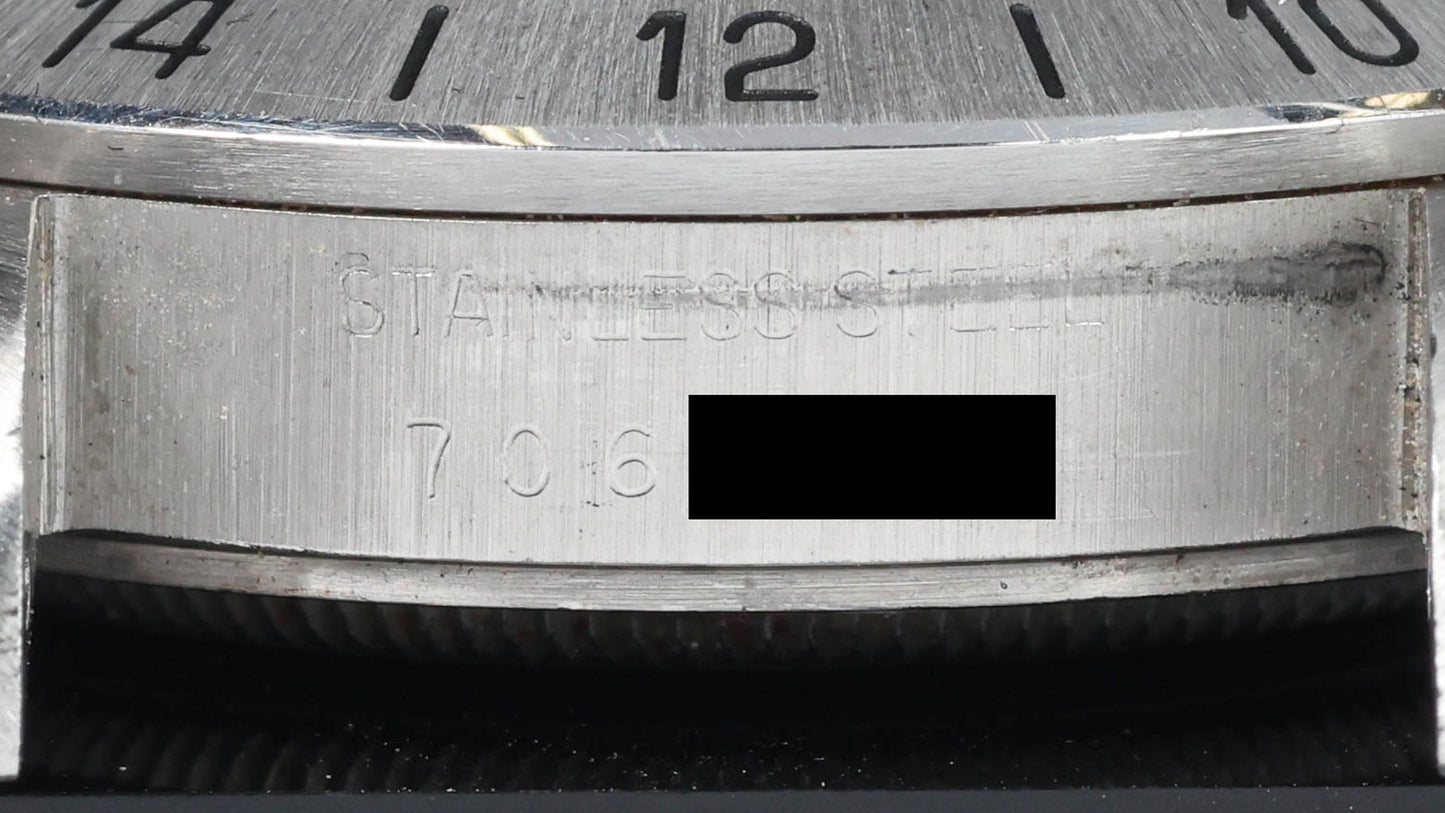
The stainless steel case is in excellent condition, retaining well-defined chamfered lugs with original hand finishing clearly visible along the lug edges. The case surfaces present cleanly with no significant wear, preserving strong geometry and sharp transitions. The bracelet is in great condition, showing some stretch consistent with age and regular use, as expected for this reference. Clasp operation remains firm and secure.
Dial and Hands
The dial and hands are in excellent condition, with clear printing and strong legibility throughout. The luminous material across the dial and hands displays an attractive warm patina that is even and well matched, enhancing the overall cohesion of the watch.
Use Advisory
As this watch is over 30 years old, it should be treated as a vintage timepiece. While robust by design, it is not recommended to wear the watch while swimming or expose it to water.
Share
Why we love this watch
Why we love this watch
Rolex Explorer II 1655 MK5 40mm
Produced between 1971 and 1985, the Rolex Explorer II reference 1655 occupies a singular position within Rolex’s professional catalogue. Unlike the Submariner or GMT-Master, it was not conceived for diving or aviation, but for environments where conventional distinctions between day and night cease to exist. A 1981 example fitted with the MK5 dial represents one of the later and most refined iterations of the reference, combining Rolex’s original conceptual intent with incremental technical and visual evolution achieved over a decade of production. This article examines the Explorer II 1655 in depth, focusing on its origins, technical construction, movement architecture, timekeeping philosophy, and the reasons it continues to command such sustained attention.
The Purpose Behind the Explorer II
The Explorer II was developed at a time when Rolex was expanding the idea of what a professional watch could be. By the late 1960s, Rolex had established itself as a supplier of highly specialised instruments: the Submariner for divers, the GMT-Master for pilots, and the Explorer for mountaineers. The Explorer II extended this logic into environments where natural light was absent or unreliable.
Cave explorers, tunnel engineers, scientists operating in polar regions, and geologists working underground often spent extended periods without exposure to sunlight. In such conditions, the human circadian rhythm can be disrupted, and distinguishing between day and night becomes difficult. The Explorer II was designed to solve this problem mechanically, without reliance on external references.
A Different Approach to the 24-Hour Display
What distinguishes the Explorer II 1655 from other Rolex professional models is its use of a fixed twenty-four-hour reference. Rather than allowing the wearer to track multiple time zones dynamically, as with the GMT-Master, the Explorer II provides a constant indication of whether the current time falls within the first or second half of the day.
This is achieved through the combination of a fixed stainless steel bezel engraved with a twenty-four-hour scale and an additional hand that completes a single rotation every twenty-four hours. This configuration reflects the watch’s intended use. It is not a travel watch in the modern sense, but a tool designed to maintain temporal orientation in environments where external cues are absent.
Case Architecture and Proportions
The Explorer II 1655 uses a stainless steel Oyster case measuring approximately 40mm in diameter. This dimension aligned it with other professional Rolex models of the era, yet the watch wears differently due to its fixed bezel and dial layout. The case features a screw-down caseback and screw-down crown, ensuring durability and resistance to dust and moisture in demanding conditions.
By 1981, case production methods had reached a high level of consistency, yet finishing was still largely manual. Well-preserved examples from this period retain clearly defined chamfered lugs, with visible hand finishing along the edges. These details provide insight into Rolex’s manufacturing processes before the transition to more automated case finishing in later decades.
The Fixed Stainless Steel Bezel
One of the most defining features of the Explorer II 1655 is its fixed bezel. Unlike the rotating bezels used on diving and GMT watches, the Explorer II’s bezel is permanently fixed to the case. The twenty-four-hour numerals are deeply engraved and filled with black enamel to maximise contrast and legibility.
The decision to use a fixed bezel reinforces the watch’s conceptual clarity. The bezel is not an interactive component, but a permanent reference against which the twenty-four-hour hand is read. This eliminates the possibility of accidental adjustment and ensures that the day-night indication remains constant.
Dial Evolution and the MK5 Configuration
Throughout its production life, the Explorer II 1655 underwent a series of subtle dial changes. These changes are often categorised into “Mark” variations, reflecting differences in text layout, luminous material, and hand proportions. The MK5 dial, seen on examples from the later years of production, represents one of the final and most visually balanced iterations.
The MK5 dial features a matte black surface with large luminous hour markers and restrained text. The printing is crisp and minimal, reflecting Rolex’s emphasis on legibility. By this stage, dial proportions had been refined through years of incremental adjustment, resulting in a layout that feels settled and purposeful.
Luminous Material and Patina
The Explorer II 1655 uses tritium luminous material on both the dial markers and hands. Over time, tritium naturally ages, often developing a warm, creamy patina. On well-preserved examples, this ageing occurs evenly, enhancing visual cohesion without compromising legibility.
A 1981 MK5 example often displays this warm patina, which reflects decades of natural ageing rather than environmental damage. The even development of colour across dial and hands reinforces the sense that the watch has aged as a complete system rather than as a collection of disparate components.
The Orange 24-Hour Hand
Perhaps the most recognisable element of the Explorer II 1655 is its oversized orange twenty-four-hour hand. This hand is mechanically geared to complete a single rotation every twenty-four hours, distinguishing it fundamentally from the GMT hand used on travel watches.
The size and colour of the hand are not aesthetic indulgences, but functional necessities. In low-light environments, the hand must be instantly distinguishable from the standard hour and minute hands. Its bold design ensures that the wearer can determine day or night at a glance, even under stress.
Movement Architecture: Calibre 1575
Powering the Explorer II 1655 is the Rolex calibre 1575, a movement derived from the widely used 1570 family. This automatic calibre was employed across several professional Rolex models and is known for its robustness, simplicity, and long-term reliability.
The calibre 1575 operates at 19,800 vibrations per hour and includes hacking seconds, allowing precise time setting. The twenty-four-hour hand is integrated directly into the movement’s gear train rather than added as a modular complication. This integration enhances stability and reduces mechanical complexity.
Timekeeping Philosophy and Performance
Rolex’s approach to timekeeping during the era of the Explorer II 1655 prioritised consistency and durability over high-frequency precision. The calibre 1575 is designed to maintain steady performance across a wide range of conditions, including temperature variation and physical shock.
In environments such as caves or polar regions, a movement that continues to run reliably is more valuable than one optimised for marginal gains in laboratory accuracy. The Explorer II reflects this philosophy clearly. It is designed to be trusted rather than adjusted frequently.
The Absence of a Quickset Date
One characteristic of the Explorer II 1655 that distinguishes it from later Rolex models is the absence of a quickset date function. The date advances gradually as the hour hand passes midnight, requiring manual cycling of the hands to adjust the date.
While this may appear inconvenient by modern standards, it reflects the movement architecture of the period and reinforces the watch’s utilitarian nature. The date is a secondary function, subordinate to the twenty-four-hour indication that defines the watch’s purpose.
Bracelet Construction and Wear Characteristics
The Explorer II 1655 was supplied on a stainless steel Oyster bracelet typical of Rolex professional models from the 1970s and early 1980s. These bracelets feature folded links, offering a balance between strength and flexibility.
Over time, stretch can develop at the link joints due to wear. This is a characteristic of the construction method rather than a defect. On well-preserved examples, the bracelet remains comfortable and secure, complementing the robustness of the case.
Reception at the Time of Release
When introduced, the Explorer II did not achieve the immediate popularity of other Rolex sports models. Its purpose was specialised, and its appearance was unconventional. The large orange hand and fixed bezel set it apart visually, while its function appealed to a relatively narrow audience.
This initial lack of widespread adoption is an important part of the reference’s history. The Explorer II 1655 was never designed to follow trends or appeal broadly. It existed to solve a specific problem, and it did so without compromise.
Evolution of the Explorer II After the 1655
The discontinuation of the 1655 marked a significant shift in the Explorer II’s identity. Subsequent references introduced independently adjustable hour hands and design elements that aligned the model more closely with the GMT-Master. While these changes broadened its appeal, they altered the original conceptual framework.
The 1655 remains the only Explorer II built around a fixed twenty-four-hour reference rather than a travel function. This distinction is central to its continued relevance and differentiation within the Rolex catalogue.
The 1981 Context
A 1981 MK5 example sits near the end of the 1655’s production life. By this stage, Rolex had refined the reference through years of incremental adjustment, resulting in a watch that felt mechanically and visually complete. The MK5 dial reflects this maturity, offering clarity and balance without unnecessary variation.
This period also represents the last years before Rolex transitioned to more modern movement architectures and design philosophies, making late examples particularly illustrative of the reference’s final form.
Why the Explorer II 1655 Is So Sought After
The sustained attention given to the Explorer II 1655 stems from its conceptual purity. It is one of the few Rolex professional models developed for a specific environment that was never diluted during its production life. The fixed bezel, integrated twenty-four-hour hand, and non-quickset movement all reinforce the watch’s identity as a true exploration instrument.
Its design is instantly recognisable and fundamentally different from other Rolex sports watches. This originality, combined with relatively modest production numbers, contributes significantly to its enduring appeal.
Design Integrity and Longevity
The Explorer II 1655 demonstrates how purpose-driven design can create lasting relevance. It does not rely on rotating components, interchangeable bezels, or layered complications. Instead, it delivers a single function with absolute clarity.
This integrity allows the watch to stand on its own terms, independent of changing trends. Decades after its introduction, it remains coherent and complete in its original form.
Relationship to the Broader Rolex Catalogue
Within Rolex’s history, the Explorer II 1655 occupies a unique position. It does not borrow directly from existing models, nor was it immediately replicated. Its isolation within the catalogue enhances its significance as a genuine experiment in professional watchmaking.
The reference reflects a period when Rolex was willing to pursue niche solutions without regard for mass appeal, guided instead by functional necessity.
Final Thoughts
The Rolex Explorer II 1655 MK5 from 1981 represents one of the most intellectually honest and purpose-driven watches Rolex has ever produced. Its design is the result of a clearly defined problem and a direct mechanical solution, executed without compromise. The fixed twenty-four-hour bezel, bold orange hand, and robust calibre 1575 work together to deliver a watch that remains coherent decades after its introduction.
Its continued appeal lies not in novelty, but in clarity of purpose. The Explorer II 1655 endures because it was never intended to be anything other than a reliable instrument for environments where time itself behaves differently.
Case & Bracelet
Case & Bracelet
- Case in excellent condition with well defined chamfered lugs. Hand finishing visible on lugs
- Bracelet in great condition some stretch noticeable as to be expected with age
Dial & Hands
Dial & Hands
- Dial & hands excellent condition
- Warm patina
Warranty & Condition
Warranty & Condition
Crown Vintage Watches provides a minimum 6-month mechanical warranty on pre-owned watches, from the date of purchase.
The warranty covers mechanical defects only.
The warranty does not cover damages such as scratches, finish, crystals, glass, straps (leather, fabric or rubber damage due to wear and tear), damage resulting from wear under conditions exceeding the watch manufacturer’s water resistance limitations, and damage due to physical and or accidental abuse.
Please note, water resistance is neither tested nor guaranteed.
Shipping and insurance costs for warranty returns to us must be covered by the customer. Returns must be shipped via traceable courier. Return shipment must be pre-paid and fully insured. Collect shipping will be refused. In case of loss or damages, the customer is liable.
Our Pledge
At Crown Vintage Watches, we stand by the authenticity of every product we sell. For added peace of mind, customers are welcome to have items independently authenticated at their own expense.
Condition
Due to the nature of vintage timepieces, all watches are sold as is. We will accurately describe the current condition and working order of all watches we sell to the best of our ability.
Shipping & Refund
Shipping & Refund