

Crown Vintage
Rolex Explorer II 1655 ‘Freccione’ 40mm 1972
Rolex Explorer II 1655 ‘Freccione’ 40mm 1972
Couldn't load pickup availability
Rolex Explorer II 1655 ‘Freccione’ 40mm 1972
Case and Bracelet
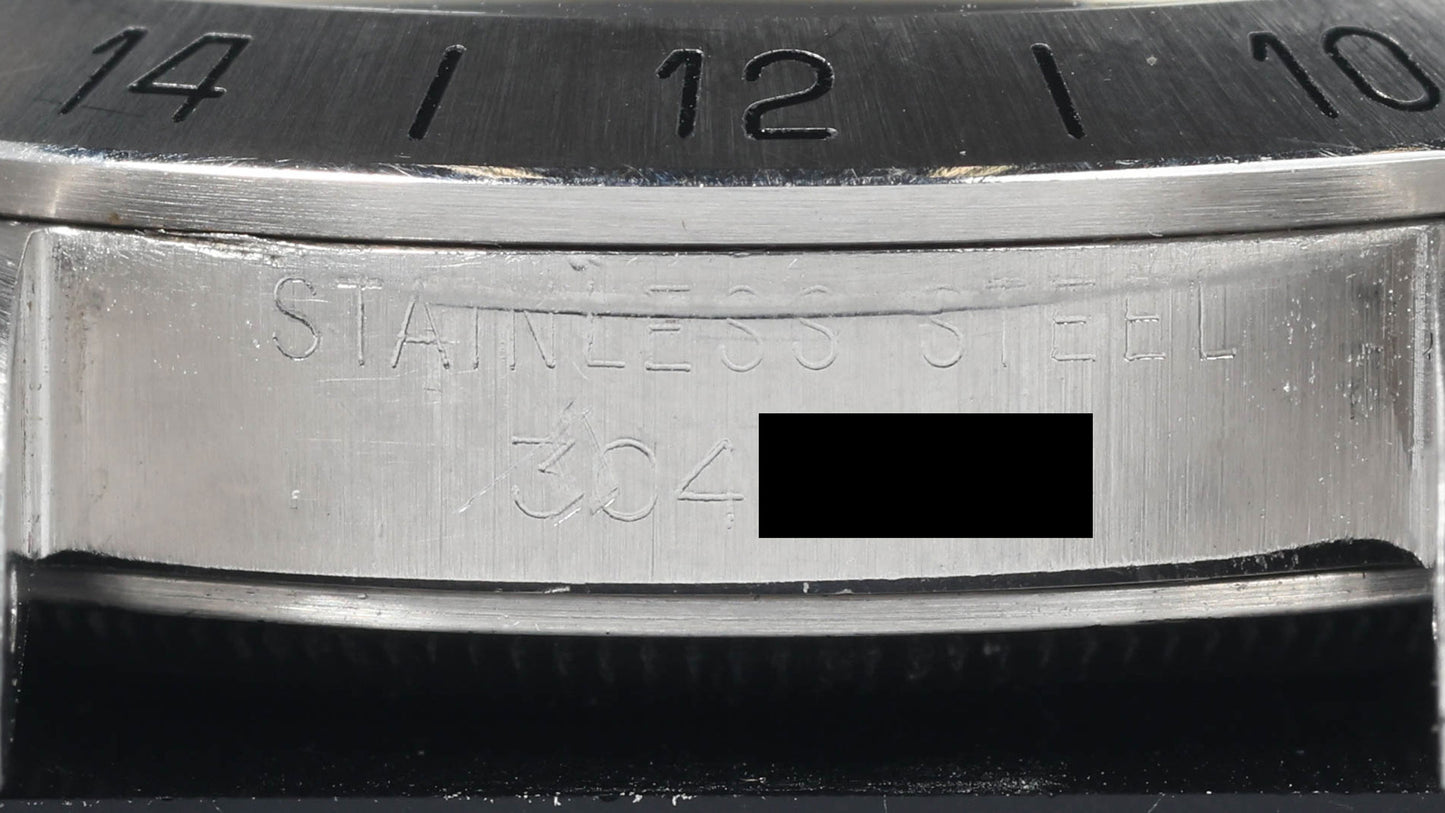
The stainless steel case is in excellent condition, retaining well-defined chamfered lugs with original hand finishing clearly visible along the lug edges. The case surfaces present cleanly with no significant wear, preserving strong geometry and sharp transitions. The bracelet is in great condition, showing some stretch consistent with age and regular use, as expected for this reference. Clasp operation remains firm and secure.
Dial and Hands
The dial and hands are in excellent condition, with clear printing and strong legibility throughout. The luminous material across the dial and hands displays an attractive warm patina that is even and well matched, enhancing the overall cohesion of the watch.
Chronometry
Chronometry was carried out on the Witschi WAIO across four positions, and the calibre 1575 returned a mean daily rate of plus 6.3 seconds per day, a negligible margin on a movement now more than fifty years old. Three of the four positions clustered tightly between plus 2.3 and plus 8.2 seconds per day, with only the twelve-up position running quicker at plus 11.9, giving a positional spread of 9.6 seconds per day. Beat error was very low throughout, between 0.1 and 0.3 milliseconds, which points to a healthy and well-adjusted escapement. Amplitude averaged 267.6 degrees, holding around 285 to 295 degrees in the flat positions and easing to roughly 244 degrees in the vertical positions, a normal pattern that reflects a sound mainspring and gear train with no sign of the weakness that would flag an overdue service. The movement was demagnetised, and the case passed its tightness test at 5BAR.
Use Advisory
As this watch is over 30 years old, it should be treated as a vintage timepiece even though it passed a 5BAR tightness test using our Witschi WAIO.
Share
Why we love this watch
Why we love this watch
Reading the Dark: A 1972 Rolex Explorer II Reference 1655 Freccione
Point the orange arrow on this Explorer II toward the 16 on its fixed steel bezel and it reads as four in the afternoon, daylight, a distinction that meant little to most watch buyers in 1972 and a great deal to the cavers and polar explorers Rolex built the reference 1655 to serve. The Explorer II was never a dress watch, nor a second time zone tool in the way it is sometimes remembered. It was an instrument for people working in places where the difference between day and night had stopped being obvious.
This particular example carries a story in two parts. Its case dates to 1972, near the start of the reference's production, while the matte black dial it wears today is a later service component, most likely fitted during a Rolex service in the late 1970s. The result is a watch that records both its origin and a chapter of its working life, and understanding it means starting with what the 1655 was actually for.
Built for the Dark
Rolex introduced the Explorer II, reference 1655, in 1971. It did not replace the original Explorer, the reference 1016 that had built its reputation on mountaineering expeditions, but joined it as a more specialised tool. Where the Explorer was about rugged simplicity, the Explorer II answered a narrower problem. In environments of permanent darkness or permanent light, a person can quickly lose track of whether the hands on a twelve-hour dial are showing morning or evening. The 1655 solved that with a fourth hand that completed one rotation every twenty-four hours, read against a fixed bezel marked from one to twenty-four.
The intended users were speleologists, the cave explorers who could spend days underground without daylight, along with researchers in polar regions where the sun behaves nothing like it does at lower latitudes. Rolex framed the watch around exactly this kind of work. For someone deep in a cave system, the orange arrow pointing at a number on the bezel removed the guesswork from a simple but vital question, the one a windowless environment takes away, which is whether it is day or night on the surface.
It was a tool built for a small audience, and that focus shaped everything about it, from the legibility of the dial to the way the case was put together. Few watches of the era wore their function quite so openly, and almost none were aimed at so specific a working life.
The Orange Arrow and the Fixed Bezel
The single most recognisable feature of the 1655 is the orange twenty-four-hour hand, an arrow-tipped pointer that gives the reference its enduring nickname, the Freccione, from the Italian word for a large arrow. Bright against the matte black dial, it is the part of the watch that does the day and night work, and it is the detail that has kept the reference recognisable decades after it left production.
Equally distinctive is the bezel. Unlike the Submariner or the GMT-Master, both of which used rotating bezels with applied aluminium inserts, the Explorer II 1655 has a fixed bezel with its twenty-four-hour scale engraved directly into the steel. The even hours appear as Arabic numerals and the odd hours as marker lines between them. Because it does not turn, the bezel is a permanent reference rather than an adjustable one, which suited a watch meant to give a steady reading rather than to chase shifting zones.
The reference also carries a second, more apocryphal nickname, the Steve McQueen. The actor was associated with Rolex, although the watch he was actually documented wearing was a Submariner reference 5512 rather than an Explorer II. The name attached itself to the 1655 regardless and has stayed with it, a reminder that nicknames in watch history do not always follow the facts.
An Indicator, Not a Second Time Zone
It is easy to assume the Explorer II was a travel watch, since a twenty-four-hour hand and a numbered bezel look like the makings of a dual time zone display. The 1655 was not that. Its twenty-four-hour hand was geared directly to the main hour hand and could not be set on its own. The two moved together, so the orange arrow simply followed the fixed bezel to show whether a given time fell in the day or the night half of the cycle.
This is the key difference between the 1655 and a true GMT watch. On the contemporary GMT-Master, the wearer set local time and turned the bezel to read a second zone against the twenty-four-hour hand. On the Explorer II, with its fixed bezel and coupled hands, there was no second zone to set. It was a day and night indicator and nothing more, and it would remain so until the reference 16550 of 1985 introduced an independently adjustable hand and turned the Explorer II into a genuine dual time watch.
The Calibre 1575 and the Oyster Case
Powering the reference 1655 is the calibre 1575, the automatic movement Rolex used across several of its sports references in this era, including the GMT-Master. It is a chronometer-certified movement running at nineteen thousand eight hundred vibrations per hour with a power reserve in the region of forty-eight hours, and it includes a hacking seconds function, so the seconds hand stops when the crown is pulled for setting. The date changes instantaneously at midnight rather than crawling over, and it sits at three o'clock beneath a Cyclops lens on the crystal.
The version in the Explorer II added the twenty-four-hour wheel that drives the orange hand. As described above, that hand was not independently adjustable in this generation, which was a limitation of the movement rather than an oversight, since Rolex had not yet developed the jumping local hour mechanism that would arrive in later references.
The case around it is stainless steel in the Oyster style, measuring thirty-nine millimetres across, with a screw-down crown and a screw-down case back that give the watch its water resistance. An acrylic crystal sits over the dial, slightly domed in the manner of the period and carrying the Cyclops magnifier above the date. It is a robust, sensibly built case, designed to take knocks in the field rather than to be admired across a dinner table.
Reading the Dial's Two Dates
The matte black dial of the 1655 changed in small ways across the reference's life, and those changes are the main way individual examples are placed in time. The luminous material was tritium, marked on the dial accordingly, with a dense field of luminous points arranged so that the watch stayed legible in the dark. Markers sit at every hour, with additional small luminous squares between them, and together with the hands they gave the watch the glow that mattered so much to its intended users.
On this example the case serial places manufacture in 1972, early in the production run. The dial it carries today, however, is marked T SWISS <25 T at six o'clock, a designation that belongs to a later period of the reference's life. The two do not come from the same moment, and the most reasonable explanation is a service.
When the Marking Changed
Early 1655 dials read T SWISS T at the base, the standard tritium marking of the first half of the 1970s. The <25 T form, which denotes a tritium luminous content below twenty-five millicuries, appeared later, around the five and a half million serial range, which corresponds to roughly 1978. Swiss dials more broadly adopted the under twenty-five marking through the second half of the decade as luminous material conventions changed.
A dial bearing the <25 T marking therefore dates to the late 1970s or after, regardless of when the case it sits in was made. On a 1972 case, an original-period dial would instead read T SWISS T, so the presence of the later marking points clearly to a dial fitted after the watch was first sold.
A Service in the Late 1970s
Our reading of this watch is that it passed through a Rolex Service Centre in the late 1970s, and that the dial now on it was fitted at that time as a period-correct service component. Rolex routinely replaced worn or damaged dials during servicing, drawing on current stock, which is why a watch can leave a service wearing a dial newer than its case. The late 1970s timing of the <25 T dial aligns with a service roughly six or seven years into the watch's life, a sensible interval for a tool watch that had seen genuine use.
Read this way, the dial is not a discrepancy to be explained away but a record of the watch's history. The 1972 case tells you when the Explorer II was born, and the later dial marks a point when it was returned to Rolex, looked after, and sent back out to keep working.
A Slow Start and a Long Afterlife
The Explorer II did not sell well when it was new. Its purpose was narrow, aimed at a small population of cave and polar explorers, and it arrived just as quartz watches were beginning to reshape the market. Some of the people most likely to appreciate a rugged mechanical tool were drawn instead to the new technology, and the dense, busy dial that served its specialised function so well struck many buyers at the time as hard to read. A number of 1655s lingered unsold at retailers, and the reference never enjoyed the immediate reception of the Submariner or the GMT-Master.
Rolex kept it in production until around 1984, with some stock carrying into 1985, before replacing it with the reference 16550. That successor grew the case slightly, swapped the acrylic crystal for sapphire, added a white dial option for the first time, and gave the Explorer II an independently adjustable hand, finally making it the true dual time watch its appearance had always suggested.
The orange hand returned as a deliberate tribute on the fortieth anniversary reference of 2011, a sign of how far the standing of the 1655 had travelled in the decades since it first struggled to find buyers.
Final Thoughts
The reference 1655 rewards knowing what you are looking at. On the surface it is a steel sports Rolex with an orange hand and a numbered bezel. Underneath, it is a purpose-built instrument for telling day from night in places where that distinction had vanished, carried by a movement shared with its better-known siblings and wrapped in a case designed for hard use.
References
1. Monochrome, In-Depth: The History of the Rolex Explorer II, monochrome-watches.com.
2. Italian Watch Spotter, The Rolex Explorer II Ref. 1655: A Complete Guide, italianwatchspotter.com.
3. Revolution, Tooled Up: The Rolex Explorer II Reference 1655, revolutionwatch.com.
4. Hairspring, Mk1 Straight Hand 1655 Rolex Explorer II, hairspring.com.
5. SwissWatchExpo, Rolex Explorer II Ultimate Guide, swisswatchexpo.com.
6. Everest Bands, What Was the First Rolex Explorer II: History of the Reference 1655, everestbands.com.
7. Beyond The Dial, Collector Guide: The Rolex Explorer II (All References In Detail), beyondthedial.com.
8. Belmont Watches, Rolex Serial Numbers by Year Chart, belmontwatches.com.
Case & Bracelet
Case & Bracelet
- Case in excellent condition with well defined chamfered lugs. Factory brushing still visible
- Bracelet in great condition some little to no stretch
Dial & Hands
Dial & Hands
- Dial & hands mint condition
- Warm patina
Warranty & Condition
Warranty & Condition
Crown Vintage Watches provides a minimum 6-month mechanical warranty on pre-owned watches, from the date of purchase.
The warranty covers mechanical defects only.
The warranty does not cover damages such as scratches, finish, crystals, glass, straps (leather, fabric or rubber damage due to wear and tear), damage resulting from wear under conditions exceeding the watch manufacturer’s water resistance limitations, and damage due to physical and or accidental abuse.
Please note, water resistance is neither tested nor guaranteed.
Shipping and insurance costs for warranty returns to us must be covered by the customer. Returns must be shipped via traceable courier. Return shipment must be pre-paid and fully insured. Collect shipping will be refused. In case of loss or damages, the customer is liable.
Our Pledge
At Crown Vintage Watches, we stand by the authenticity of every product we sell. For added peace of mind, customers are welcome to have items independently authenticated at their own expense.
Condition
Due to the nature of vintage timepieces, all watches are sold as is. We will accurately describe the current condition and working order of all watches we sell to the best of our ability.
Shipping & Refund
Shipping & Refund