

Crown Vintage
Rolex Explorer II 1655 MK4 ‘Freccione’ 40mm 1975
Rolex Explorer II 1655 MK4 ‘Freccione’ 40mm 1975
Couldn't load pickup availability
Rolex Explorer II 1655 MK4 ‘Freccione’ 40mm 1975
Case and Bracelet
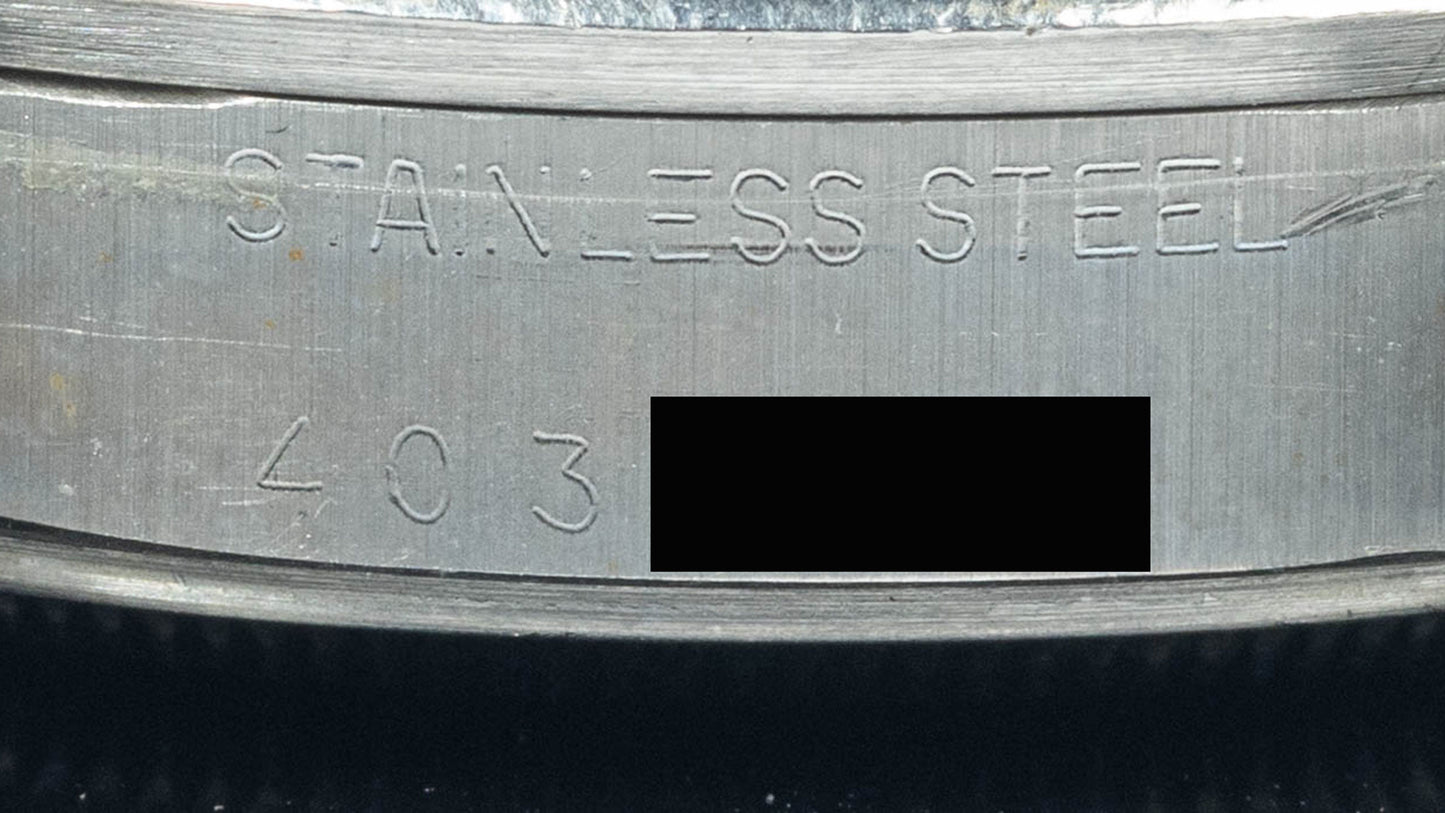
The 40mm stainless steel Oyster case is in good vintage condition and wears its history openly, with honest marks visible around both sides of the case. Nothing here has been disguised. What matters more on a 1655 is what is absent: there is no pitting and no corrosion between the lugs or on the caseback. Those two areas are the traps on a 1970s Oyster, because the recess between the lugs holds the serial engraving and collects perspiration and bracelet grit where a cloth never reaches, and the caseback rim sits against the wrist for decades at a time. A case that has stayed clean in both places has been worn and stored properly rather than simply tidied up before sale. The fixed steel 24 hour bezel is integral to this reference and does not rotate, so there is no bezel action, insert or click spring to assess, only the engraved ring itself.
The bracelet is in good condition, with hairlines across the surfaces and moderate stretch consistent with its age. Stretch on a Rolex Oyster bracelet of this era is less a fault than accumulated mileage, since the play develops between the pins and the link holes and is then multiplied across every link in the bracelet.
Dial and Hands
The matte black Mark IV dial is in flawless condition. The tritium plots read evenly across the hour markers with no losses or lifting, and the printing remains crisp. The hands are in very good condition, including the broad orange 24 hour arrow that gives the reference its Freccione nickname and that was deliberately shaped stubby and wide to carry more tritium than a slim hand could. As expected of tritium, the lume no longer glows and now serves as a visual rather than functional element.
The watch has passed a 5 bar waterproof test. As with any vintage Oyster, that result reflects the case at the moment of testing and is not an invitation to swim in it. A Witschi trace can be provided on request.
Watch is running strong but a service is recommended.
Share
Why we love this watch
Why we love this watch
Why We Love the Rolex Explorer II 1655 MK4 'Freccione' 40MM, 1975
The big orange arrow on this dial cannot tell you the time in another country. It was never meant to. Point it at the fixed steel ring around the dial and it answers one question only, the question you stop being able to answer for yourself after ten hours underground with a lamp on your helmet: is it morning or is it night. Rolex built an entire reference around that single problem in 1971, sold it slowly for the better part of fifteen years, and in doing so made the most singular tool watch in its catalogue. This is reference 1655, and everything odd about it is deliberate.
A Watch for People Who Could Not See the Sun
The Explorer II did not arrive from nowhere. It arrived from a name Rolex had been building for eighteen years.
The name came off a mountain in 1953
Rolex trademarked the Explorer name in January 1953, the same year Tenzing Norgay and Edmund Hillary reached the summit of Everest with Rolex chronometers in the expedition kit, as Monochrome's history of the Explorer records. The watch on that climb, reference 6098, is now generally treated as a pre-Explorer rather than the first of the line. What followed it was: references 6150 and 6350 in 1953, then 6610, then the reference 1016 that ran from 1963 to 1989 and became the definitive 36mm Explorer.
The 1016 was a study in subtraction. Black dial, 3-6-9 numerals, no date, no complication, nothing on the dial that did not help you read the time in poor light. Hold that thought, because the Explorer II went the other way entirely.
1971 and the problem of the caves
In 1971 Rolex introduced a second Explorer aimed at a much narrower user. The 1655 was designed for speleologists, the people who spend days at a time in cave systems where there is no daylight to lose track of, only a wristwatch. Monochrome's history of the Explorer II describes it plainly as a tool watch for spelunking, made because time spent in caves blurs the line between day and night. Bob's Watches puts the same idea in the user's voice: someone who will soon lose all notion of morning, afternoon, day or night.
Solve that and the design writes itself. You need a hand that completes one rotation every twenty four hours rather than twelve, a scale for it to point at, and enough luminous material on both to be read by helmet lamp. That is the 1655 in one sentence.
Why the bezel does not turn
Here is the detail that separates this watch from every other Rolex with a 24 hour hand. The bezel is fixed. It is solid steel, engraved with even numerals and hash marks for the odd hours, and it does not rotate at all.
On the GMT-Master reference 1675, the contemporary that shared much of this architecture, the bezel turns so the 24 hour hand can be offset against it to read a second time zone. On the 1655 there is nothing to turn and nothing to offset, because the 24 hour hand tracks the local hour hand and only the local hour hand. Monochrome is direct about this: on the 1655 the orange hand is a day and night indicator, not a GMT function. That capability did not arrive on an Explorer II until the reference 16550 replaced this watch in the mid 1980s.
People have called that a flaw for fifty years. It is not a flaw, it is a specification. A caver does not need Hong Kong. A caver needs to know, without ambiguity, whether the world above the entrance is light or dark.
The Freccione, and the Name It Never Earned
Two nicknames follow this reference around, and only one of them is honest.
Freccione
Italian collectors named it the Freccione, meaning big arrow, after the enormous orange hand that dominates the dial, a naming Italian Watch Spotter traces directly to the arrow itself. The hand is deliberately stubby and broad rather than elegant, and the reason is functional: Beyond the Dial notes it was shaped that way to carry extra tritium. More surface area means more lume, and more lume means the hand stays readable longest in the environment the watch was built for. It is the only orange element on an otherwise monochrome dial, which is why the eye finds it before it finds anything else.
The Steve McQueen story
The 1655 is widely called the Steve McQueen, and there is no evidence McQueen ever owned or wore one. Revolutionrecords the nickname as attributed to a reported preference, while noting the watch McQueen actually wore in the photographs everyone remembers was a matte dial Submariner reference 5512. Bob's Watches states it flatly: McQueen never actually wore an Explorer II 1655.
We mention it because the name is unavoidable and because the truth is more interesting than the myth. The 1655 did not need a film star. It was a slow seller in period, described by Revolution as a slow burner initially thought garish, with a dial considered too busy for a Rolex. The reference survived fifteen years on the strength of what it did, not on who was seen wearing it.
Calibre 1575: A GMT Movement Given a Simpler Job
Inside is the Rolex calibre 1575, in the GMT configuration that drives the additional 24 hour hand.
The base movement was introduced in 1965 and remained in production until 1981, running 25 jewels at 19,800 vibrations per hour with a 48 hour power reserve, according to Millenary Watches. It carries an overcoil balance spring and is regulated by Microstella nuts on the balance rim rather than by a moving index, which is the reason a well serviced example of this generation holds its rate the way it does. The same family powered the Submariner and the Sea-Dweller of the era, and Beyond the Dial notes the movement is shared with the GMT-Master.
Two practical consequences follow. The first is hacking seconds: pull the crown and the seconds hand stops dead, so the watch can be set against a time signal to the second. The second is that a 19,800 vibration beat, slower than the 28,800 of Rolex's later calibres, gives the sweep seconds hand a visibly gentler tick, five beats per second instead of eight. It is a small thing that dates the watch honestly every time you look at it.
Early 1655 examples are documented with movements stamped 1570 as well as 1575, a quirk Monochrome attributes to early stamping practice and Craft and Tailored also records across the reference.
Reading the MK4 Dial
The 1655 changed quietly and constantly through its run. Bob's Watches counts five dial revisions, four bezel variants and two different seconds hands across roughly fifteen years, and Beyond the Dial counts as many as seven dial variants depending on how finely you slice them. None of the changes were announced. All of them are visible if you know the sequence.
The sequence in brief
Italian Watch Spotter sets out the progression. The Mark I carries a large coronet at twelve and a rounded foot to the R in Rolex, with T SWISS T at six. The Mark II keeps tritium marked the same way but thickens the points of the coronet and tightens the spacing of PERPETUAL. The Mark III is the one collectors call the rail dial, where letters in SUPERLATIVE CHRONOMETER OFFICIALLY CERTIFIED align vertically beneath one another.
What makes a Mark IV
The Mark IV is defined by two changes. The coronet becomes narrower and taller than the one before it, and the depth marking at six o'clock changes to T SWISS < 25 T, rendered in a serif font. That second change is not a styling decision, it is regulation showing up on a dial: the marking declares tritium radioactivity below 25 millicuries, and it appears across Rolex's catalogue as the permitted limits tightened through the 1970s. The Mark V that followed keeps the same wording but drops the serif and opens out the base oval of the coronet.
One honest caveat is worth setting down. Mark numbering for this reference is a convention agreed by dealers and authors rather than by Rolex, the schemes do not always align between sources, and dials were fitted from stock rather than in strict date order, so period and mark overlap rather than lock together. Craft and Tailored catalogues a Mark IV in a 1977 case. The traits, not the calendar, identify the dial.
The lume, and what fifty years does to it
The dial and hands carry roughly thirty five tritium plots between them, per Beyond the Dial. Tritium stops glowing usefully after a couple of decades, and what it leaves behind is the reason these dials look the way they do now: plots that have turned from white to cream, ivory or amber, each one ageing at its own rate. On a matte black dial that shift is the clearest evidence of a watch's age there is, and it is not reproducible.
What 1975 Means Here
A 1975 case sits in the middle of the reference's life, and the middle was a strange place for Rolex to be.
Quartz had arrived, the Swiss industry was in the early years of the crisis that followed, and Rolex was still selling a mechanical steel sports watch designed for a few thousand cave explorers. The 1655 did not sell in volume in those years. It kept being made anyway, which tells you something about how Rolex thought about tool references then.
The serial dates the case. Using the reset-based chart in our Rolex serial numbers guide, 1975 runs from roughly 3,862,000 to the 1976 start at about 4,156,000, engraved between the lugs at the six o'clock side of the case where every Rolex carried it before 2005. A serial dates the case rather than the sale, so a 1975 case may well have left a retailer's window in 1976 or later.
Wearing 40 Millimetres of 1970s Steel
The case is a 40mm Oyster in stainless steel with crown guards, listed at 39mm by some sources and 40mm by others depending on where the calipers land. There was never a gold version and never a dial colour other than black, which is unusual restraint for a reference that ran fifteen years.
On the wrist it is a busier watch than an Explorer 1016 and a calmer one than a Pepsi bezel GMT-Master. The engraved steel bezel gives it a brightness around the dial without adding colour, the orange hand supplies the only accent, and the acrylic crystal domes the whole thing slightly so the dial appears to sit deeper than it does. Acrylic was chosen over glass because it deforms rather than shatters, which matters when the intended user is squeezing through rock. It also does something a modern sapphire crystal cannot, bending the light across the outer edge of the dial so the printing at six o'clock distorts slightly as the wrist turns.
The proportions are the other half of it. Forty millimetres was a large watch in 1975 and reads as a moderate one now, which is why this reference has aged into a size most people can wear without thinking about it. The date sits at three under a Cyclops, the case is rated to 100 metres, and the whole thing weighs what a steel Oyster on a steel bracelet has always weighed, which is enough to be felt and not enough to be a nuisance.
Final Thoughts
What we love about this 1655 is that it refuses to be a more useful watch than it was asked to be. The bezel does not turn because turning it would serve nobody underground. The 24 hour hand is fat and stubby because a slim one would hold less tritium. The dial is busy because legibility beat elegance in the brief. The movement gives up a modern beat rate in exchange for the kind of construction that is still keeping time fifty years later. Rolex built this for a few thousand people who work in the dark, largely ignored the fact that it sold slowly, and left it in the catalogue until the design had earned its place. A 1975 MK4 example is that idea at full strength, orange arrow and all.
Case & Bracelet
Case & Bracelet
- Case in good vintage condition with honest wear visible around both sides of the case
- Bracelet in good condition, hairlines visible with moderate stretch as to be expected with age.
- No pitting or corrosion visible between lugs and on the caseback.
Dial & Hands
Dial & Hands
- Dial in flawless condition
- Hands very good condition
Warranty & Condition
Warranty & Condition
Crown Vintage Watches provides a minimum 6-month mechanical warranty on pre-owned watches, from the date of purchase.
The warranty covers mechanical defects only.
The warranty does not cover damages such as scratches, finish, crystals, glass, straps (leather, fabric or rubber damage due to wear and tear), damage resulting from wear under conditions exceeding the watch manufacturer’s water resistance limitations, and damage due to physical and or accidental abuse.
Please note, water resistance is neither tested nor guaranteed.
Shipping and insurance costs for warranty returns to us must be covered by the customer. Returns must be shipped via traceable courier. Return shipment must be pre-paid and fully insured. Collect shipping will be refused. In case of loss or damages, the customer is liable.
Our Pledge
At Crown Vintage Watches, we stand by the authenticity of every product we sell. For added peace of mind, customers are welcome to have items independently authenticated at their own expense.
Condition
Due to the nature of vintage timepieces, all watches are sold as is. We will accurately describe the current condition and working order of all watches we sell to the best of our ability.
Shipping & Refund
Shipping & Refund