

Crown Vintage
Rolex Explorer II 16570 40mm Circa 1999 Box & Booklets
Rolex Explorer II 16570 40mm Circa 1999 Box & Booklets
Couldn't load pickup availability
Rolex Explorer II 16570 40mm Circa 1999 Box & Booklets
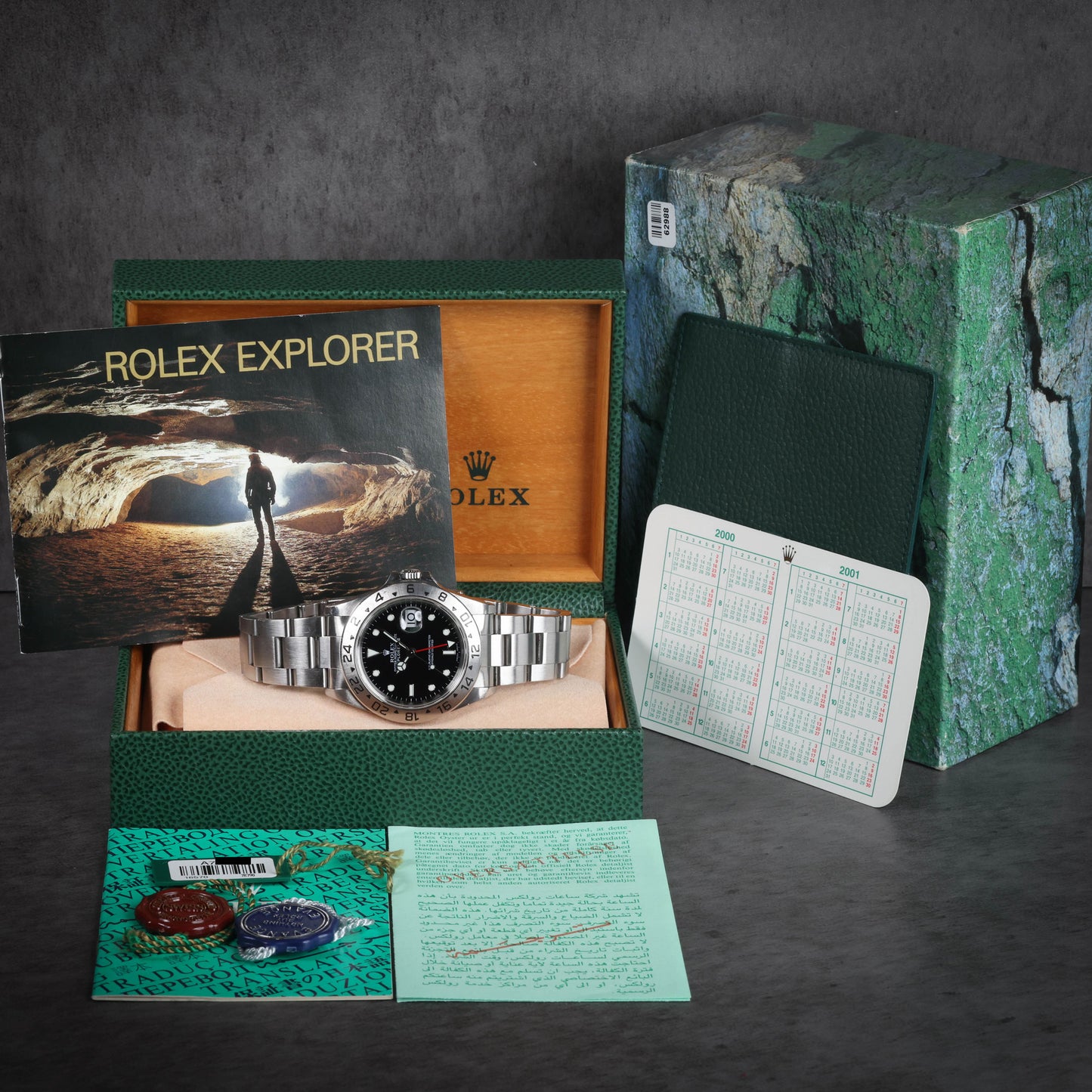
Supplied with its original box and booklets, this Rolex Explorer II 16570 presents in great overall condition and wears as a tidy, well-preserved example throughout.
The stainless steel case retains nicely defined lugs with factory brushing still visible across the relevant surfaces, and the crown guards remain crisp and well-formed. Light hairlines are present around the case flanks and bezel area under normal light, consistent with careful wear over time and indicative of an example that has not been subjected to workshop polishing. The fixed 24-hour bezel displays deep, even numerals with the same light surface hairlines, and the sapphire crystal is clean and free of any distracting marks.
The Oyster bracelet presents in great condition, with light stretch present as expected on a worn example of this age, though the links articulate smoothly throughout their length. The clasp closes securely and the Rolex coronet remains sharp and well-defined. Caseback text is clear and fully legible.
The dial and hands are flawless. Printing is crisp, the lume plots are clean, and contrast across the dial is strong. The overall presentation is original and undisturbed, with nothing to suggest refinishing or replacement of any component. Crown action is precise in all positions, with winding and time-setting feeling smooth and well-regulated. An honest, presentable example that wears exceptionally well on the wrist.
Share
Why we love this watch
Why we love this watch
Time Without Daylight: The Enduring Appeal of the Rolex Explorer II 16570
The Rolex Explorer II 16570 is one of the most misunderstood references in the modern Rolex catalogue, frequently overshadowed by the Submariner and the GMT-Master II despite possessing a technical pedigree and design rationale that is entirely its own. A circa 1999 example arrives at a particularly compelling point in the reference's production history: the calibre 3185 is fully bedded in, the dial configuration is settled, and the watch carries the purposeful, understated character that defines the best tool watches of its era. For the collector who approaches vintage and recent-vintage Rolex from a position of genuine horological curiosity rather than market momentum, the Explorer II 16570 from this period represents one of the most rewarding acquisitions the category has to offer.
Rolex and the Origins of the Explorer II
Rolex was founded in London in 1905 by Hans Wilsdorf and Alfred Davis, relocating to Geneva in 1919 following the introduction of punitive British wartime import taxes on movements.¹ The company's reputation was built on two foundational achievements: the development of the Oyster, the world's first waterproof wristwatch case, introduced in 1926, and the Perpetual self-winding rotor mechanism, patented in 1931.² Together, these two innovations established the engineering culture that would define Rolex's professional tool watch programme for the following seven decades.
The original Explorer was introduced in 1953, developed in close association with the British expedition that made the first confirmed ascent of Everest on 29 May of that year.³ The watch that Edmund Hillary and Tenzing Norgay wore to the summit became one of the most potent marketing associations in the history of the wristwatch, and the Explorer line that followed carried the name of serious, high-stakes exploration in a way that no amount of advertising could have manufactured.
The Explorer II was introduced in 1971 as reference 1655, designed to address a specific navigational problem faced not by mountaineers but by cave explorers and polar scientists.⁴ In environments without natural light, whether deep underground or above the Arctic Circle during the summer months when the sun does not set, the distinction between AM and PM becomes genuinely difficult to track on a standard 12-hour dial. The 1655's solution was a fixed 24-hour graduated bezel and a large, distinctive 24-hour hand that indicated the full rotation of the day, making the AM and PM distinction explicit at a glance.⁵ The watch became known among collectors as the "Freccione" for the outsized arrow of its 24-hour hand, and it remains one of the most visually arresting Rolex references of the 1970s.
The 16570 was introduced in 1989, replacing the interim reference 16550 that had served as the bridge between the original 1655 and the modern Explorer II.⁶ The 16570 retained the core concept of its predecessors but introduced a significant functional upgrade: where the 1655's 24-hour hand was mechanically linked to the main hour hand and could not be independently adjusted, the 16570's calibre 3185 allows the 24-hour hand to be set separately, effectively transforming the Explorer II into a dual-timezone instrument capable of tracking home time and local time simultaneously.⁷ This single change elevated the 16570 from a navigational aid for specialists into a genuinely versatile travel watch for any wearer crossing time zones regularly.
Technical Specifications of the Rolex Explorer II 16570
Case and Construction
The 16570 is housed in Rolex's Oyster case, measuring 40mm in diameter, a specification that felt substantial when the reference was introduced and reads as balanced and wearable by contemporary standards.⁸ The case is machined from 904L stainless steel, a corrosion-resistant alloy more commonly associated with the chemical processing and aerospace industries than with watchmaking, chosen by Rolex for its exceptional surface hardness and its ability to accept and retain a high polish.⁹ Water resistance is rated to 100 metres, delivered through the combination of the screw-down Triplock crown and the Oyster caseback, both of which form part of the same hermetically sealed case architecture.
The bezel on the 16570 is fixed and non-rotating, graduated with a 24-hour scale that runs from 1 to 24 in an engraved and painted format.¹⁰ The fixed bezel is a deliberate departure from the unidirectional rotating bezels of the Submariner and Sea-Dweller lines, reflecting the Explorer II's different operational context: a cave explorer or polar researcher does not need to track elapsed dive time, but does need a permanent, tamper-resistant reference scale for reading the 24-hour hand at any moment without the risk of accidental rotation changing the baseline. The bezel insert on a circa 1999 example is aluminium, consistent with period production, and correct examples show the characteristic ageing of the printed hour markers that distinguishes original inserts from later replacements.
The caseback is solid and plain, without engraving beyond the standard Oyster reference information on the inner surface, and the crown sits at the three o'clock position protected by the standard Oyster crown guards present throughout the 16570's production run.
Movement
The circa 1999 Rolex Explorer II 16570 is powered by the calibre 3185, a self-winding movement operating at 28,800 vibrations per hour with a power reserve of approximately 48 hours.¹¹ The 3185 is a GMT-capable derivative of the celebrated calibre 3135 architecture, sharing the same fundamental design philosophy but incorporating the additional GMT module that drives the independently adjustable 24-hour hand. The movement features a Parachrom hairspring produced from a paramagnetic niobium-zirconium alloy, offering significantly greater resistance to magnetic interference and mechanical shock than a conventional steel hairspring.¹²
The calibre 3185 also incorporates Rolex's free-sprung variable inertia balance wheel, regulated by means of gold Microstella nuts that allow precise rate adjustment without the long-term instability associated with traditional regulator systems.¹³ The movement is certified by COSC as a chronometer, having been independently tested to confirm accuracy within plus five and minus two seconds per day across multiple positions and temperatures, before undergoing Rolex's own additional testing to its internal standards prior to casing.¹⁴
The independently settable 24-hour hand is operated via the crown in the second position, distinct from the date adjustment in the first position and the time setting in the third.¹⁵ This three-position crown operation is a detail that distinguishes the 16570 immediately from the earlier 1655 in practical use and represents one of the most meaningful functional improvements in the Explorer II's production history.
Dial and Hands
The 16570 was produced in two dial variants throughout its production run: a gloss black dial and a polar white dial, the latter being sufficiently distinct in character and collector perception to be treated as a separate consideration when evaluating the reference.¹⁶ A circa 1999 example in either configuration carries applied white gold hour markers with SuperLuminova lume fills, Rolex having transitioned away from tritium in the mid-to-late 1990s across its sports reference range. SuperLuminova does not patinate in the manner of tritium, meaning the lume on a well-preserved 1999 example retains its original colour and photoluminescent capacity rather than ageing to an ivory tone.
The black dial variant presents the hour markers against a deep gloss background with the characteristic Explorer II text hierarchy: "OYSTER PERPETUAL DATE / EXPLORER II" in the upper registers, with "SUPERLATIVE CHRONOMETER / OFFICIALLY CERTIFIED" stacked in the lower half.¹⁷ The polar white dial reverses the visual relationship entirely, presenting dark applied markers against an off-white background that gives the watch a markedly different presence on the wrist and has attracted a dedicated following among collectors who find the white dial's legibility and visual warmth more compelling than the conventional sporting black.
The hands carry the same SuperLuminova fills as the dial markers on a circa 1999 example, and the large 24-hour hand, finished in a contrasting orange on examples from this period, is one of the most distinctive hand designs in the Rolex catalogue.¹⁸ The orange colouring provides immediate visual separation from the standard hour and minute hands when reading the 24-hour scale, a straightforwardly functional detail that also happens to give the Explorer II an immediacy and character that more restrained Rolex designs lack.
What Makes a Circa 1999 Example Significant
A circa 1999 Rolex Explorer II 16570 carries an A-series serial number, corresponding to Rolex production records for the 1998 to 2000 window.¹⁹ The reference was in the middle of a long and stable production run at this point, with the 16570 ultimately continuing in production until 2011, when it was replaced by the reference 216570 with its enlarged 42mm case. A 1999 example therefore occupies the mature central phase of the 16570's lifespan: the specification is resolved, the production quality is consistent, and the watch retains the 40mm case dimension that a significant proportion of the collector community regards as the correct size for the Explorer II formula.
The significance of the 40mm specification deserves particular emphasis in the context of the current market. When Rolex enlarged the Explorer II to 42mm with the 216570, the response among collectors was divided, and a substantial body of opinion has consistently held that the 40mm proportions of the 16570 suit the reference's design language more precisely.²⁰ The fixed bezel, the broad hour markers, and the large 24-hour hand all read differently on a 40mm case than they do on a 42mm one, and for collectors who hold this view, the 16570 is not merely the predecessor to the current model but the definitive expression of the Explorer II concept.
The Explorer II 16570 Against Its Contemporaries
To appreciate the 16570 fully, it helps to place it alongside the other dual-timezone references available from Rolex in the same period. The GMT-Master II 16710, produced concurrently through the late 1990s and into the 2000s, shares the calibre 3185 and the same core GMT functionality but delivers it through a rotating 24-hour bezel rather than a fixed one.²¹ The difference is more than aesthetic. The GMT-Master II's rotating bezel allows the wearer to track a third timezone by aligning the bezel graduation to a chosen reference point, making it a more flexible instrument in theory for frequent travellers managing multiple time zones simultaneously. The Explorer II's fixed bezel, by contrast, offers no such flexibility but gains permanence: the AM and PM reference is always where it should be, readable without any prior adjustment or setup.
The choice between the two references is therefore a genuine one that reflects different use cases rather than a simple hierarchy of desirability. The GMT-Master II has historically commanded stronger market recognition and higher auction results on account of its colour variants and its stronger popular profile, but the Explorer II's fixed bezel design is arguably the more honest expression of the original tool watch brief.²² A watch built for a cave explorer does not benefit from a rotating bezel that can be knocked out of alignment in the dark. The Explorer II's solution is simpler, more robust, and more appropriate to its stated purpose.
The Explorer II and the Polar Science Community
The connection between the Explorer II and polar scientific research is more than a marketing narrative. The Scott Polar Research Institute at Cambridge, which has documented equipment used on British Antarctic expeditions since the early twentieth century, holds records of Rolex watches being issued to researchers working in the continuous daylight conditions of the Antarctic summer, precisely the environment for which the 24-hour hand was designed.²³ The ability to distinguish noon from midnight by instrument rather than by sky conditions is a genuine operational requirement in those latitudes, and the Explorer II addressed it directly.
COMEX, the French commercial diving company whose collaboration with Rolex produced the Sea-Dweller's helium escape valve, also operated in polar environments on subsea infrastructure projects during the 1980s and 1990s, and the Explorer II's combination of robust Oyster case construction and 24-hour readability made it a logical choice for personnel working in those conditions.²⁴ These associations are not incidental. They are the reason the Explorer II exists in the form it does, and they give the 16570 a professional credibility that purely recreational watch designs, however technically accomplished, cannot replicate.
Final Thoughts
The Rolex Explorer II 16570 from circa 1999 is a watch that rewards the collector who takes the time to understand what it is actually for. Its roots are not in recreational diving or aspirational sport but in the genuinely demanding environments of cave exploration and polar science, and the design decisions that define it, the fixed 24-hour bezel, the independently settable GMT hand, the bold orange 24-hour indicator, all follow from that original brief with the kind of logical coherence that the best tool watches share. It does not ask to be admired. It asks to be used.
For the collector approaching the 16570 for the first time, the advice is consistent with that which applies across all serious Rolex acquisitions: prioritise originality of dial and hands above all else, examine case preservation carefully, and verify the serial number against documented production records before committing to a purchase. A genuine, unpolished circa 1999 example with its original components intact is not merely a sound long-term holding in a market that has consistently rewarded the 16570 since the reference's discontinuation in 2011. It is one of the clearest arguments available for the proposition that the most interesting Rolex watches are not always the most loudly celebrated ones.
References
- Rolex SA, The History of Rolex, official corporate history, rolex.com.
- Dowling, J. and Hess, J., The Best of Time: Rolex Wristwatches, Schiffer Publishing, 1996.
- Rolex SA, Rolex and Exploration, official editorial archive, rolex.com.
- Patrizzi, O., Rolex Wristwatches, Antiquorum Editions, 1999.
- Maran, A., Rolex Explorer and Explorer II, Schiffer Publishing, 2014.
- Maran, A., Rolex Explorer and Explorer II, Schiffer Publishing, 2014.
- Rolex SA, reference 16570 technical specification, archived production documentation.
- Rolex SA, Oyster case dimensional records, archived.
- Rolex SA, materials technical documentation, rolex.com/en/rolex-technology/materials.
- Patrizzi, O., Rolex Wristwatches, Antiquorum Editions, 1999.
- Rolex calibre 3185 specification, Swiss Federal Institute of Intellectual Property records.
- Rolex SA, Parachrom hairspring technical documentation, rolex.com.
- Cutmore, M., Watches 1850-1980, David & Charles, 2002.
- COSC, official chronometer certification criteria, cosc.ch.
- Maran, A., Rolex Explorer and Explorer II, Schiffer Publishing, 2014.
- Rolex serial and dial dating reference, Rolex Collectors Forum, rolexforums.com.
- Patrizzi, O., Rolex Wristwatches, Antiquorum Editions, 1999.
- Maran, A., Rolex Explorer and Explorer II, Schiffer Publishing, 2014.
- Serial number dating reference, Bobs Watches vintage Rolex database, bobswatches.com.
- Altieri, G., The Explorer II Argument: 40mm vs 42mm, Hodinkee, 2019.
- Maran, A., Rolex GMT-Master and GMT-Master II, Schiffer Publishing, 2013.
- Phillips Watches, Geneva Watch Auction catalogues, 2018-2024, phillips.com/watches.
- Scott Polar Research Institute, equipment archive and expedition records, spri.cam.ac.uk.
Dietlin, F., COMEX and the Evolution of the Professional Dive Watch, Europa Star, 2004
Case & Bracelet
Case & Bracelet
- Case & bracelet in great condition, light hairlines visible around the case, nicely defined lugs with factory brushing still visible.
- The bracelet has light stretch.
Dial & Hands
Dial & Hands
Dial & hands flawless.
Warranty & Condition
Warranty & Condition
Crown Vintage Watches provides a minimum 6-month mechanical warranty on pre-owned watches, from the date of purchase.
The warranty covers mechanical defects only.
The warranty does not cover damages such as scratches, finish, crystals, glass, straps (leather, fabric or rubber damage due to wear and tear), damage resulting from wear under conditions exceeding the watch manufacturer’s water resistance limitations, and damage due to physical and or accidental abuse.
Please note, water resistance is neither tested nor guaranteed.
Shipping and insurance costs for warranty returns to us must be covered by the customer. Returns must be shipped via traceable courier. Return shipment must be pre-paid and fully insured. Collect shipping will be refused. In case of loss or damages, the customer is liable.
Our Pledge
At Crown Vintage Watches, we stand by the authenticity of every product we sell. For added peace of mind, customers are welcome to have items independently authenticated at their own expense.
Condition
Due to the nature of vintage timepieces, all watches are sold as is. We will accurately describe the current condition and working order of all watches we sell to the best of our ability.
Shipping & Refund
Shipping & Refund