

Crown Vintage
Rolex Explorer II 16570 'Black' 40MM 1996
Rolex Explorer II 16570 'Black' 40MM 1996
Couldn't load pickup availability
Rolex Explorer II 16570 'Black' 40MM 1996
Case and Bracelet
The 40mm Oyster case is in great condition and has been lightly polished. On this reference that distinction is worth drawing carefully, because the Explorer II carries more finished steel on show than most Rolex sports watches of the period. This case has drilled lugs, correct for 1996 and retained by the reference until the end of 2002, and they are the most honest gauge of how much steel a case has lost, because the openings soften and elongate before anything else does. The work here reads as light, which is the distinction between a case that has been tidied and one that has been reshaped.
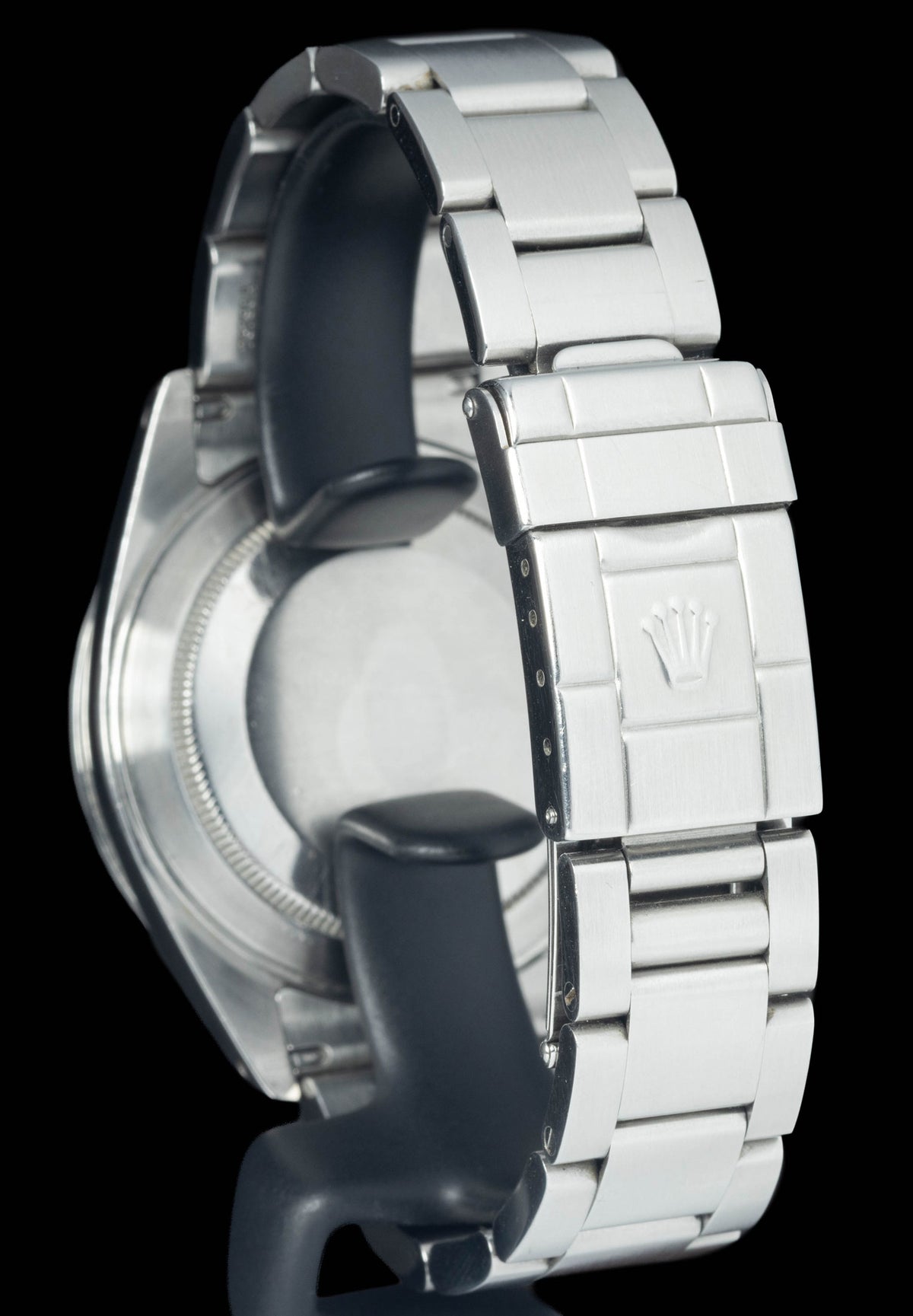
The watch is on an Oyster bracelet, reference 78790A, in great condition. That reference is a later Rolex bracelet than the 1996 case it is fitted to, being the solid end link revision of the 78790 that Rolex supplied on the 16570. Sag is the normal finding on a bracelet that has been worn daily for decades, so a bracelet presenting in great condition is a bracelet that has either been used lightly or looked after properly.
Dial and Hands
The dial and hands are in very good condition, and on this particular watch that grade needs reading in context, because the dial is a Rolex service dial rather than the tritium dial the case left Geneva with. It carries the words SWISS MADE at six o'clock. The hands were replaced with it, as they must be, since a tritium handset over a Luminova dial reads as two different colours under any light. The practical consequence is that nothing on this dial is ageing. Everything is presented as it was fitted. The glossy black lacquer, the applied markers in their white gold surrounds, the Mercedes hour hand and the red orange 24 hour hand are all judged on the same unforgiving basis as a modern dial, and a very good grade against that standard describes a dial and handset that are clean, even and complete, with only the minor marks a watch of this age collects in ordinary use.
Share
Why we love this watch
Why we love this watch
Nothing Left to Fade: The 1996 Rolex Explorer II 16570
This Explorer II has a T prefix serial, which puts its case in the last years of tritium, and a dial that has never contained any. The text above six o'clock reads SWISS on its own, a marking Rolex used for about a year from 1998 and then dropped, so the dial is younger than the steel around it by two or three years. The hands match the dial. The bracelet, an Oyster 78790A, is a revision that belongs to the following decade. All of it came from Geneva, fitted by Rolex during service, which makes this a 16570 assembled from three points in its own reference's history.
A Watch for People Who Could Not See the Sun
The Explorer II exists because of a problem that has nothing to do with travel.
The name arrived first
Rolex trademarked the Explorer name in January 1953, months before Tenzing Norgay and Edmund Hillary summited Everest. What followed was the 36mm line, the 6350 and 6610 and then the reference 1016 that ran from 1963 to 1989, a black dial with 3-6-9 numerals and nothing else on it. That watch was an exercise in removing things. The Explorer II went the other way.
1971 and the caves
In 1971 Rolex introduced the reference 1655 for speleologists, people who spend days underground where there is no daylight to keep track of. Monochrome describes it plainly as a tool watch for spelunking, built because time in caves erases the difference between morning and night. It has a hand that turns once every twenty four hours and a fixed steel bezel engraved with a twenty four hour scale for that hand to point at.
The bezel does not rotate, and on the 1655 that was the whole point. The 24 hour hand was locked to the local hour hand and could not be offset, so it answered one question only: is it light or dark up there. It was a day and night indicator, not a second time zone.
1985: the hand comes loose
The reference 16550 replaced it in 1985 and changed the watch's job. The additional hour hand could now be set independently of the main one, which made the Explorer II a true GMT for the first time. The case grew to 40mm, sapphire replaced acrylic, Mercedes hands replaced the earlier sticks, and a white Polar dial joined the black one. The movement was the calibre 3085 with 27 jewels at 28,800 vibrations per hour.
That is the watch the 16570 inherited, and the reason it is worth spelling out is that everything odd about the Explorer II is a leftover from the cave brief. The fixed bezel stayed fixed even after the hand it serves stopped being a day and night indicator. A watch built for one purpose acquired a second one, and kept the furniture of the first.
1989: The Reference 16570
The 16570 arrived in 1989 and ran into 2011, twenty two years, which makes it the longest lived Explorer II by a distance. Sources differ on the final year, with Monochrome giving 2010 and Beyond the Dial giving 2011, which is the sort of disagreement that happens at the end of a reference rather than a real dispute.
Visually it changed very little from the 16550. The case stayed at 40mm in steel with crown guards, a screw down crown, a flat sapphire crystal and the fixed engraved 24 hour bezel. Both dials carried over, black and the white Polar, and on the 16570 the Polar dial gained black outlines around the applied indices and hands where the 16550 had used plain silver, which is a small change that does a great deal for legibility on a white dial.
The bezel that never got its job back
Look at what the fixed bezel does on a 16570 and the answer is almost nothing. The 24 hour hand can be set independently now, so a second time zone is read by offsetting the hand against a scale that cannot move, which means the bezel has been demoted from an instrument to a printed reference. Rolex left it in solid steel anyway, engraved rather than inserted, with even hours in numerals and the odd hours as hash marks.
The result is the reason this watch wears the way it does. A steel bezel with no insert and no rotation gives the 40mm case a bright, hard ring around the dial without adding a colour or a texture, and it is the only sports Rolex of the period where the bezel is quieter than the dial. Everything expressive on this watch happens inside that ring.
Calibre 3185
Inside is the calibre 3185, introduced in 1989 alongside the GMT-Master II 16710 and built on the architecture of the 3135. It runs 31 jewels at 28,800 vibrations per hour, measures 28.5mm across and 6.45mm deep, winds bidirectionally, uses Kif Elastor shock protection and hacks when the crown is pulled. It drives central hours, minutes, sweep seconds, an independent 24 hour hand and a date at three.
One detail is worth knowing because it changes how the watch is used. The 3185 is semi quickset rather than true quickset, as CaliberCorner records: there is no separate crown position that jumps the date on its own. The fast route is the independent hour hand, which you run forward through two full revolutions to advance the date by one day. That is not a flaw so much as the consequence of an architecture where the jumping hour hand is the clever part.
The 3185 is also the movement associated with a wandering 24 hour hand, where the hand sits slightly off its marker or drifts when the hour hand is adjusted. Rolex addressed it with the calibre 3186 around 2005 and 2006, with a Parachrom hairspring, which is the dividing line between the last generation of 16570 and everything before it.
Four Generations, Read Off the Dial
Twenty two years of production gave this reference four versions, and the quickest way to place one is the line above six o'clock.
Tritium, 1989 to 1997
The first generation dial reads SWISS and T < 25, which is a regulatory declaration rather than decoration. Tritium is radioactive and glows without being charged, and the marking states that the dial carries less than 25 millicuries of it. Tritium also has a half life of a little over twelve years, so those dials have been dimming since they were printed, and the luminous plots have been warming from white towards cream while they did it.
On the Polar dial that ageing produced the best known thing the Explorer II has ever done, which is the cream dial: white surfaces on some 16550 and early 16570 examples have shifted to ivory and beyond. It is the reason tritium and this reference are spoken about in the same sentence.
The Swiss only year
In 1998 Rolex stopped using radioactive luminous material and moved to Luminova, which charges under light instead of glowing on its own. The T in the dial text no longer described anything, so it came off, and for roughly a year across 1998 and 1999 Rolex printed the single word SWISS and nothing else. Then it settled on SWISS MADE. That interim is the shortest lived dial marking in the reference's run, and it exists only because a safety decision landed before the replacement wording had been agreed.
Swiss Made, and the last generation
From 1999 the dial reads SWISS MADE with Super-LumiNova, brighter than Luminova and equally stable. The fourth generation from around 2005 brought the calibre 3186, solid end links as standard and the ROLEX ROLEX ROLEX rehaut engraving introduced as an anti counterfeiting measure.
A 1996 Case and a 1999 Dial
What the serial says
The serial is engraved between the lugs at the six o'clock side, where Rolex put it on everything made before the number moved to the rehaut in 2005. A T prefix covers 1996 into 1998, which our Rolex serial numbers guide sets out with the rest of the letter prefixes. A 16570 case from that window left the factory with a tritium dial, because that was the only kind being made.
Why the dial is newer
Rolex stopped supplying tritium dials when it stopped producing them. From 1998 a watch sent in for overhaul with a tired or damaged dial came back with current production, because current production was what was in the drawer, and Millenary Watches states the position directly: Rolex no longer uses radium or tritium, so a service dial carries Luminova or Super-LumiNova. A watch serviced inside that narrow 1998 to 1999 window left the service centre with the SWISS only dial that was current for those few months. That is what this Explorer II is wearing.
The hands follow necessarily. Luminous material is matched as a set, and tritium hands over a Luminova dial would read as two different colours in any light, so the dial and the handset were changed together. On this reference that includes the 24 hour hand, the red orange pointer that is the one thing on the dial the eye finds first. Sources describe that colour as red and as orange with about equal confidence, sometimes within the same publication, and the truth is that it has always sat between the two and reads differently against a black dial than it does against a Polar one.
Nothing left to fade
Here is the physical consequence, and on this particular reference it carries some weight. The Explorer II is the Rolex best known for a dial that changes colour. Tritium is what did it, and tritium is precisely what this dial does not have. Luminova does not decay and does not patinate. The dial on this watch has looked the same since the day it was fitted and will keep looking the same, while the case around it has thirty years of wrist behind it. The gap between a case that has obviously lived and a dial that has not is the whole character of the watch.
The Bracelet: Oyster 78790A
The 16570 went through its own bracelet sequence. The earliest examples wore the Oyster 78360 with hollow 501B end links. From the second generation the reference moved to the 78790 with the flip-lock clasp. Solid end links appeared during the third generation and were standard by the fourth, and the 78790A is the solid end link version of the 78790, documented as factory fitment on the 16570 and the GMT-Master 16710, with clasp date codes observed from 2002 and 2005.
Final Thoughts
The Explorer II started as a single purpose instrument for people who could not see the sun, kept its fixed bezel long after the hand it serves had been given a second job, and in the 16570 settled into the most quietly capable version of itself: 40mm, a real independent hour hand, and twenty two years in the catalogue without needing to be redesigned.
References
1. Monochrome Watches, In-Depth: The History of the Rolex Explorer II: https://monochrome-watches.com/history-rolex-explorer-ii-adventure-watch-gmt-1655-16550-16570-216570-226570-in-depth/
2. Beyond the Dial, Collector Guide: The Rolex Explorer II, All References In Detail: https://www.beyondthedial.com/post/collector-guide-the-rolex-explorer-ii-all-references-in-detail/
3. Monochrome Watches, In-Depth: The History of the Rolex Explorer: https://monochrome-watches.com/history-rolex-explorer-from-1953-36mm-1016-14270-114270-214270-124270-in-depth-review/
4. CaliberCorner, Rolex Caliber 3185 Watch Movement: https://calibercorner.com/rolex-caliber-3185/
5. Millenary Watches, What is a Rolex Swiss Only Dial?: https://millenarywatches.com/rolex-swiss-only-dial/
6. Millenary Watches, What is a Rolex Service Dial?: https://millenarywatches.com/what-is-rolex-service-dial/
7. Everest Bands, Comparing Every Rolex Lume: Radium, Tritium, Super-LumiNova and Chromalight: https://www.everestbands.com/blogs/bezel-barrel/comparing-every-rolex-lume
8. Own The Watch, The Rolex Explorer II Ref. 16570: https://www.ownthewatch.com/p/rolex-explorerii-16570
9. Own The Watch, The Orange GMT Hand on the Rolex Explorer II: https://www.ownthewatch.com/p/rolex-explorer-ii-orange-hand
10. Rolex Forums, Bracelet Question, 78790 vs 78790A: https://www.rolexforums.com/showthread.php?p=12676873
11. Lunar Oyster, 2002 Rolex 78790A Flip-Lock Bracelet SEL 16710/16570: https://lunaroyster.com/product/2002-rolex-78790a-flip-lock-bracelet-sel-16710-16570-gmt-master-2/
12. Bob's Watches, Rolex Serial Numbers and Production Dates Lookup Chart: https://www.bobswatches.com/rolex-serial-numbers
Case & Bracelet
Case & Bracelet
- The case remains in great condition - lightly polished
- Bracelet in great condition
Dial & Hands
Dial & Hands
- Dial & hands very good
Warranty & Condition
Warranty & Condition
Crown Vintage Watches provides a minimum 6-month mechanical warranty on pre-owned watches, from the date of purchase.
The warranty covers mechanical defects only.
The warranty does not cover damages such as scratches, finish, crystals, glass, straps (leather, fabric or rubber damage due to wear and tear), damage resulting from wear under conditions exceeding the watch manufacturer’s water resistance limitations, and damage due to physical and or accidental abuse.
Please note, water resistance is neither tested nor guaranteed.
Shipping and insurance costs for warranty returns to us must be covered by the customer. Returns must be shipped via traceable courier. Return shipment must be pre-paid and fully insured. Collect shipping will be refused. In case of loss or damages, the customer is liable.
Our Pledge
At Crown Vintage Watches, we stand by the authenticity of every product we sell. For added peace of mind, customers are welcome to have items independently authenticated at their own expense.
Condition
Due to the nature of vintage timepieces, all watches are sold as is. We will accurately describe the current condition and working order of all watches we sell to the best of our ability.
Shipping & Refund
Shipping & Refund