

Crown Vintage
Rolex Explorer II 16570 Black 40mm 2002 Box & Papers
Rolex Explorer II 16570 Black 40mm 2002 Box & Papers
Couldn't load pickup availability
Rolex Explorer II 16570 Black 40mm 2002 Box & Papers
Case and Bracelet
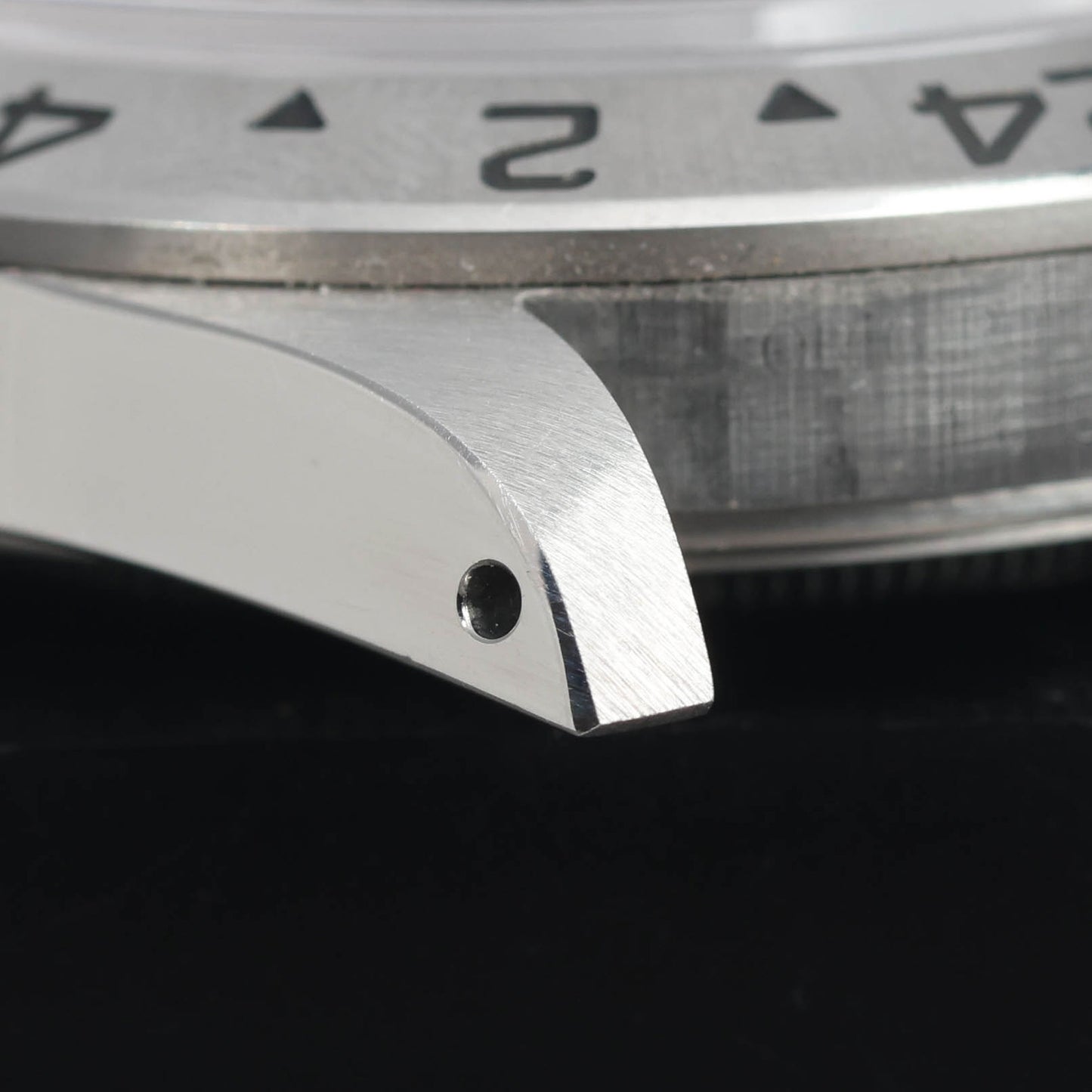
The 40mm Oyster case is in excellent condition and, importantly, remains unpolished, with very little wear visible and the factory finishing intact across the surfaces. The brushed satin surfaces that define the Explorer II are crisp and unspoiled, the lines of the case sharp, exactly as they should be on a watch that has been well kept. The brushed Oyster bracelet is likewise in excellent condition, sitting securely and showing minimal signs of use, with the clasp operating cleanly.
Dial and Hands
The dial and hands are flawless. The glossy black dial is clean and unmarked, the applied hour markers and Mercedes hands in their white gold surrounds crisp and bright, and the red 24-hour hand sharp against the dial. The Super-LumiNova plots are intact and even throughout. The presentation is exactly as it should be, with nothing to note across either the dial or the handset.
Chronometry
Chronometry was carried out on the Witschi WAIO. The reference 16570 is powered by the chronometer-certified calibre 3185, held to the COSC tolerance of −4 to +6 seconds per day. This example returned a rate of +6 seconds per day, sitting right at the favourable upper edge of that chronometer window, with a beat error of just 0.2ms and a healthy amplitude of 252 degrees, all of which point to a movement running strongly and in good order. The watch also successfully passed a 5BAR pressure test, confirming its tightness against water at the time of testing.
Use Advisory
The Explorer II 16570 is a robust modern sports watch made to be worn daily, and this example, now around twenty-four years old, remains in strong mechanical health. As with any watch that has been in service for two decades, periodic servicing is recommended to keep it running at its best. Treated with normal everyday care, it will continue to perform reliably for many years to come.
Share
Why we love this watch
Why we love this watch
A Watch Built to Tell Day From Night: The 2002 Rolex Explorer II 16570
The red 24-hour hand sweeping across the black dial of this 2002 Explorer II 16570 exists for one particular reason, which is so that someone deep underground, or living through the endless light of a polar summer, could still tell noon from midnight. That is an unusual thing to ask of a wristwatch, and it is the whole idea behind the Explorer II. Where most Rolex sports watches were built for a place, the diver's depths or the pilot's time zones, this one was built for a condition: the loss of daylight as a way of knowing the time of day. Everything about the 16570, from its fixed 24-hour bezel to its all-brushed case, follows from that single, slightly eccentric purpose.
The Explorer and Its Second Act
Rolex built its Explorer name on high places. The original Explorer of 1953 grew out of the company's long association with Himalayan expeditions, including the first successful ascent of Everest in that same year, when Rolex Oyster watches travelled with the climbing parties as part of the equipment. The Explorer distilled that experience into a rugged, supremely legible three-hand watch made to keep working in hostile conditions, defined by toughness and clarity rather than complication. Its black dial, bold numerals, and luminous markers were about one thing above all, which was being read instantly in poor conditions by someone with no attention to spare. The Explorer II, which arrived in 1971 as the reference 1655, took that same ethos somewhere more specialised.
The 1655 was aimed not at mountaineers but at cave explorers, speleologists who spent days underground in total darkness where the body quickly loses track of whether it is day or night. To solve that, Rolex gave the watch a bold arrow-tipped 24-hour hand and a fixed bezel marked out in twenty-four hours, so the wearer could read the hour against a full day-night cycle. On that first Explorer II the 24-hour hand was linked to the main hands and served purely as a day or night indicator. The reference earned the Italian nickname Freccione, meaning big arrow, for that distinctive hand, and it is also widely and wrongly called the Steve McQueen, a nickname with no real basis, since the watch McQueen actually wore was a Submariner. The 1655 sold slowly and was, for years, the overlooked member of the Rolex sports family, but it planted the idea that the later references would carry forward.
The Reference 16570
The watch matured into the form most people now recognise with the reference 16570, introduced in 1989 and produced all the way through to 2011. That twenty-two-year run is by far the longest of any Explorer II generation, and it followed the short-lived second-generation 16550, which had appeared in 1985 and lasted only about four years. The 16570 kept the 40mm steel case, the fixed 24-hour bezel, and the brushed Oyster bracelet, and it offered the same two dial choices the line would keep: a glossy black dial, as here, and a white version known as the Polar. The black dial never picked up a nickname of its own, which suits a watch that has always gone about its business without much fuss.
Because it was made for so long, the 16570 is really a family of small variations on one theme. Over its life Rolex changed the luminous material, the movement, the lug holes, and the inner bezel ring, all without altering the essential look of the watch. That makes the year of a given example genuinely meaningful, because the date places it within a clear sequence of changes. A 2002 watch sits in the heart of the run, modern enough to be thoroughly usable and early enough to retain the cleaner, more restrained details of the reference's middle years.
It is worth pausing on the generation in between, because it explains much of what the 16570 inherited. The second-generation 16550 of 1985 was the watch that transformed the Explorer II from a clever day-night indicator into a true dual-time instrument, by adopting Rolex's first movement with an independently adjustable 24-hour hand. It also brought the sapphire crystal and the 40mm case the line would keep. The 16550 is remembered for another reason too: a number of its white dials, finished in a paint that proved unstable, drifted over the years from bright white toward a warm cream. The 16570 took everything the 16550 had introduced, settled the recipe, and then ran with it for more than two decades, which is why the third-generation watch feels so resolved. Nothing about it seems experimental, because by 1989 the experimenting was done.
The 24-Hour Hand and Fixed Bezel
The defining feature of the Explorer II is the way its 24-hour hand and bezel work together. The bezel is fixed rather than rotating, engraved with a twenty-four-hour scale, and the extra hand makes one full revolution of the dial every twenty-four hours instead of twelve. From the second-generation 16550 onward, and so on this 16570 too, that 24-hour hand became independently adjustable, which turns the watch into a genuine dual-time instrument. You can set the 24-hour hand to a second time zone and read it off the fixed bezel, while the main hands show local time. Because the bezel does not turn, the Explorer II offers one fixed reference rather than the freely adjustable arrangement of the GMT-Master, and that was a deliberate decision by Rolex to keep the two models distinct. For its original audience the same hand did the simpler and more vital job of saying, at a glance, whether the twelve on the dial meant midday or the middle of the night.
The Movement Inside
A 2002 Explorer II 16570 is powered by the calibre 3185, the automatic movement Rolex used in the reference for most of its life and shared with the GMT-Master II of the period. It runs at 28,800 vibrations per hour, holds 31 jewels, and offers around 48 hours of power reserve. Its key trick is the independently adjustable 24-hour hand that makes the watch a true travel movement. The 3185 has one well-known quirk, a slight wobble of the 24-hour hand when the time is set, which is harmless and simply a characteristic of the calibre. Rolex eventually addressed it with the calibre 3186, which arrived in the reference in 2007 with a Parachrom hairspring for better resistance to magnetism and temperature, but a 2002 watch predates that change and carries the 3185. The date, it is worth noting, is non-quickset, set by advancing the hands rather than by a dedicated quick-set position.
Case, Dial and Bracelet
The 16570 case is 40mm of Rolex's corrosion-resistant 904L steel, finished almost entirely in brushed satin rather than polish, a tool-watch trait that keeps it from looking too dressy. A screw-down Twinlock crown sits between crown guards, and a sapphire crystal protects the dial, with a date window at three o'clock beneath a Cyclops lens. The black dial carries applied hour markers and Mercedes hands in white gold surrounds, with the red 24-hour hand cutting across them. On a 2002 example the luminous material is Super-LumiNova, indicated by the SWISS MADE text at the foot of the dial, which means the lume remains bright and stable rather than aged. The lugs on a watch of this date are still drilled through, a practical detail Rolex would phase out across the following couple of years, and the brushed Oyster bracelet is fitted with solid end links and a folding clasp. The inner bezel ring is plain, without the repeating ROLEX engraving that the reference gained only toward the end of its run.
The Quiet One in the Lineup
Among Rolex's professional sports watches, the Explorer II has always been the understated one. It lacks the underwater glamour of the Submariner, the jet-age romance of the GMT-Master, and the motorsport theatre of the Daytona, and for much of its history it was the model people walked past on the way to those. Yet that is precisely what many people have come to like about it. The 16570 is about as versatile as a watch can be, equally at ease with a suit or a sleeve rolled up over a workbench, and it carries the full weight of Rolex engineering without any of the signals that draw a second glance across a room.
The black dial leans into that character even further. The white Polar dial, with its black-outlined markers, is the more visually unusual of the two and tends to attract the eye first, while the black 16570 is the quieter, more classically Rolex of the pair. It reads at a distance simply as a clean, capable steel sports watch, and only on closer inspection gives up the detail of the fixed 24-hour bezel and the extra hand. For a watch born to solve a problem most of us will never face, it has turned out to be one of the most genuinely wearable things Rolex has ever made.
The proportions are a large part of why. At 40mm with a slim profile, the 16570 wears with an ease that its larger 42mm successor traded away for presence, sitting flat under a cuff and disappearing on the wrist in the way a true daily watch should. The all-brushed steel hides the small marks of everyday wear rather than showing them off, the sapphire shrugs off scratches, and the movement asks for little beyond being worn. It is the kind of watch that rewards being used rather than admired, which is exactly what its makers intended when they built the first Explorer for people heading somewhere difficult.
A 2002 Example in Particular
Knowing the year tells you a great deal about how a 16570 is configured, and a 2002 watch lands in a particularly coherent spot. It has the calibre 3185 with its independently adjustable 24-hour hand, the Super-LumiNova lume that glows reliably and stays white rather than ageing, and the plain inner bezel ring of the pre-engraving years. It still wears the drilled lugs that give the case a slightly more purposeful, old-school look and make strap changes easy, paired with the solid-end-link Oyster bracelet that had become standard by this point. In other words it combines the usability of a modern Rolex with the cleaner detailing of the reference's middle period, before the last round of updates arrived later in the decade.
Final Thoughts
The Rolex Explorer II 16570 is the long-serving heart of a watch that began as one of Rolex's most specialised tools, built so that explorers cut off from daylight could still tell the time of day. A 2002 black example captures the reference at a confident, settled point in its twenty-two-year life, powered by the calibre 3185 and dressed in the clean, restrained details of its middle years. The history of the Explorer and the cave-diving brief behind the original 1655 explain why the watch is shaped the way it is, with its fixed 24-hour bezel and its extra hand. The watch itself, understated, all-brushed, and quietly capable of almost anything, explains why the 16570 has become one of the most quietly loved Rolex sports watches of all.
References
1. Monochrome Watches, “In-Depth: The History of the Rolex Explorer II.” monochrome-watches.com.
2. Bob’s Watches, “Rolex Explorer II 16570.” bobswatches.com.
3. Fratello Watches, “Buyer’s Guide: The Rolex Explorer II Ref. 16570.” fratellowatches.com.
4. Luxury Bazaar, “Rolex 16570 Explorer II Collector’s Guide.” luxurybazaar.com.
5. Beyond the Dial, “Collector Guide: The Rolex Explorer II.” beyondthedial.com.
6. Twain Time, “Guide to the Rolex Explorer II 16570.” twaintime.com.
7. Gray and Sons, “History and Evolution of the Rolex Explorer II.” grayandsons.com.
Case & Bracelet
Case & Bracelet
- Case in excellent unpolished condition, very little wear visible.
- Bracelet in excellent condition
Dial & Hands
Dial & Hands
- Dial & hands flawless
Warranty & Condition
Warranty & Condition
Crown Vintage Watches provides a minimum 6-month mechanical warranty on pre-owned watches, from the date of purchase.
The warranty covers mechanical defects only.
The warranty does not cover damages such as scratches, finish, crystals, glass, straps (leather, fabric or rubber damage due to wear and tear), damage resulting from wear under conditions exceeding the watch manufacturer’s water resistance limitations, and damage due to physical and or accidental abuse.
Please note, water resistance is neither tested nor guaranteed.
Shipping and insurance costs for warranty returns to us must be covered by the customer. Returns must be shipped via traceable courier. Return shipment must be pre-paid and fully insured. Collect shipping will be refused. In case of loss or damages, the customer is liable.
Our Pledge
At Crown Vintage Watches, we stand by the authenticity of every product we sell. For added peace of mind, customers are welcome to have items independently authenticated at their own expense.
Condition
Due to the nature of vintage timepieces, all watches are sold as is. We will accurately describe the current condition and working order of all watches we sell to the best of our ability.
Shipping & Refund
Shipping & Refund