

Crown Vintage
Rolex Explorer II 16570 'Panna Dial' 40MM 1991
Rolex Explorer II 16570 'Panna Dial' 40MM 1991
Couldn't load pickup availability
Preloved Rolex Explorer II 16570 'Panna Dial' 40MM 1991
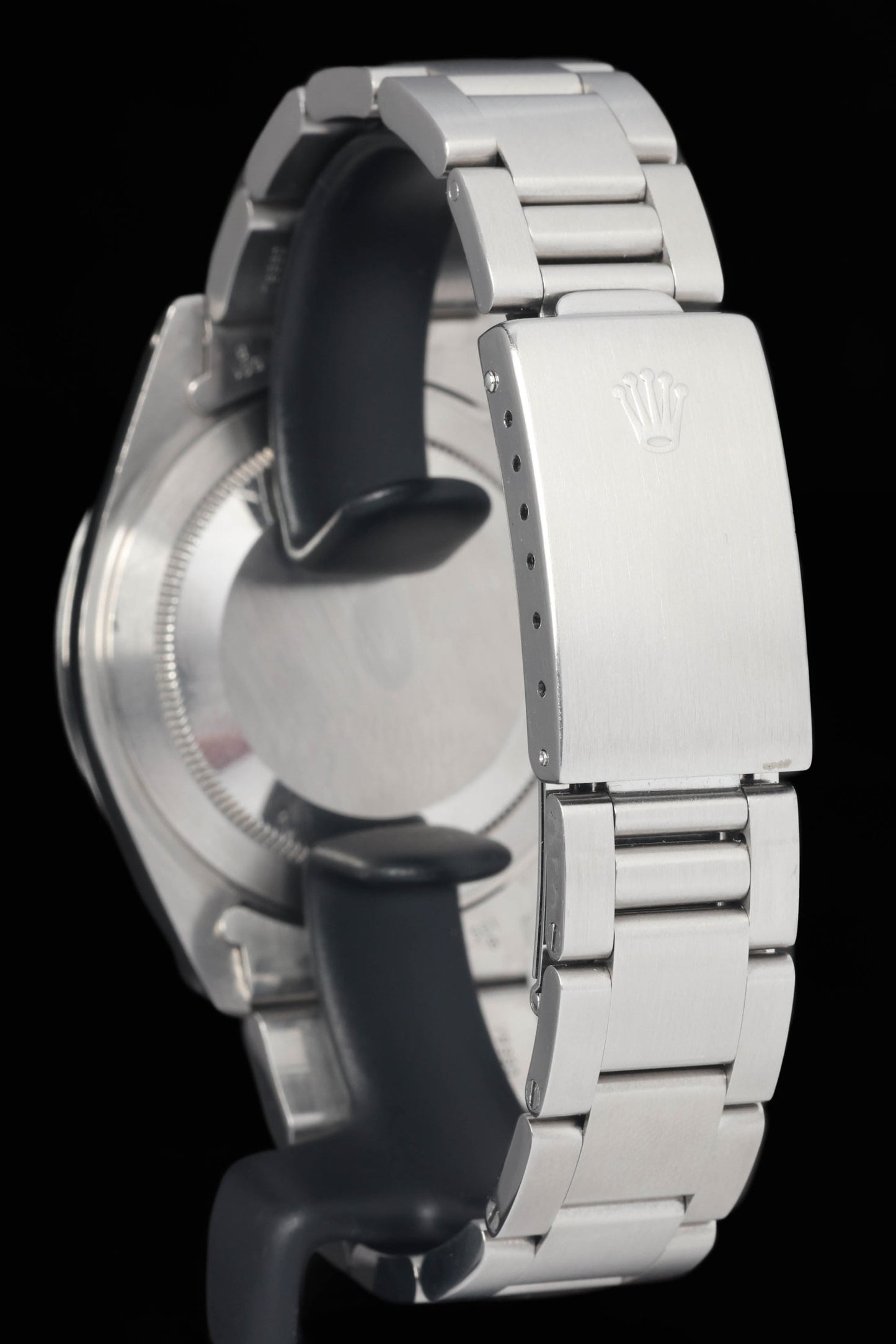
Case and Bracelet
The case is in excellent condition, showing little to no hairline scratches consistent with careful wear. The lugs remain extremely sharp with factory brushing still clearly visible across the top surfaces, retaining strong definition and original character. The overall case profile is very crisp, with no dents or significant damage observed.
The bracelet is also in great condition, displaying very light hairline scratches throughout. It remains structurally sound with good integrity and presents in keeping with the age of the watch.
Dial and Hands
The dial has aged into a warm cream tone, creating the distinctive Panna appearance. The tritium hour markers have developed an even pumpkin patina, and the hands show matching ageing for a cohesive vintage aesthetic.
As this watch is over 30 years old, it should be treated as a vintage timepiece and not worn whilst swimming, even though originally designed as a sports watch.
Witschi WAIO Test Report Summary
The Rolex Explorer II 16570 ‘Panna Dial’ 40mm (1991) has been assessed using a Witschi WAIO timing machine to evaluate accuracy and overall mechanical performance.
Tested in four positions, the watch is running at an average rate of +1.2 seconds per day, reflecting very strong timekeeping stability across positional variance.
The recorded beat error of 0.2 milliseconds indicates precise alignment of the escapement and balance assembly, demonstrating sound mechanical adjustment.
Amplitude measured 250 degrees, representing healthy energy transfer through the movement and consistent performance within expected parameters for a watch of this vintage.
Overall, the results confirm that this Explorer II is operating to a high mechanical standard, delivering stable accuracy and balanced amplitude across multiple positions.
Share
Why we love this watch
Why we love this watch
The White That Would Not Stay White: Rolex Explorer II 16570 'Panna' Dial 40mm, 1991
Rolex never intended to make this dial. The Explorer II 16570 left Geneva in 1991 wearing a stark polar white face, and somewhere in the years that followed, the lacquer quietly disobeyed its maker and mellowed into the warm ivory tone Italian collectors christened panna, their word for cream. That act of chemical rebellion is what makes this watch so compelling. The 16570 is one of the great unsung Rolex sports references, a 40mm steel GMT built for cave systems and polar stations, and in this early N-serial example the most disciplined watch company on earth was overruled by time itself. The result is a dial that no two examples share and that Rolex could not reproduce if it tried.
The House That Hans Wilsdorf Built
Rolex began not in Geneva but in London, where the Bavarian-born Hans Wilsdorf founded Wilsdorf and Davis in 1905 to assemble and distribute wristwatches at a time when serious men still carried pocket watches. Wilsdorf registered the Rolex name in 1908, chose it partly because it was short enough to fit on a dial and easy to pronounce in any language, and set about proving that a wristwatch could be as accurate as any pocket chronometer. In 1910 a Rolex became the first wristwatch to receive a Swiss chronometer certificate, and in 1919 the company moved to Geneva.
Two inventions then defined everything that followed. In 1926 Rolex introduced the Oyster, the first commercially successful waterproof wristwatch case, sealed by a screw-down bezel, caseback and crown. A year later Wilsdorf strapped one to the young English swimmer Mercedes Gleitze for her cross-Channel swim, and the watch emerged running after more than ten hours in the water, an event Wilsdorf trumpeted on the front page of the Daily Mail. In 1931 came the Perpetual rotor, the self-winding mechanism whose descendants still power every Rolex today. Waterproof case plus perpetual winding equalled a sealed, self-sufficient machine, and that formula carried Rolex into its golden age of tool watches: the Explorer in 1953, launched in the year Everest was conquered, the Submariner for divers the same year, and the GMT-Master for Pan Am crews shortly after. By the time the Explorer II arrived, Rolex had spent two decades building watches for professions rather than for fashion.
The Explorer II Story
1971: a watch for the world without daylight
The Explorer II appeared in 1971 as reference 1655, and it remains one of the most single-minded watches Rolex has ever made. It was conceived for speleologists, the cave explorers who spend days underground where there is no daylight to distinguish morning from midnight, and for polar scientists living through months of continuous sun or darkness. Its solution was a fixed 24-hour bezel in steel paired with a large orange 24-hour hand, so the wearer always knew whether it was 10 in the morning or 10 at night. On the 1655 that orange hand was locked to the hour hand as a pure day-night indicator rather than an independent second time zone. Italian collectors nicknamed it the Freccione, the big arrow, and it ran on the calibre 1575 shared with the GMT-Master of the era. It sold modestly in its day, which tells you how uncompromising it was.
1985: the 16550 and the first accidental cream dials
In 1985 Rolex modernised the concept with the transitional reference 16550. The case grew to 40mm, a sapphire crystal replaced acrylic, and the new calibre 3085 allowed the 24-hour hand to be set independently, turning the Explorer II into a true GMT watch at last. Crucially, the 16550 introduced a white dial option, quickly nicknamed polar, alongside the black. And it was here that the story took its famous accidental turn. The white lacquer Rolex used on these dials was chemically unstable, and over years of exposure many 16550 polar dials drifted from bright white to a rich cream. Rolex regarded it as a defect and corrected the formula. History has judged it rather differently.
The Reference 16570: The Twenty-Two Year Explorer
The 16570 arrived in 1989 to replace the short-lived 16550, and it would go on to be produced until 2011, one of the longest runs of any modern Rolex sports reference. It refined rather than reinvented. The 40mm Oyster case in stainless steel carried the same fixed, engraved 24-hour bezel with a slightly modified font, a screw-down crown and 100 metres of water resistance. Inside, the new calibre 3185 replaced the 3085. On the polar version, the white gold surrounds of the 16550's markers and hands were now filled with black, giving the dial its distinctive outlined, high-contrast look, with black Mercedes hands and a red 24-hour hand sweeping over the white ground. The watch was fitted with the Rolex 78360 Oyster bracelet with its folding clasp, a piece of honest late-1980s Rolex engineering that rattles a little and works forever.
A 1991 example like this one sits in the earliest and most interesting chapter of the run. The serial falls in the N-series, the dial is finished in the glossier early lacquer, and the lume is tritium, marked SWISS-T<25 at six o'clock. Rolex would move to Luminova in 1998 and Super-LumiNova soon after, and with those changes the dials became chemically stable and visually uniform. The first-generation tritium dials, with their slightly porcelain-like gloss, belong to a different and warmer species.
Details that date a 1991 example
Because the 16570 ran for twenty-two years, the early watches form a distinct sub-family, and a 1991 example carries a cluster of features that later production quietly abandoned. The tritium lume is the most obvious: from 1998 the dials read SWISS only, and from around 1999 SWISS MADE with Super-LumiNova, both of which stay white forever. Only the SWISS-T<25 dials age. The case still has drilled lug holes, a practical touch for strap changes that Rolex phased out of its sports models in the 2000s, and the bracelet is the hollow-link 78360 with 501B end pieces, lighter and jinglier than the solid-link bracelets that followed. Even the clasp is the simpler stamped folding design of the period.
None of these details was considered special when the watch was new. They were simply how Rolex built things in 1991, in the last years before the brand's great turn toward heavier cases, ceramic bezels and solid bracelets. Taken together they give the early 16570 a lightness and a mechanical honesty that the final examples of 2011, excellent watches though they are, no longer had. The panna dial sits on top of all this as the finishing touch that only the first few years of production could ever produce.
The Panna Dial: Rolex Overruled by Chemistry
Here is the detail that lifts this particular watch out of the ordinary. The cream colour change is overwhelmingly associated with the 16550, because Rolex reformulated the dial lacquer precisely to stop it happening. Yet it is now well documented that a small number of the earliest 16570 dials, produced before the corrected lacquer fully took over and generally found on examples up to the early 1990s, carried the same unstable finish. Those dials left the factory stark white and have spent three decades slowly ripening into cream. A 1991 N-serial 16570 with a genuine panna dial is therefore something of a contradiction in terms: a reference created to eliminate the cream dial, wearing one anyway.
What makes the effect so appealing is its completeness. The change is not localised staining but an even, all-over warming of the entire dial surface, as if the watch had been photographed on tungsten film. The black-outlined markers and hands, designed to stand out crisply against white, now frame fields of soft ivory. The tritium plots, themselves aged to a gentle custard tone, no longer contrast with the dial but harmonise with it. The red 24-hour hand becomes the single vivid note on an otherwise entirely mellowed face. It is a colour scheme no designer specified and no factory can repeat, arrived at by nothing more than lacquer, light and thirty-five years.
There is a satisfying irony in all of this happening to a Rolex. This is the company that industrialised precision, that tests every case under pressure and certifies every movement, that has spent a century engineering variables out of watchmaking. The panna dial is the variable that got away. Each one aged at its own pace, in its own climate, on its own wrist, which means every surviving example is effectively a one-off finished by circumstance rather than by Geneva.
The Calibre 3185: Quiet Competence
The movement inside is the calibre 3185, introduced with this generation and used by Rolex across its GMT-Master II and Explorer II lines through the 1990s and into the 2000s. It runs at 28,800 vibrations per hour, carries 31 jewels, offers around 50 hours of power reserve and is built around the free-sprung Rolex architecture with a Breguet overcoil hairspring and Microstella regulation. Its party piece is the independently adjustable 12-hour hand: pull the crown to the intermediate position and the local hour hand jumps in one-hour steps without stopping the seconds or disturbing the minutes, which makes crossing time zones a ten-second operation. The 24-hour hand keeps home time on the fixed bezel, exactly as the speleologists' original required.
The 3185 has never been a glamorous movement, and that is rather the point. It was designed to be serviced by any Rolex watchmaker anywhere in the world, to shrug off magnetism, knocks and neglect, and to keep chronometer time for decades. Thirty-five years on, examples like this one do precisely that. It is the horological equivalent of a Land Rover engine: unexciting to describe and deeply reassuring to own.
On the Wrist
The 16570 may be the best-proportioned sports Rolex of its era. At 40mm across and a little over 12mm thick, with the slim fixed bezel giving it a broader, more open dial than any Submariner or GMT-Master II, it wears with a flat, low confidence that modern 42mm sports watches cannot imitate. The drilled lug holes, the lightweight hollow-link Oyster bracelet and the modest polished bevels all mark it as a product of the last period when Rolex built tools first and luxury objects second.
With a panna dial, the character changes again. A standard polar 16570 is crisp, clinical, almost Alpine. The cream version is soft, vintage and strange in the best way, reading at a glance like a much older watch wearing modern clothes. It goes with tweed as easily as with a field jacket. And because the change was gradual and organic, the watch carries its history visibly: this exact shade of ivory is the record of every year between 1991 and today.
Final Thoughts
The Explorer II 16570 was Rolex correcting a mistake, and the panna dial is the mistake refusing to be corrected. In one watch you get the whole arc of the story: Wilsdorf's waterproof, self-winding formula, the cave explorers' 24-hour dial of 1971, the accidental cream lacquer of the 16550, and the long, dependable reign of the 16570 itself, all gathered under a dial that turned from white to ivory against the express wishes of its maker. Plenty of watches are beautiful by design. This one is beautiful by accident, and it wears that accident with a warmth the catalogue version never had. It is the rarest thing in the Rolex universe: a surprise.
References
- Craft and Tailored, 1991 Rolex Explorer II Ref. 16570 Cream Dial, craftandtailored.com
- Fratello, Buyer's Guide: The Rolex Explorer II Ref. 16570, fratellowatches.com
- Monochrome Watches, The History of the Rolex Explorer II, monochrome-watches.com
- Analog:Shift, A Brief Guide to the Rolex Explorer II Polar
- Bob's Watches, Rolex Explorer II History: From Caves to Mountain Peaks
- Beyond the Dial, Collector Guide: The Rolex Explorer II, All References in Detail
- European Watch Company, Spelunking Into the Details: The Rolex Explorer II Reference 16550
Case & Bracelet
Case & Bracelet
- Case in very good condition, little to no hairlines visible.
- Lugs very sharp with factory brushing still visible.
- Bracelet in great condition, very light hairline scratches visible.
Dial & Hands
Dial & Hands
- Dial & hands have formed pumpkin patina
- Dial has aged into a cream colour
Warranty & Condition
Warranty & Condition
Crown Vintage Watches provides a minimum 6-month mechanical warranty on pre-owned watches, from the date of purchase.
The warranty covers mechanical defects only.
The warranty does not cover damages such as scratches, finish, crystals, glass, straps (leather, fabric or rubber damage due to wear and tear), damage resulting from wear under conditions exceeding the watch manufacturer’s water resistance limitations, and damage due to physical and or accidental abuse.
Please note, water resistance is neither tested nor guaranteed.
Shipping and insurance costs for warranty returns to us must be covered by the customer. Returns must be shipped via traceable courier. Return shipment must be pre-paid and fully insured. Collect shipping will be refused. In case of loss or damages, the customer is liable.
Our Pledge
At Crown Vintage Watches, we stand by the authenticity of every product we sell. For added peace of mind, customers are welcome to have items independently authenticated at their own expense.
Condition
Due to the nature of vintage timepieces, all watches are sold as is. We will accurately describe the current condition and working order of all watches we sell to the best of our ability.
Shipping & Refund
Shipping & Refund