

Crown Vintage
Rolex Explorer II 16570 'Polar' 40MM 1997
Rolex Explorer II 16570 'Polar' 40MM 1997
Couldn't load pickup availability
Preloved Rolex Explorer II 16570 'Polar' 40MM 1997
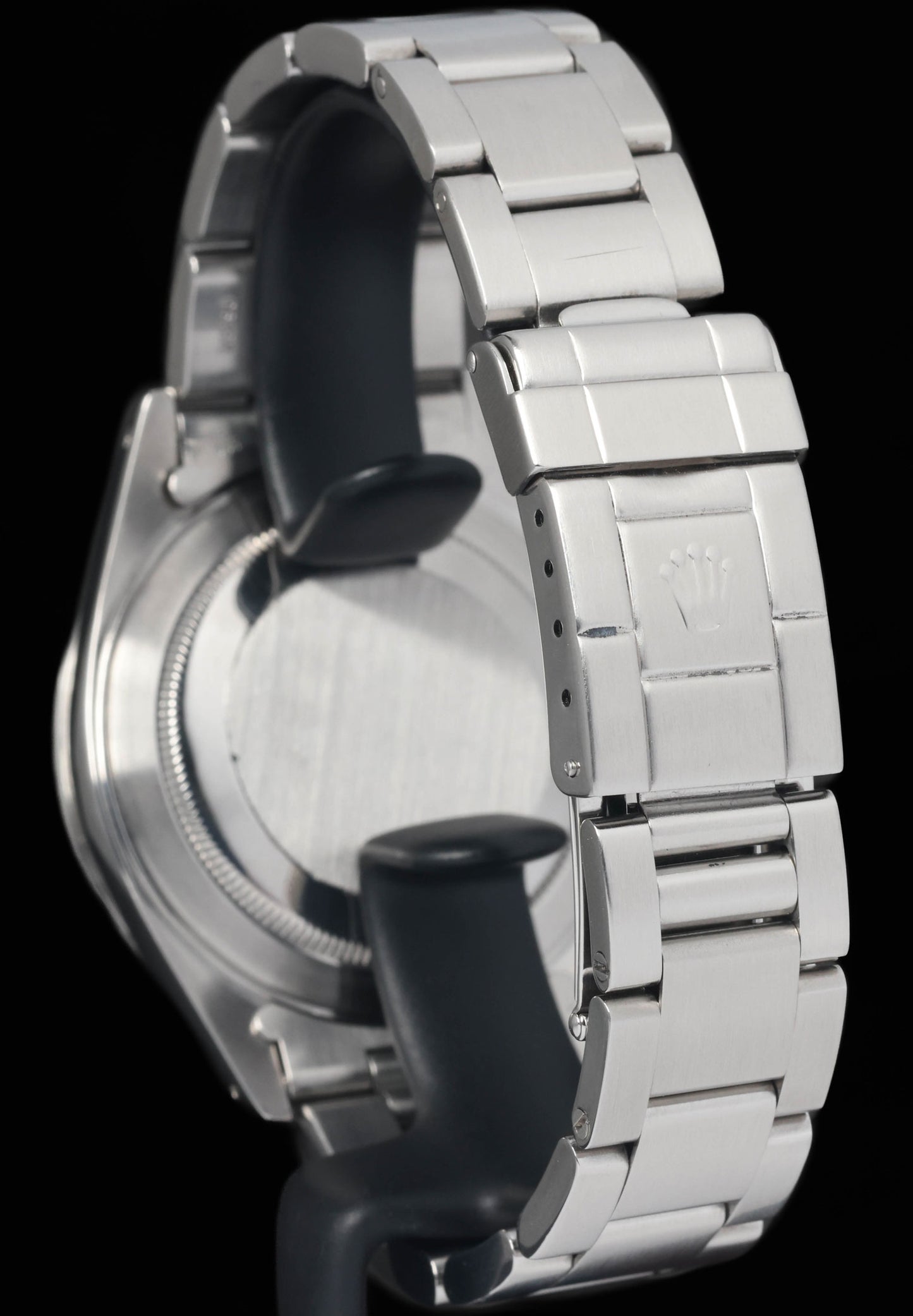
This previously polished 1997 Rolex Explorer II 16570 Polar remains in great condition, showing light wear consistent with careful use. The stainless steel 40mm case retains sharp edges and solid proportions, with light hairlines visible around both sides under close inspection. The Oyster bracelet is equally well-preserved, exhibiting some light surface hairlines on the clasp and links but no stretch or notable damage. The white Polar dial is in very good condition, displaying bright tone and strong contrast against the applied black surrounds. The hands are in very good shape, showing no corrosion or discoloration, with lume ageing evenly across both dial and handset. The fixed 24-hour bezel remains clearly defined, and the sapphire crystal is clean and scratch-free.
Tested across four positions on the Witschi WAIO, the calibre 3185 returns a mean daily rate of +3.3 seconds, a result that sits within the COSC chronometer tolerance of -4/+6 seconds per day and speaks well of a movement now approaching its fourth decade of service. Beat error measures 0.3 milliseconds, indicating the impulse is well centred and the lever geometry remains properly set, a result that requires no correction. Amplitude of 240 degrees is serviceable and consistent with a calibre 3185 that has accumulated significant running time; The watch has passed a 5BAR pressure test, confirming the Twinlock crown and case gaskets continue to provide the water resistance Rolex specifies for this reference.
Share
Why we love this watch
Why we love this watch
Into the Dark: The Rolex Explorer II Reference 16570 in Tritium
The 1997 Rolex Explorer II reference 16570 sits at a precise and unrepeatable point in the watch's 22-year production run: late enough to carry the upgraded 78790 Oyster bracelet with Fliplock clasp, early enough to still wear tritium lume under its fixed 24-hour bezel, and calibre 3185 in the form Rolex had refined it to over nearly a decade of production. It is a watch defined not by spectacle but by resolve, the product of a brief and specific moment in a reference that evolved quietly and continuously from 1989 to 2011.
The Origins of the Explorer II
Rolex launched the Explorer II in 1971 under reference 1655, a watch designed with a specific and somewhat unusual user in mind. Spelunkers and polar researchers operating in environments without natural light cues had no reliable way to distinguish day from night using a conventional watch. The original Explorer, introduced in 1953 and famously worn on the first successful ascent of Everest by Tenzing Norgay and Edmund Hillary, addressed demanding physical conditions above ground. The Explorer II addressed something more disorienting: the psychological and navigational difficulty of prolonged darkness.
The 1655, nicknamed the Freccione for its bold orange arrow-tipped 24-hour hand, provided a fixed 24-hour bezel against which that hand tracked a full rotation every 24 hours. It was a simple, readable system, and it worked. But the movement it housed, the calibre 1575, did not allow the 24-hour hand to be set independently. It was an AM/PM indicator, not a true dual-time instrument.
That changed in 1985 with reference 16550, which introduced the calibre 3085 and with it the ability to set the local hour hand independently from the 24-hour hand and the running seconds. The Explorer II became a genuine GMT watch, able to track two separate time zones simultaneously. It was a significant functional upgrade, and it set the template the 16570 would inherit and build upon when it arrived four years later.
Reference 16570: The Longest Chapter
Rolex introduced the reference 16570 in 1989, and it would remain in production until 2011, making it one of the longest-running references in Rolex sports watch history. The fundamental architecture was carried over from the 16550: a 40 mm Oyster case in stainless steel, a fixed 24-hour bezel, sapphire crystal with Cyclops date magnification, and the choice of a black or white "Polar" dial. The significant update was under the dial, where the calibre 3085 gave way to the thinner calibre 3185, an in-house automatic movement running at 28,800 vph with 31 jewels and a 48-hour power reserve.
Over its 22 years of production, the 16570 evolved in ways that are now clearly delineated by dial signatures, bracelet codes and lume materials. The 1997 example lands at a meaningful juncture within that evolution.
What a 1997 Example Represents
By 1997, the 16570 had been in production for eight years and the calibre 3185 was well established. The watch retained tritium luminous material, a fact encoded in the "SWISS T < 25" text printed at the six o'clock position on the dial. Tritium had been the lume standard for Rolex sports watches for decades, a self-luminous material that charged without exposure to light. Swiss regulations governing its use were tightening across this period, and the 16570 would transition to non-radioactive Luminova shortly after. A 1997 example is, in most readings, among the final tritium-era 16570s produced.
The bracelet on a 1997 watch tells its own story. Earlier 16570 references left the factory on the reference 78360 Oyster bracelet without a safety catch. By 1997, Rolex had upgraded the bracelet to the reference 78790, which added the Fliplock safety latch to the clasp. This was a meaningful functional improvement: the Fliplock prevented accidental bracelet release during field use, the kind of detail Rolex integrated quietly and without ceremony. Both the 78360 and 78790 are hollow end-link bracelets; the solid end-link 78790A would not arrive until 2000. The 1997 bracelet is therefore hollow end-link with Fliplock, a specific combination that marks this transitional period precisely.
The case retains drilled lug holes, a construction detail that persisted through the early 2000s before Rolex moved to solid external lug ends. These holes, aligned with the inner lug face to accept a spring bar tool, were a practical feature for strap or bracelet changes in the field. Later production 16570s abandoned them as Rolex standardised case construction across its sports range.
Calibre 3185: The Movement That Defined a Generation
The calibre 3185 is a movement with a particular place in Rolex history. It was derived from the calibre 3085 that had powered the 16550, with key refinements including an increase from 27 to 31 jewels and a reduction in movement height from 7.2 mm to 6.45 mm. The thinner profile allowed the 16570 to maintain a case height of approximately 12 mm despite the additional mechanical complexity of the independently adjustable GMT hand.
That independent hour hand is the 3185's most important feature for the explorer II's stated purpose. The local hour can be moved in one-hour increments via the crown without stopping the watch and without disturbing the 24-hour hand, which continues to track a reference time against the fixed bezel. Advancing the local hour past midnight or noon automatically advances or retains the date accordingly, a detail that distinguished the 16570 from many contemporary GMT watches that required manual date correction after hour-hand jumps. Each calibre 3185 was submitted to COSC for chronometer certification before casing, and then to Rolex's own inspection programme, with passing watches marked "Superlative Chronometer Officially Certified" across the lower half of the dial.
The 3185 powered the 16570 from 1989 until 2007, when Rolex introduced the calibre 3186 with a Parachrom hairspring for improved resistance to magnetism and temperature variation, accompanied by a laser-engraved rehaut. The 1997 watch carries the 3185, the movement that occupied the majority of the reference's production life and the one most closely associated with the 16570's identity as a working instrument.
Case and Bezel Architecture
The 40 mm Oyster case of the 16570 is machined from corrosion-resistant 904L Oystersteel and pressure-tested to 100 metres. A Twinlock crown secures via twin O-rings and threads flush against the case at the three o'clock position, free of the crown guards that characterise the Submariner. This absence of crown guards is not a structural omission but a deliberate choice: the Explorer II's case is not built for pressure depths, and removing the guards keeps the silhouette cleaner and the case more comfortable under a glove or jacket sleeve.
The bezel is fixed stainless steel, not ceramic or aluminium, engraved with 24-hour numerals and filled with gloss black lacquer. Because it does not rotate, there is no risk of accidental displacement during cave traversal or equipment handling. The 24-hour scale reads clearly: odd hours are numerals, even hours are indicated by marks, and the entire scale is legible at a glance once the eye is trained to it. Rolex has never offered a rotating bezel on the Explorer II, a consistent design decision that separates it from the GMT-Master and maintains the simplicity appropriate to its purpose.
The sapphire crystal sits slightly domed, giving a profile consistent with the tool-watch aesthetic. The Cyclops lens magnifies the date at three o'clock by 2.5x, a standard Rolex feature across the date-equipped sports range at this period.
Dial, Hands and Tritium Lume
The 16570 was available in black or white. The black dial is glossy, high-contrast, with white text and bright applied white-gold hour markers. The white Polar dial uses the same markers but surrounds them with black outlines rather than white-gold; against the white ground, it reads differently, with a graphic quality that has given the Polar version a distinct identity within the reference.
Applied white-gold hour markers sit at every position: a triangle at twelve, batons at three, six and nine, and circular plots at the remaining hours. The Mercedes-style hour hand, sword-shaped minute hand and lollipop seconds hand are all luminous. The red 24-hour hand ends in a small luminous triangle that tracks the bezel's 24-hour scale; its colour provides the visual separation needed to read two simultaneous time zones at speed.
On a 1997 watch, the lume is tritium, filling the applied markers and hands with material that glows soft green when freshly charged but softens over decades into warm cream. The "SWISS T < 25" footer at six o'clock documents the presence of tritium: the notation indicates that the watch contains less than 25 millicuries of radioactive material, the regulatory disclosure required at the time. This patina is part of the watch's material history, a record of years on the wrist.
The Fixed Bezel and Its Purpose
The Explorer II's fixed 24-hour bezel is sometimes misread as a limitation relative to the rotatable insert of a GMT-Master. It is, more accurately, a different tool for different conditions. A rotatable bezel allows rapid tracking of multiple time zones through physical manipulation. The fixed 24-hour bezel of the Explorer II provides a static AM/PM reference that cannot be displaced by contact with a rope, a glove, a cave wall or a sleeping bag. For underground navigation, where the risk of accidental bezel rotation is real and where a misread time-of-day could affect surface communications, the fixed bezel is the more reliable instrument.
The combined system of fixed bezel and independently adjustable hour hand allows a user to set the 24-hour hand to a reference time, such as UTC, and track local time on the conventional hour hand without losing the absolute time reference. Scientists wintering in polar stations used exactly this configuration: UTC on the 24-hour hand for communication windows with off-station teams, local station time on the hour hand for internal operations. The 16570 was not designed as a statement piece. It was designed as infrastructure.
Final Thoughts
The 1997 Rolex Explorer II reference 16570 is a document of a specific moment in one of the brand's most quietly significant references. The Fliplock bracelet had just arrived. Tritium was approaching its final years in the reference. The calibre 3185 was fully mature. The drilled lug holes remained. Everything about a 1997 example places it precisely in the middle passage of the 16570's long production arc, carrying the details of the early reference while incorporating the refinements that Rolex had built steadily into it across eight years. It is a 40 mm tool watch in the tradition that the Explorer II established in 1971 and maintained without interruption: purposeful, legible, resistant to the conditions that make precision difficult, and built to perform in the dark.
Case & Bracelet
Case & Bracelet
- The case remains in great condition - lightly polished
- Bracelet in great condition
Dial & Hands
Dial & Hands
- Dial & hands very good
Warranty & Condition
Warranty & Condition
Crown Vintage Watches provides a minimum 6-month mechanical warranty on pre-owned watches, from the date of purchase.
The warranty covers mechanical defects only.
The warranty does not cover damages such as scratches, finish, crystals, glass, straps (leather, fabric or rubber damage due to wear and tear), damage resulting from wear under conditions exceeding the watch manufacturer’s water resistance limitations, and damage due to physical and or accidental abuse.
Please note, water resistance is neither tested nor guaranteed.
Shipping and insurance costs for warranty returns to us must be covered by the customer. Returns must be shipped via traceable courier. Return shipment must be pre-paid and fully insured. Collect shipping will be refused. In case of loss or damages, the customer is liable.
Our Pledge
At Crown Vintage Watches, we stand by the authenticity of every product we sell. For added peace of mind, customers are welcome to have items independently authenticated at their own expense.
Condition
Due to the nature of vintage timepieces, all watches are sold as is. We will accurately describe the current condition and working order of all watches we sell to the best of our ability.
Shipping & Refund
Shipping & Refund