

Crown Vintage
Rolex Explorer II 16570 Black 40mm 2004 Box & Papers
Rolex Explorer II 16570 Black 40mm 2004 Box & Papers
Couldn't load pickup availability
Rolex Explorer II 16570 Black 40mm 2004 Box & Papers
This example of the Rolex Explorer II 16570 presents in very good overall condition. The stainless steel case remains in good state, retaining its original factory lines and sharp edges with visible wear. The fixed 24-hour bezel shows crisp, deeply engraved numerals and maintains its original brushed finish.
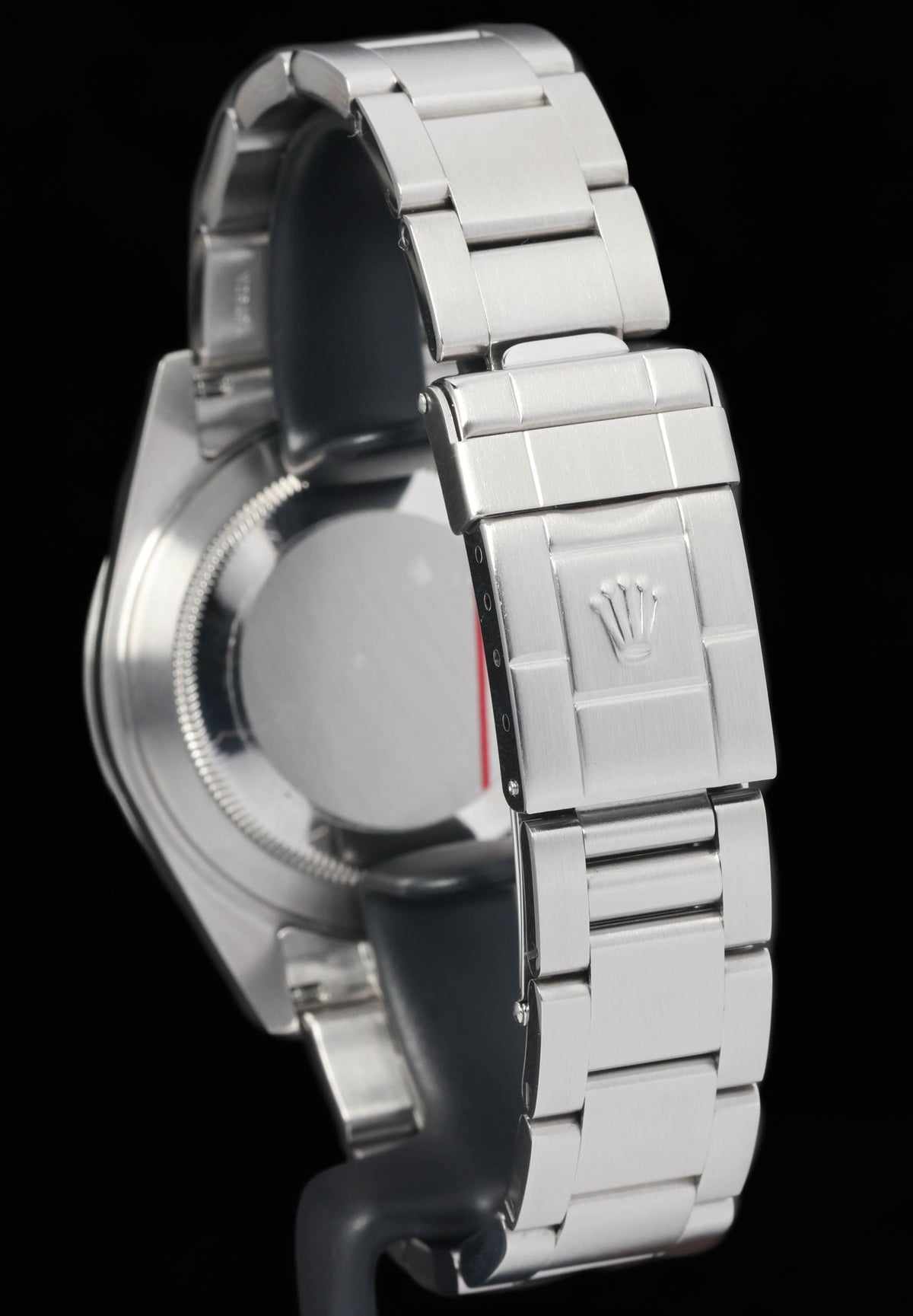
The Oyster bracelet is also in great condition, with some stretch and signs of wear consistent with careful handling. The clasp retains its correct coronet engraving and original brushed texture.
The dial and hands are flawless, showing no marks, discoloration, or ageing. The lume plots are clean and evenly coloured, and the red 24-hour hand remains vivid. Overall, this is a superb and exceptionally well-preserved example of the Explorer II 16570, showing minimal evidence of use and remaining true to its original factory finish.
Share
Why we love this watch
Why we love this watch
Born in the Dark: Rolex Explorer II Reference 16570 Black Dial
Rolex and the Logic of the Purpose-Built Watch
Rolex was founded in London in 1905 by Hans Wilsdorf and his brother-in-law Alfred Davis, operating initially under the name Wilsdorf and Davis before the Rolex name was registered in 1908. The company relocated to Geneva in 1919 and has remained there since. What distinguished Rolex from its earliest years was a commitment to watchmaking as an engineering discipline rather than a decorative one. The Oyster case, patented in 1926, was the first hermetically sealed wristwatch construction, combining a screw-down caseback and crown to keep the movement genuinely isolated from water and dust. The Perpetual self-winding rotor followed, making the automatic wristwatch a practical proposition for the first time. These were not styling exercises. They were solutions to problems that previous watchmakers had either ignored or accepted as unsolvable.
By the 1950s, Rolex had assembled a family of purpose-built professional watches, each developed around the requirements of a specific environment or discipline. The Submariner for divers. The GMT-Master for long-haul aviation crews. The Milgauss for physicists working in high electromagnetic fields. Each watch in this line was developed in close consultation with professionals who would use it in the field, and each one carried the visual evidence of that development in its design. Every element was accountable to function. In 1971, Rolex extended this logic underground.
The Explorer II: Built for Perpetual Darkness
The Rolex Explorer II launched in 1971 with the reference 1655, and it was built to answer a problem that the original Explorer, designed for mountaineers operating in daylight, could not address. Speleologists, those who explore cave systems professionally and recreationally, work in environments of complete and unbroken darkness. Spending extended periods underground, sometimes days at a time, dissolves the body's sense of whether it is day or night. The mechanisms by which human beings orient themselves temporally, the rhythm of light and darkness, the rise and set of the sun, simply do not exist below the earth's surface. A watch that displayed the time in twelve-hour format offered no help with this problem. A spelunker reading three o'clock on a standard dial had no way of knowing whether that meant the middle of the afternoon or the middle of the night.
The Explorer II 1655 addressed this with a fixed 24-hour graduated bezel and an additional oversized arrow hand, finished in orange, that made one complete rotation in 24 hours rather than 12. Read against the bezel, this hand told the wearer unambiguously whether the time was a.m. or p.m., restoring the temporal orientation that perpetual darkness removes. The design built the solution into the watch's physical architecture. There was no mode to switch into, no button to press. The 24-hour hand simply pointed at a number on the bezel, and that number answered the question. The dial was generous with luminous material by the standards of any contemporary watch: 24 tritium-filled accents ran around the full dial perimeter to correspond with the 24-hour bezel scale, ensuring the watch functioned as a complete instrument in conditions of zero ambient light.
The reference 1655 is known informally as the Freccione, Italian for big arrow, a nickname derived from the prominence of that orange 24-hour hand across the dial. It was a watch that made no attempt at restraint in its visual priorities. Legibility was the brief and the design was built entirely in service of it. Production continued until 1985, by which time the watch had been worn on polar expeditions, in cave systems, and in the deep mines for which the day/night indicator was a practical instrument. In environments where the watch's primary function was legibility in total or near-total darkness, a black ground with luminous white markers was the only rational choice. The watch's visual identity was shaped entirely by the conditions it was built to operate in, and that identity was black.
A Watch That Changed Its Function
The reference 1655 was produced until 1985, accumulating a series of dial variations across its fourteen-year run. Its successor, the reference 16550, introduced in 1985, brought significant changes: a 40mm case, sapphire crystal, Mercedes hands, and a new movement in the form of Calibre 3085. The Calibre 3085 transformed the Explorer II from a day/night indicator into a genuine GMT watch. On the 1655, the 24-hour hand moved in fixed synchronisation with the main hour hand and could not be independently set. On the 16550 and all subsequent Explorer II references, the 24-hour hand could be adjusted separately, allowing a home time zone to be tracked while the main hour hand displayed local time. The watch became, in addition to everything else it already was, one of the most capable travel instruments Rolex had ever produced.
The 16550 also introduced a white dial option for the first time in the Explorer II's history, giving the line the two-dial character it has maintained ever since. Black remained the original. The reference 16550 was produced for only four years before being succeeded by the reference 16570 in 1989, and the two-dial configuration carried through unchanged.
Reference 16570: Twenty-Two Years of Refinement
The reference 16570 was produced from 1989 until 2011, a span of twenty-two years that makes it one of the longest-running references in Rolex's professional range. Over that period, it was updated methodically and without fanfare. The luminous material shifted from tritium, marked by the "T SWISS T" text at the base of the dial, to LumiNova in 1998 and then to SuperLumiNova shortly after, with dial text transitioning through "SWISS" and then "SWISS MADE" accordingly. The bracelet transitioned from the 93150 Oyster with hollow end-links to the 93250 with solid end-links from around 2000. Drilled lug holes were removed between 2000 and 2003, giving the case a cleaner and more unified profile. The movement was updated from Calibre 3185 to the 3186 around 2005, the latter adding Rolex's blue Parachrom hairspring. Later still, the mid-2000s brought the repeating "ROLEX" engraving to the rehaut as an anti-counterfeiting measure.
A 2004 example inhabits the mature middle period of the reference. The solid-link bracelet and the clean, unengraved rehaut are both in place. SuperLumiNova fills the dial markers. The Calibre 3185 is the movement inside, one year before the 3186 update. Every detail of the watch had been resolved through fifteen years of production without any single element of the design having been revised enough to warrant a new reference number. That stability is itself a form of confidence.
Calibre 3185: GMT Architecture
The Calibre 3185 inside the 2004 reference 16570 is a 31-jewel automatic GMT calibre operating at 28,800 beats per hour, based on the architecture of Rolex's Calibre 3135. The central difference between the 3185 and the standard 3135 is the independently adjustable 24-hour hand, which can be set by pulling the crown to its intermediate position and rotating it without disturbing the main hour or minute hands. This is the flyer GMT mechanism: local time, displayed by the main hour hand, can be advanced or retarded in full-hour increments while the 24-hour reference zone hand holds position. The result is a watch that handles time zone changes with minimal disruption to the home time display.
Power reserve stands at 50 hours. The movement carries COSC chronometer certification, meeting the Official Swiss Chronometer Testing Institute's tolerance of minus four to plus six seconds per day. Microstella regulation screws on the balance rim allow fine rate adjustment during servicing. The 3185 was produced from 1988 until its replacement by the 3186, and by 2004 the calibre had accumulated sixteen years of real-world deployment across the Explorer II and GMT-Master II lines. It was a movement that required no defence by this point in its production life.
The Black Dial: The Original Expression
The black dial of the reference 16570 is not an alternative to the Polar. It is the original. Every Explorer II ever produced before the reference 16550 carried a black dial, and the 16550's introduction of the white option in 1985 positioned black and white as parallel expressions of the same design rather than establishing either as a default. On the 16570, the black dial carries white gold applied hour markers with SuperLumiNova fill and white gold Mercedes-style hands charged with the same material. Against the black ground, the white gold markers and hands present a high contrast that reads immediately in both bright light and darkness. The red 24-hour GMT arrow, making one rotation across the fixed 24-hour bezel in a full day, provides a third point of reference in that composition. Where the Polar dial makes its statement through the inversion of convention, the black dial makes its statement through the force of the original logic. This was the dial designed for darkness, and in that environment it performs exactly as intended.
The fixed 24-hour bezel itself, graduated around its entire circumference and machined from brushed steel, gives the Explorer II a visual identity that no other Rolex professional reference shares. Unlike the rotating bezel of the Submariner or the bi-directional bezel of the GMT-Master II, it does not move. It is a reference scale, static and permanent, against which the 24-hour hand is read. This fixed character gives the watch a somewhat more resolved appearance than rotating-bezel designs. There is nothing to misalign, nothing to be accidentally knocked out of position. The bezel does one thing and it does it always.
Against the black dial, the luminous fill in the applied markers and hands is charged by ambient light and released in darkness with a green-white glow. In the cave systems the watch was designed for, or in the aircraft cabins and hotel rooms it more commonly inhabits today, the display remains readable without any external light source for several hours after the last charge. The design premise of the 1655, maximum legibility in zero light, was carried forward into the SuperLumiNova generation intact.
Box and Papers: The Complete Record
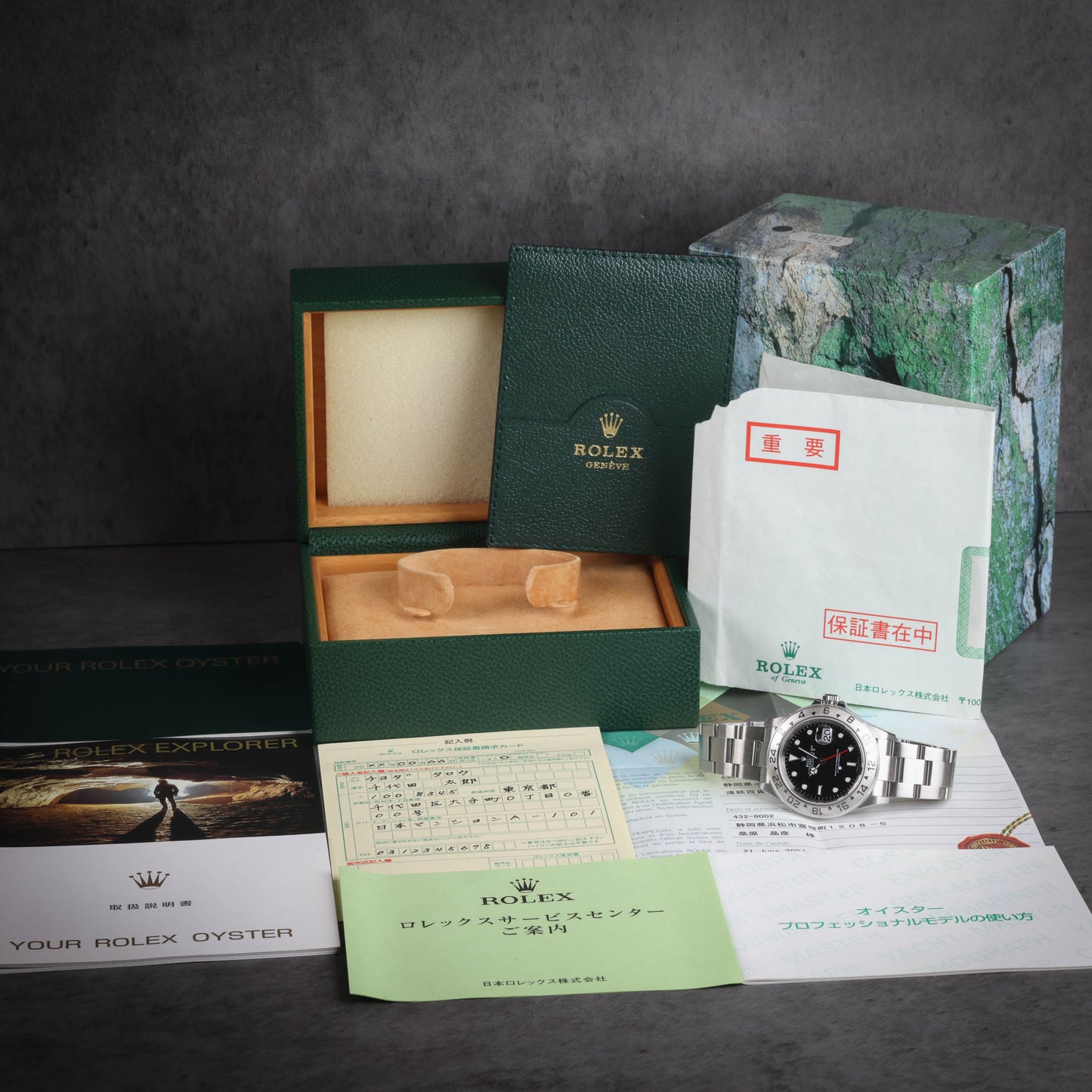
A 2004 reference 16570 offered with its original box and papers establishes the watch with a documented identity. The papers, warranty card or certificate issued at the point of sale, provide a fixed reference for the watch's production period and provenance. For a reference with as many sub-variants as the 16570, produced across twenty-two years with multiple lume, bracelet, case, and movement generations, that precision carries specific weight. It determines which iteration of the reference is being examined before any technical inspection begins, and it closes the gap between estimation and record.
Final Thoughts
The Rolex Explorer II reference 16570 with a black dial is the watch in its original form. The black dial was the only option Rolex offered for the Explorer II's first fourteen years of production, and the logic behind it has not changed across five decades. A watch designed to be read in the absence of light is a watch for which a black dial with high-contrast luminous markers is the correct starting point, and the reference 16570 carries that logic forward in a case and movement that represent the design at its most capable. The fixed 24-hour bezel does not rotate. The Calibre 3185 tracks a second time zone independently. The SuperLumiNova markers charge in daylight and discharge in darkness. None of this requires the cave system or the polar expedition it was designed for. It is present and functional regardless of where the watch is worn, which is precisely why the Explorer II has outlasted the era of professional cave exploration that first inspired it.
The 2004 example with its original box and papers is this watch fully accounted for: mature in manufacture, documented in provenance, and carrying the black dial that has been the Explorer II's authentic expression since the Freccione first appeared in 1971.
Case & Bracelet
Case & Bracelet
- Case in very good condition, little to no wear visible.
- Bracelet in excellent condition
Dial & Hands
Dial & Hands
- Dial & hands flawless
Warranty & Condition
Warranty & Condition
Crown Vintage Watches provides a minimum 6-month mechanical warranty on pre-owned watches, from the date of purchase.
The warranty covers mechanical defects only.
The warranty does not cover damages such as scratches, finish, crystals, glass, straps (leather, fabric or rubber damage due to wear and tear), damage resulting from wear under conditions exceeding the watch manufacturer’s water resistance limitations, and damage due to physical and or accidental abuse.
Please note, water resistance is neither tested nor guaranteed.
Shipping and insurance costs for warranty returns to us must be covered by the customer. Returns must be shipped via traceable courier. Return shipment must be pre-paid and fully insured. Collect shipping will be refused. In case of loss or damages, the customer is liable.
Our Pledge
At Crown Vintage Watches, we stand by the authenticity of every product we sell. For added peace of mind, customers are welcome to have items independently authenticated at their own expense.
Condition
Due to the nature of vintage timepieces, all watches are sold as is. We will accurately describe the current condition and working order of all watches we sell to the best of our ability.
Shipping & Refund
Shipping & Refund