

Crown Vintage
Rolex Explorer II 16570T Polar 40mm 2004 Box & Booklets
Rolex Explorer II 16570T Polar 40mm 2004 Box & Booklets
Couldn't load pickup availability
Rolex Explorer II 16570T Polar 40mm 2004 Box & Booklets
This example of the Rolex Explorer II 16570 presents in very good condition. The stainless steel case remains in excellent state, retaining its original factory lines and sharp edges with little to no visible wear. The fixed 24-hour bezel shows crisp finishing with light wear on the numerals.
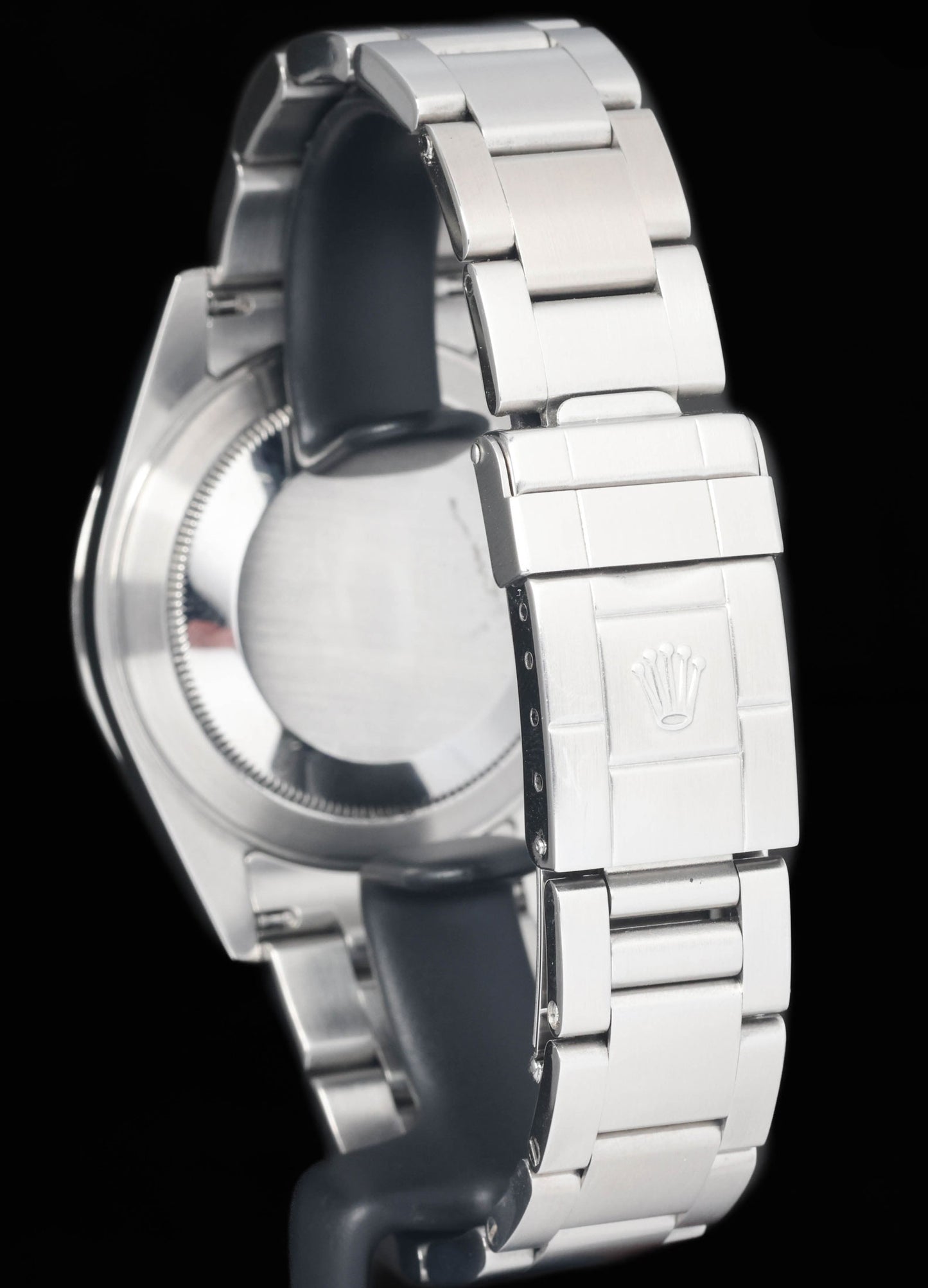
The Oyster bracelet is also in excellent condition, with minimal stretch and only the faintest signs of wear consistent with careful handling. The clasp retains its correct coronet engraving and original brushed texture.
The dial and hands are flawless, showing no marks, discolouration, or ageing. The lume plots are clean and evenly coloured, and the red 24-hour hand remains vivid. Overall, this is a superb and exceptionally well-preserved example of the Explorer II 16570, showing minimal evidence of use and remaining true to its original factory finish.
Share
Why we love this watch
Why we love this watch
White Dial, No Compromise: The Rolex Explorer II 16570 Polar
There are two ways to wear a Rolex Explorer II 16570, and they produce two entirely different watches. The black dial version is the expected choice: sporting, legible, in keeping with the broader visual language of Rolex's professional tool watch range. The Polar white dial is something else. It is quieter in some respects and more commanding in others, presenting the Explorer II's architecture against an off-white background that shifts the watch's character entirely without altering a single mechanical component. A 2004 example of the 16570 in Polar white is a late-production piece from one of the most capable references Rolex built during the modern era, wearing a dial configuration that has attracted a collector following entirely disproportionate to the attention the reference receives in the broader market.
Rolex and the Foundations of the Explorer Programme
Rolex was founded in London in 1905 by Hans Wilsdorf and Alfred Davis before relocating to Geneva in 1919 following the imposition of British wartime import tariffs that made the existing operation commercially untenable.¹ The company's earliest engineering focus was on waterproofing and precision, producing the Oyster case in 1926 and the Perpetual self-winding rotor in 1931, two innovations that established Rolex as the defining manufacturer of robust, self-sufficient mechanical wristwatches.²
The Explorer name arrived in 1953, attached to the reference worn by Edmund Hillary and Tenzing Norgay on the first confirmed ascent of Everest.³ The association between Rolex and high-altitude exploration was not manufactured retrospectively: the watches had been issued to the expedition precisely because their reliability in extreme cold and low-pressure environments had been demonstrated in prior testing. The Explorer line that followed carried that provenance directly, and the professional credibility it established gave Rolex the authority to develop increasingly specialised tool references in the decades that followed.
The Explorer II was conceived in 1971 as reference 1655, addressing a problem that had nothing to do with mountains.⁴ Speleologists working in cave systems and scientists stationed in polar regions during continuous daylight or darkness had no reliable way of distinguishing AM from PM on a standard 12-hour dial. The 1655's answer was a fixed 24-hour graduated bezel and a bold 24-hour hand that completed one rotation per day, making the distinction between morning and afternoon explicit and immediate.⁵ The reference that resulted, known to collectors as the Freccione for the large arrow of its 24-hour hand, established a design logic that the 16570 would carry forward and refine across more than two decades of production.
The 16570 replaced the transitional reference 16550 in 1989, bringing with it the calibre 3185 and a fundamental functional upgrade: the 24-hour hand could now be set independently of the main timekeeping train, transforming the Explorer II from a single-timezone AM and PM indicator into a genuine dual-timezone instrument.⁶ The watch that had been designed for geologists working underground was now equally suited to a transatlantic traveller tracking two time zones simultaneously. The brief had expanded without the original purpose being compromised.
Technical Specifications of the Rolex Explorer II 16570
Case and Construction
The 16570 is housed in Rolex's Oyster case at 40mm in diameter, with a case thickness of approximately 13mm and water resistance rated to 100 metres via the screw-down Triplock crown system.⁷ The case material is 904L stainless steel, a grade selected by Rolex for its exceptional resistance to corrosion and oxidation and its capacity to maintain a high surface finish under normal wear conditions.⁸ The combination of brushed and polished surfaces across the case is executed with the precision that characterises all Rolex Oyster cases of this period, and examples that have avoided workshop polishing retain the original geometry of the lug profiles and case flanks in a way that polished equivalents cannot.
The bezel is fixed and engraved with a 24-hour scale running from 1 to 24, filled with black paint on the white dial variant in a manner that produces strong contrast against the bezel surface.⁹ The decision to use a fixed rather than rotating bezel reflects the Explorer II's operational history: in a cave environment, a rotating bezel that could be displaced accidentally is a liability rather than a feature, and the fixed design ensures the 24-hour reference is always where it should be. The caseback is solid and unadorned, carrying standard Oyster reference and serial information on the inner surface.
Movement
The 2004 Rolex Explorer II 16570 is powered by the calibre 3185, a self-winding movement beating at 28,800 vibrations per hour with a power reserve of approximately 48 hours.¹⁰ The 3185 is derived from the calibre 3135 architecture, one of the most extensively tested and widely respected movements in modern Swiss watchmaking, modified to incorporate the GMT complication that drives the independently settable 24-hour hand. The movement features Rolex's Parachrom hairspring, produced in-house from a paramagnetic niobium-zirconium alloy that offers substantially greater resistance to magnetic fields and mechanical shock than a conventional steel hairspring.¹¹
Regulation is achieved through a free-sprung variable inertia balance wheel adjusted via gold Microstella nuts, a system that allows precise rate setting without the long-term drift associated with traditional lever regulators.¹² The calibre 3185 carries COSC chronometer certification, independently tested to run within plus five and minus two seconds per day across multiple positions and temperatures, before Rolex applies its own additional testing criteria prior to casing.¹³ The 24-hour hand is set via the crown in its second position, operating independently of both the date adjustment in the first position and the main time setting in the third, a three-step crown operation that defines the 16570's practical use.
The Polar Dial: Construction and Character
The Polar white dial fitted to a 2004 16570 is a flat panel in an off-white tone, carrying applied white gold hour markers with SuperLuminova lume fills and a printed outer minute track in black.¹⁴ Rolex completed its transition from tritium to LumiNova-based compounds across its sports reference range through the mid-to-late 1990s, and a 2004 example carries SuperLuminova throughout, a compound that does not age or patinate in the manner of tritium but charges reliably and emits a consistent blue-toned glow in darkness.
The applied hour markers read differently against the Polar background than they do on the black dial. Against white, the white gold edges of the markers produce a subtler contrast that emphasises the three-dimensionality of the applied indices rather than their luminosity against a dark field. The effect is a dial that rewards close examination in a way the black version does not, with the depth and construction of the individual markers more immediately apparent. The printed text, carrying the standard Explorer II hierarchy of "OYSTER PERPETUAL DATE / EXPLORER II" above and "SUPERLATIVE CHRONOMETER / OFFICIALLY CERTIFIED" below, reads cleanly in black against the off-white background.¹⁵
The hands follow the standard Mercedes configuration of the Explorer II range, with the 24-hour hand finished in orange, a detail that on the Polar dial produces a more pronounced visual contrast than on the black dial given the lighter background.¹⁶ The orange hand against white creates a clarity of reading that is arguably superior to the black dial configuration in certain lighting conditions, particularly in the diffuse, low-contrast light of overcast environments, which is precisely the kind of light a polar researcher or cave explorer might expect to encounter when emerging from an extended period underground or indoors.
The Polar Dial in the Context of the 16570 Production Run
The white dial variant of the 16570 has been produced alongside the black dial throughout the reference's production life, but in meaningfully smaller numbers.¹⁷ The black dial has always been the default choice for buyers approaching the Explorer II as a sports or travel watch, and the Polar's relative scarcity in the secondary market is a direct consequence of lower initial sales volume rather than any deliberate limitation on Rolex's part. This has created a situation familiar to experienced collectors: the less commercially obvious choice at point of sale has become the more sought-after variant in retrospect.
A 2004 example carries an F-series or V-series serial number, corresponding to Rolex production records for the 2003 to 2005 period.¹⁸ By this point in the 16570's lifespan, the reference had been in production for fifteen years and would continue for a further seven before being replaced by the 216570 in 2011. A 2004 Polar dial example therefore sits in the settled, mature phase of the reference's production, with the specification fully resolved and the manufacturing tolerances consistent, but with the 40mm case dimension that the reference would retain for only seven further years before Rolex's enlargement of the Explorer II to 42mm closed the chapter on the original proportions.
The Case for 40mm
The transition to 42mm that accompanied the introduction of the reference 216570 in 2011 was not universally welcomed, and the collector argument in favour of the 16570's original proportions has only strengthened in the years since.¹⁹ The Explorer II's design elements, the fixed 24-hour bezel, the applied hour markers, the bold GMT hand, were conceived and balanced for a 40mm case, and the relationship between those elements at that diameter produces a composition that is difficult to improve. On a 42mm case, the same elements read differently: the bezel graduation is more widely spaced, the dial proportions shift, and the watch's character moves perceptibly toward the assertive rather than the purposeful.
The preference for 40mm is not simply nostalgia. It is a genuine design argument that the 16570 makes on the wrist, and the Polar dial variant makes it particularly clearly. The off-white dial at 40mm produces a watch that is visually present without being physically imposing, and the combination of the white background, the orange GMT hand, and the restrained case proportions gives the 16570 Polar a wearability across different contexts that the larger 216570 and its successors cannot fully replicate.²⁰
The Explorer II Among Its Contemporaries
Placing the 16570 against the other dual-timezone references in Rolex's early 2000s catalogue clarifies what makes it distinct. The GMT-Master II 16710, produced concurrently and sharing the calibre 3185, addresses the same fundamental need for dual-timezone readability through an entirely different mechanical and visual approach: a rotating 24-hour bezel that can be aligned independently to indicate a third timezone, combined with the colour-coded bezel insert that became the reference's most recognisable feature.²¹ The GMT-Master II's rotating bezel is more flexible in theory, allowing multi-timezone tracking without touching the crown, but it introduces the possibility of accidental displacement that the Explorer II's fixed bezel eliminates entirely.
The choice between the two references has historically been framed as a question of character rather than capability, and that framing is accurate. The GMT-Master II is the more visually prominent reference, its colour variants and strong collector associations giving it a market profile that the Explorer II has never matched in volume terms.²² The Explorer II's comparative underrepresentation in the popular conversation about Rolex sports references is precisely what makes a 2004 Polar dial example compelling to the collector who prioritises substance over profile. It is a technically equivalent watch, housed in the same steel, powered by the same movement, but carrying a design rationale and an aesthetic character that have attracted a quieter and more considered following.
Final Thoughts
The 2004 Rolex Explorer II 16570 in Polar white is the product of a design logic that has never been improved upon. Every element of the watch, the fixed 24-hour bezel, the independently settable GMT hand, the 40mm case, the off-white dial that sets it apart from every other reference in the Rolex sports catalogue, exists for a reason that predates any collector conversation. It was built to be used in environments where a standard watch would fail the task, and it was built in proportions that have only grown more considered with the passage of time.
What the secondary market has confirmed in the years since the 16570's 2011 discontinuation is that the Polar dial variant occupies a position that no subsequent reference has filled. The 216570 that replaced it is a capable watch, but it is a different watch, larger in case, different in proportion, and further removed from the original Explorer II brief in ways that matter to anyone who has spent time understanding the reference. The 40mm Polar dial in late production, carrying the calibre 3185 in its most resolved form, represents the 16570 at its peak. That combination will not be produced again, and the market has begun to price that fact accordingly.
References
- Rolex SA, The History of Rolex, official corporate history, rolex.com.
- Dowling, J. and Hess, J., The Best of Time: Rolex Wristwatches, Schiffer Publishing, 1996.
- Rolex SA, Rolex and Exploration, official editorial archive, rolex.com.
- Patrizzi, O., Rolex Wristwatches, Antiquorum Editions, 1999.
- Maran, A., Rolex Explorer and Explorer II, Schiffer Publishing, 2014.
- Rolex SA, reference 16570 technical specification, archived production documentation.
- Rolex SA, Oyster case dimensional records, archived.
- Rolex SA, materials technical documentation, rolex.com/en/rolex-technology/materials.
- Patrizzi, O., Rolex Wristwatches, Antiquorum Editions, 1999.
- Rolex calibre 3185 specification, Swiss Federal Institute of Intellectual Property records.
- Rolex SA, Parachrom hairspring technical documentation, rolex.com.
- Cutmore, M., Watches 1850-1980, David & Charles, 2002.
- COSC, official chronometer certification criteria, cosc.ch.
- Rolex SA, luminescence compound transition documentation, archived service records.
- Rolex serial and dial dating reference, Rolex Collectors Forum, rolexforums.com.
- Maran, A., Rolex Explorer and Explorer II, Schiffer Publishing, 2014.
- Altieri, G., The Polar Dial: Explorer II's Overlooked Variant, Hodinkee, 2020.
- Serial number dating reference, Bobs Watches vintage Rolex database, bobswatches.com.
- Altieri, G., The Explorer II Argument: 40mm vs 42mm, Hodinkee, 2019.
- Phillips Watches, Geneva Watch Auction catalogues, 2018-2024, phillips.com/watches.
- Maran, A., Rolex GMT-Master and GMT-Master II, Schiffer Publishing, 2013.
Phillips Watches, Geneva Watch Auction catalogues, 2018-2024, phillips.com/watches.
Case & Bracelet
Case & Bracelet
- Case in good unpolished condition, visible wear.
- Bracelet in good condition, some stretch & wear visible.
Dial & Hands
Dial & Hands
Dial & hands flawless.
Warranty & Condition
Warranty & Condition
Crown Vintage Watches provides a minimum 6-month mechanical warranty on pre-owned watches, from the date of purchase.
The warranty covers mechanical defects only.
The warranty does not cover damages such as scratches, finish, crystals, glass, straps (leather, fabric or rubber damage due to wear and tear), damage resulting from wear under conditions exceeding the watch manufacturer’s water resistance limitations, and damage due to physical and or accidental abuse.
Please note, water resistance is neither tested nor guaranteed.
Shipping and insurance costs for warranty returns to us must be covered by the customer. Returns must be shipped via traceable courier. Return shipment must be pre-paid and fully insured. Collect shipping will be refused. In case of loss or damages, the customer is liable.
Our Pledge
At Crown Vintage Watches, we stand by the authenticity of every product we sell. For added peace of mind, customers are welcome to have items independently authenticated at their own expense.
Condition
Due to the nature of vintage timepieces, all watches are sold as is. We will accurately describe the current condition and working order of all watches we sell to the best of our ability.
Shipping & Refund
Shipping & Refund