

Crown Vintage
Rolex GMT Master 1675 Pepsi 'Mk 2' 40mm 1971
Rolex GMT Master 1675 Pepsi 'Mk 2' 40mm 1971
Couldn't load pickup availability
Rolex GMT Master 1675 Pepsi 'Mk 2' 40mm 1971
Case and Bracelet
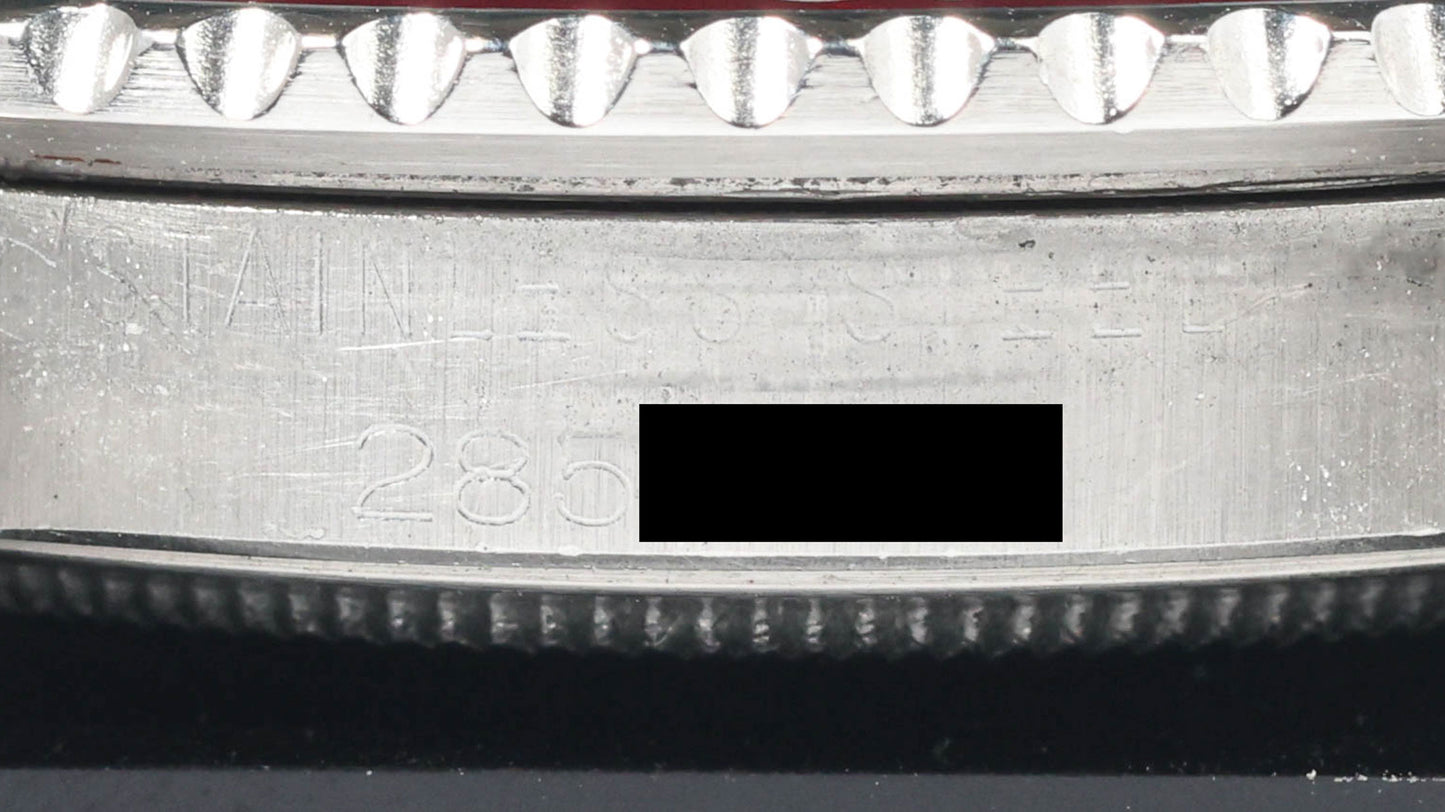
The stainless steel Oyster case presents in good vintage condition, holding its forty-millimetre proportions well, with light hairlines visible across the surfaces consistent with age and ordinary wear over five decades. The crown guards and lug profiles remain clearly defined, and the acrylic crystal sits cleanly over the dial. The bracelet is in good condition and wears comfortably, with some stretch visible across the links, a characteristic trait of vintage Rolex bracelets from this period that comes from years of regular wear rather than any fault in the watch itself.
Dial and Hands
The matte black Mark 2 dial is in very nice condition, with the bold, squared printing of this variant intact and the surface free of any distracting marks. The dial and hands carry a strong, matching patina, the aged tritium having warmed to a consistent honey tone across the hour markers and the Mercedes handset. That the lume on the dial and the hands has aged in step is exactly what you want to see on an example of this age, and it leaves the watch highly legible while giving it the settled, even character that only comes with time.
Chronometry
Chronometry was carried out on the Witschi WAIO across four positions. The calibre 1575 is chronometer-certified, so its results are read against the COSC mean daily rate tolerance of minus four to plus six seconds per day. The movement returned a mean daily rate of plus 3.0 seconds per day, sitting comfortably within that tolerance and representing good timekeeping for a movement now more than fifty years old. The dial-down position ran the fastest at plus 10.4 seconds per day and the six-up position the slowest at minus 5.1, giving a positional spread of 15.5 seconds per day, a degree of positional variance that is normal for a vintage movement of this age. Beat error was excellent throughout, between 0.1 and 0.4 milliseconds, which points to a well-centred pallet fork and a healthy escapement. Amplitude averaged 249.2 degrees, holding around 257 to 262 degrees in the flat positions and easing to roughly 235 to 243 degrees in the vertical positions, a consistent pattern that reflects a sound mainspring and gear train. The movement was demagnetised prior to testing.
Use Advisory
As this watch is over 30 years old, it should be treated as a vintage timepiece.
Share
Why we love this watch
Why we love this watch
A folded-link Oyster bracelet, a bold-fonted Mark 2 dial and a hacking Calibre 1575 place this 1971 GMT-Master squarely in the most settled phase of the reference's two-decade production run.
A Tool Watch Built for the Jet Age
The GMT-Master story begins not with this reference but with its predecessor, the 6542, a pioneering dual-time watch developed for Pan Am pilots navigating the newly opened skies of the jet age. By 1959 Rolex had moved on to the reference 1675, which represented a complete re-design of the GMT, both inside and out. Where the 6542 had shared its case with the Turn-O-Graph, the 1675 received a new 40mm case that now featured crown guards for a larger and more robust overall appearance.
The 1971 Movement Update
By the time this particular example left the factory, Rolex had just introduced one of the most practical refinements in the reference's history. In 1971, Rolex enhanced the Caliber 1575 with the hacking feature, meaning that the seconds hand comes to a complete stop when the winding crown is pulled out, allowing the wearer to set the time to the second against a reference signal. The Calibre 1575 itself had replaced the earlier 1565 around the middle of the previous decade, bringing with it a slightly longer 48-hour power reserve and a higher operating frequency. The 1575 operates at 19,800 beats per hour, has 26 jewels, and measures 6.30mm in height by 28.50mm in diameter, a movement architecture that traces its lineage back to the calibre 1530.
The Mark 2 Dial
Dial study is where the 1675 rewards close attention, and the Mark 2 is one of the more clearly defined chapters in that story. The Mark 2 dial is well balanced and easily identified by the bold thickness of its font, with the Rolex printing thicker and the letters more square than the wider lettering found on other matte dials. The dial fell within a serial range running roughly from the high 2 million to the high 3 million series, which corresponds neatly with case numbers produced in the early 1970s, including 1971.
From Glossy Gilt to Matte Radial
This dial generation represents the settled endpoint of a visual evolution that had been underway since the watch's introduction. Early models from the 1960s featured glossy gilt dials, radium or early tritium lume, pointed crown guards, and chapter rings circling the dial's edge, hallmarks of Rolex's pre-professional aesthetic. As the decade progressed, the triangular-tipped GMT hand was enlarged for better legibility, crown guards became more rounded, and by around 1968 the glossy dials gave way to matte black dials with white printing. By 1971, that matte radial format, with its bold Mark 2 typography and creamy-aging tritium plots, had become the standard face of the reference.
The Pepsi Bezel
The red and blue bezel insert fitted to this example carries its own piece of aviation history. The colour pairing was originally intended as a nod to the company colours of Pan Am Airlines, and by 1971 it sat alongside a newly introduced alternative. By 1971, Rolex had started offering the option of an all-black bezel insert, instead of the traditional red and blue insert, which makes the persistence of the Pepsi configuration on this watch a continuation of the GMT-Master's founding visual identity rather than the only option available to a buyer that year.
Case and Bracelet
The case architecture introduced with the 1675 remains one of its most significant contributions to the GMT-Master lineage. To accommodate the new shoulders flanking the winding crown, the case grew by 2mm, clocking in at 40mm in diameter, the first time crown guards had appeared on a GMT-Master at all. The bracelet fitted to examples from this period reflects another transitional moment in Rolex's bracelet supply. The Oyster rivet bracelet transitioned to an Oyster folded link 7836 bracelet with 280 end links around 1970, before moving to 380 end links shortly after, circa 1971 to 1972, placing a folded-link configuration squarely within the expected fitment for a watch of this date.
Final Thoughts
The 1971 GMT-Master 1675 occupies a settled middle chapter in a reference that ran for two decades and absorbed more change than almost any other Rolex sports model of its era. Production of the 1675 lasted 21 years, the longest run of any GMT-Master reference, and the configuration seen here, hacking Calibre 1575, Mark 2 dial, folded-link bracelet and Pepsi bezel, represents the reference at the point where its design language had matured into the form most associated with the model today. It is this combination of mechanical refinement and visual continuity that defines the GMT-Master of 1971.
References
- Craft + Tailored, "The Quintessential Vintage Classic: The Reference 1675 Rolex GMT-Master"
- Gray & Sons, "The History and Evolution of the Rolex GMT-Master"
- Bob's Watches, "Rolex 1675 GMT-Master Co-Branded Dials"
- Vintage Watch Collective, "1971 Rolex GMT-Master Ref. 1675 MK1 'Long E' Dial"
- Wind Vintage, "Collector's Guide: The Rolex GMT-Master Reference 1675 in Steel"
- Bob's Watches, "Rolex GMT-Master 1675 Radial Dial"
- Andrea Piccinini, "A Comprehensive Guide to the Rolex GMT Master 1675 with Radial Dial"
- GMTMaster1675.com, "Mark 2 — Rolex GMT Master 1675"
Case & Bracelet
Case & Bracelet
- Case in great vintage condition, light hairlines visible.
- Sharp lugs with factory brushing still visible
- Bracelet in excellent condition with little to no stretch visible.
Dial & Hands
Dial & Hands
Dial & hands great condition.
Warranty & Condition
Warranty & Condition
Crown Vintage Watches provides a minimum 6-month mechanical warranty on pre-owned watches, from the date of purchase.
The warranty covers mechanical defects only.
The warranty does not cover damages such as scratches, finish, crystals, glass, straps (leather, fabric or rubber damage due to wear and tear), damage resulting from wear under conditions exceeding the watch manufacturer’s water resistance limitations, and damage due to physical and or accidental abuse.
Please note, water resistance is neither tested nor guaranteed.
Shipping and insurance costs for warranty returns to us must be covered by the customer. Returns must be shipped via traceable courier. Return shipment must be pre-paid and fully insured. Collect shipping will be refused. In case of loss or damages, the customer is liable.
Our Pledge
At Crown Vintage Watches, we stand by the authenticity of every product we sell. For added peace of mind, customers are welcome to have items independently authenticated at their own expense.
Condition
Due to the nature of vintage timepieces, all watches are sold as is. We will accurately describe the current condition and working order of all watches we sell to the best of our ability.
Shipping & Refund
Shipping & Refund