

Crown Vintage
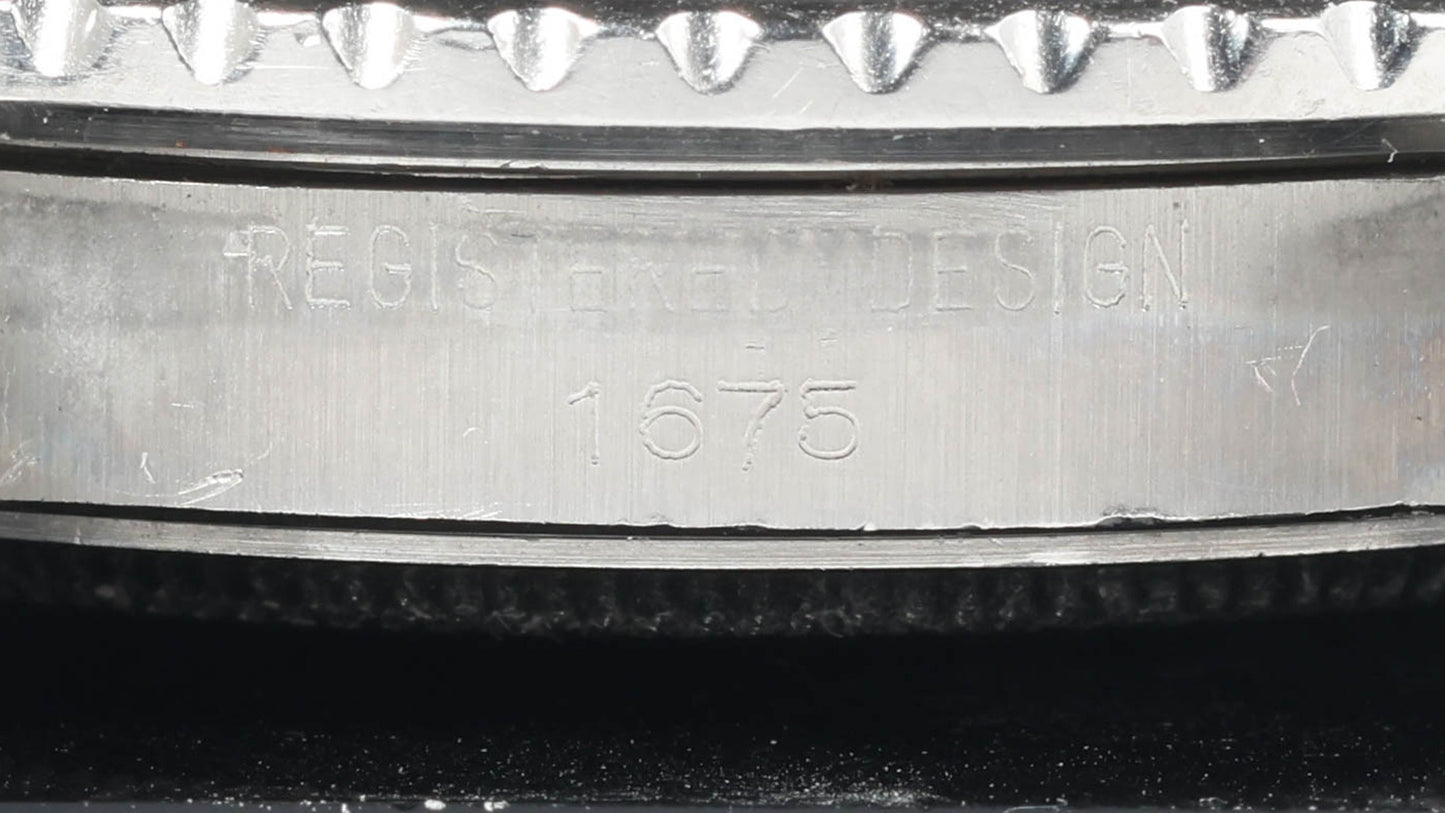
Rolex GMT Master 1675 Pepsi 'Mk 2' 40mm 1971
Rolex GMT Master 1675 Pepsi 'Mk 2' 40mm 1971
Couldn't load pickup availability
Rolex GMT Master 1675 Pepsi 'Mk 2' 40mm 1971
The stainless steel Oyster case presents in good vintage condition, holding its forty-millimetre proportions well, with light hairlines visible across the surfaces consistent with age and ordinary wear over five decades. The crown guards and lug profiles remain clearly defined, and the acrylic crystal sits cleanly over the dial. The bracelet is in good condition and wears comfortably, with some stretch visible across the links, a characteristic trait of vintage Rolex bracelets from this period that comes from years of regular wear rather than any fault in the watch itself.
The matte black Mark 2 dial is in very nice condition, with the bold, squared printing of this variant intact and the surface free of any distracting marks. The dial and hands carry a strong, matching patina, the aged tritium having warmed to a consistent honey tone across the hour markers and the Mercedes handset. That the lume on the dial and the hands has aged in step is exactly what you want to see on an example of this age, and it leaves the watch highly legible while giving it the settled, even character that only comes with time.
Share
Why we love this watch
Why we love this watch
Stop-Seconds and Square Letters: The 1971 GMT-Master 1675 in Pepsi
When Rolex added a hacking seconds mechanism to the calibre 1575 in 1971, the GMT-Master 1675 quietly crossed a mechanical threshold, and an example from that year wearing the squared, closely set coronet now designated the Mark 2 dial sits exactly on it. A 1971 1675 in Pepsi is therefore two stories at once, a movement caught in the act of gaining its stop-seconds function, and a matte dial in the middle of its own slow evolution. Neither detail announces itself from across a room. Both reward the kind of close looking that the reference has invited for more than six decades.
This is a watch defined less by a single dramatic feature than by the precise moment in its long production run that it represents. To understand why a 1971 Mark 2 holds its particular place, it helps to start where the GMT-Master itself began.
An Answer to the Jet Age
The GMT-Master was not conceived as a luxury object. It was a tool built to solve a specific problem created by a specific era. As long-haul jet travel became routine in the early 1950s, the crews flying transatlantic and transpacific routes needed to read more than one time zone at a glance. Pan American World Airways, then the most prominent name in international aviation, approached Rolex for a watch that could show home time and local time together. The result, the reference 6542, arrived in the middle of the decade and established the template that every GMT-Master since has followed.
The mechanism was elegant in its simplicity. A fourth hand made a single rotation every twenty-four hours rather than every twelve, and it was linked to the standard hour hand. The wearer set local time on the conventional hands, then turned a graduated twenty-four-hour bezel until its numerals lined up with that fourth hand to read a second zone. The bezel was split into two colours, red for the daytime hours and blue for the night, a practical day and night indicator that also gave the watch the look it is still known for. The first 6542 carried a Bakelite bezel and wore no crown guards, and it went to Pan Am crews as something close to standard issue.
That original design had its vulnerabilities. The early bezel material was fragile, and the case offered no protection for the winding crown. When Rolex set out to make the GMT-Master more durable, it produced the reference that would carry the line for the next two decades.
How the 1675 Refined the Template
Rolex introduced the reference 1675 in 1959, and it brought the first meaningful structural change to the GMT-Master. This was the first model in the line to feature crown guards, the small flanks of steel that shield the winding crown on either side. The case grew to the forty-millimetre Oyster proportions that have stayed with the GMT-Master ever since, with a screw-down crown and a threaded case back that give the Oyster its water resistance. An aluminium bezel insert replaced the brittle early material, and the dial text was updated to read Superlative Chronometer Officially Certified, marking the chronometer rating of the movements inside.
The 1675 ran from 1959 to 1980, the longest production span of any GMT-Master, and that longevity is the source of its enormous internal variety. Over twenty-one years the dials, bezels, crown guards, hands, movements and bracelets all changed, sometimes more than once. A 1971 example is a snapshot of one narrow band within that run, and almost every component on it can be placed on a timeline of its own.
From Calibre 1565 to 1575
The earliest 1675s were powered by the calibre 1565, an automatic movement beating at eighteen thousand vibrations per hour and carrying the date function that the GMT layout required. Around 1965 Rolex replaced it with the calibre 1575, which ran at a higher nineteen thousand eight hundred vibrations per hour and offered a power reserve in the region of forty-eight hours. The two movements were closely related, with the 1575 representing a refinement rather than a clean-sheet redesign, and both were chronometer certified.
By 1971 the 1575 was well established as the reference's movement, and it would remain so until the end of production. What it lacked, in its early form, was the ability to stop the seconds hand when the crown was pulled. That changed in the very year our example was made.
The 1971 Hacking Update
Around 1971 Rolex modified the calibre 1575 to add a hacking, or stop-seconds, function. With this update, pulling the crown out to set the time brought the seconds hand to a complete halt, allowing the watch to be synchronised precisely to a time signal before the crown was pushed back in. It is a small convenience, and on the wrist it changes nothing about how the watch looks. As a marker of date, though, it is unusually clean. A 1675 made in 1971 sits right at the introduction of this feature, which is part of what makes a watch from this year a genuine transitional piece rather than a settled, late-run example.
This is the mechanical reason the year matters. The calibre 1575 that emerged from this point onward, complete with its hacking seconds, carried the GMT-Master 1675 unchanged through to the close of its run at the end of the decade.
Reading the Mark 2 Dial
If the movement places a 1971 1675 on a mechanical timeline, the dial places it on a visual one. The matte dials of the 1675 have been studied and grouped into a sequence of variants, and the differences between them come down to typography, the shape of the coronet, and the texture of the printed surface rather than anything as obvious as colour.
From Gilt to Matte
For its first years the 1675 wore glossy lacquered dials with gilt, or gold-coloured, printing, surfaces that catch the light and glow warmly against the black. Around 1966 Rolex began fitting matte dials with flat white printing instead. No official explanation for the change was ever published, and the matte dials went on to account for the bulk of the reference's production from the late 1960s through to 1980. They suit the GMT-Master's identity as an instrument. The flat black surface kills reflections, and the crisp white text reads cleanly in any light, which is exactly what a working pilot's watch was meant to do.
A 1971 dial is firmly a matte dial, and within the matte family it belongs to one of the earlier groupings.
What Sets the Mark 2 Apart
The variant designated the Mark 2 is identified by the weight and shape of its printing. The lettering of the word Rolex is notably thick and bold, and the individual letters are squarer than on most other matte dials, which tend to be wider than they are tall. The clearest tell is the spacing within the brand name, where the L and the E of Rolex sit closer together than the other letters, a quirk that becomes easy to spot once you know to look for it. The coronet above the text echoes the shape seen on the very earliest matte dials, and the lume on the markers lies flat rather than carrying the waffled texture of certain late examples that preceded it.
The Oyster Perpetual and chronometer lines beneath retain heavier serifs carried over from the preceding dial. Taken together, these are the marks of a dial whose proportions feel solid and balanced. The Mark 2 is generally seen on cases from roughly the late 1960s serial ranges into the early and middle part of the 1970s, which places a 1971 example comfortably within its window.
The Pepsi Bezel and a Look That Stuck
The red and blue bezel insert is the single most recognisable thing about the GMT-Master, and the nickname Pepsi attached itself to the watch because those two colours echo the livery of the cola brand. The colour split was never decorative for its own sake. The red half marks the daytime hours and the blue half marks the night, so the bezel doubles as an at-a-glance day and night reference for the second time zone being tracked. Of all the insert combinations the 1675 was offered with over the years, the red and blue Pepsi is the most consistent presence across the whole production run.
Aluminium bezel inserts age in their own way. The anodised colour can soften and fade with exposure to light and wear, and the two halves rarely fade at the same rate, so a vintage Pepsi insert often shows one colour holding its tone more strongly than the other. That uneven, sun-touched quality is part of what gives an individual vintage GMT-Master its character, since no two inserts wear down along quite the same path.
A 1971 GMT-Master in the Hand
On the wrist a 1971 1675 reads as compact by modern standards, even though its forty-millimetre case was generous for its day. The acrylic crystal sits slightly domed over the dial and carries the Cyclops lens over the date aperture at three o'clock, a feature Rolex had standardised across its date models. Acrylic warms and softens the way light meets the dial in a way that later sapphire crystals do not, and it is one of the quiet pleasures of a watch from this period.
By 1971 the handset had settled into the form most associated with the vintage GMT-Master, with the Mercedes hour hand and the larger, more legible twenty-four-hour hand that had replaced the slender early version. Through this part of the run the reference was supplied on a folded-link Oyster bracelet or, alternatively, the five-piece Jubilee, both in steel, with the more substantial solid-link bracelets arriving later in the decade. Whichever it wore, the watch carried the balance of a purpose-built instrument rather than a dress piece, which is precisely what it was designed to be.
Final Thoughts
What makes a 1971 GMT-Master 1675 in Pepsi worth dwelling on is not a single headline feature but the way the year ties several threads together. The calibre 1575 had just gained its hacking seconds, marking a clear point on the movement's own timeline. The matte dial had moved on from its first iterations into the bold, square-lettered form designated the Mark 2. The Pepsi bezel, by then more than fifteen years into its life, carried the same red and blue logic that the original Pan Am tool watch had introduced in the middle of the 1950s.
A watch like this rewards attention to detail because every detail has a place in a long and well-documented story. The reference 1675 ran for twenty-one years and changed continually as it went, and a 1971 Mark 2 captures one specific, legible moment in that evolution. It is the GMT-Master doing what it has always done, telling two times at once, while quietly recording the time of its own making in the shape of its letters and the mechanism behind its dial.
References
1. Wind Vintage, Collector's Guide: The Rolex GMT-Master Reference 1675 in Steel, windvintage.com.
2. gmtmaster1675.com, The Movement, Mark 2, and Matte Dials reference pages, gmtmaster1675.com.
3. Craft and Tailored, The Quintessential Vintage Classic: The Reference 1675 Rolex GMT-Master, journal.craftandtailored.com.
4. Monochrome, In-Depth: The History of the Rolex GMT-Master and GMT-Master II (1955 to 2024), monochrome-watches.com.
5. Revolution, Rolex GMT-Master, A Brief History, revolutionwatch.com.
6. Bob's Watches, The Rolex GMT-Master Reference 6542 and Rolex GMT-Master History, bobswatches.com.
7. Italian Watch Spotter, Vintage Rolex GMT-Master: The Complete Guide, italianwatchspotter.com.
Case & Bracelet
Case & Bracelet
- Case in good vintage condition, light hairlines visible.
- Bracelet in good condition with some stretch visible.
Dial & Hands
Dial & Hands
- Dial & hands very nice condition
- Matching strong patina
Warranty & Condition
Warranty & Condition
Crown Vintage Watches provides a minimum 6-month mechanical warranty on pre-owned watches, from the date of purchase.
The warranty covers mechanical defects only.
The warranty does not cover damages such as scratches, finish, crystals, glass, straps (leather, fabric or rubber damage due to wear and tear), damage resulting from wear under conditions exceeding the watch manufacturer’s water resistance limitations, and damage due to physical and or accidental abuse.
Please note, water resistance is neither tested nor guaranteed.
Shipping and insurance costs for warranty returns to us must be covered by the customer. Returns must be shipped via traceable courier. Return shipment must be pre-paid and fully insured. Collect shipping will be refused. In case of loss or damages, the customer is liable.
Our Pledge
At Crown Vintage Watches, we stand by the authenticity of every product we sell. For added peace of mind, customers are welcome to have items independently authenticated at their own expense.
Condition
Due to the nature of vintage timepieces, all watches are sold as is. We will accurately describe the current condition and working order of all watches we sell to the best of our ability.
Shipping & Refund
Shipping & Refund