

Crown Vintage
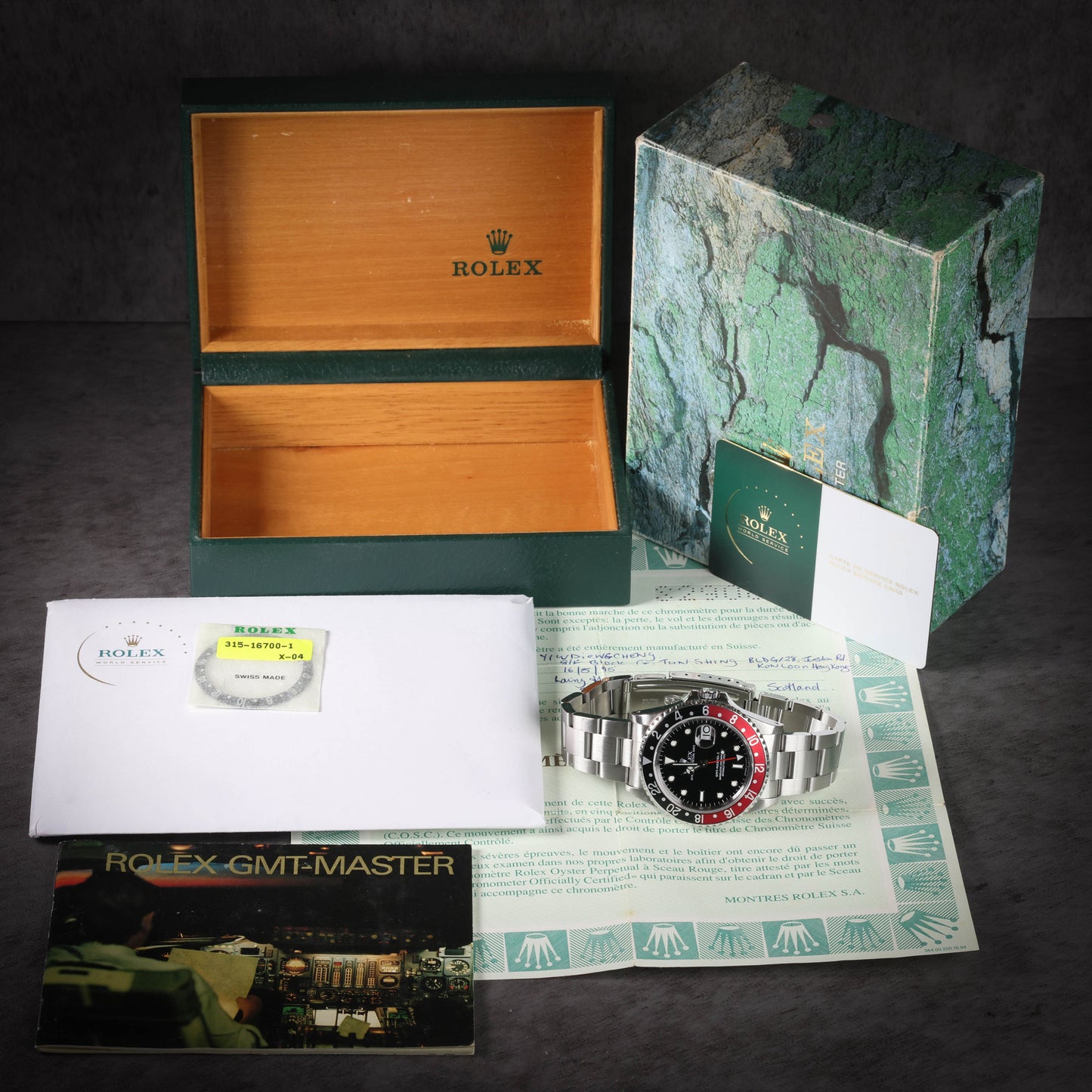
Rolex GMT Master II 'Coke' 16710 40MM 1993 Box & Papers
Rolex GMT Master II 'Coke' 16710 40MM 1993 Box & Papers
Couldn't load pickup availability
Rolex GMT Master II 'Coke' 16710 40MM 1993 Box & Papers
This Rolex GMT-Master II 16710 40mm (1993), offered with box and papers, is presented in very good overall condition. The stainless steel case remains well defined, showing some visible wear consistent with age and careful use, including light surface marks, but no major wear or structural issues. The proportions remain correct, and the watch retains a strong vintage presence on the wrist.
This 1993 Rolex GMT Master II was serviced by the Japanese Rolex Service Centre in 2024. This included a Full Overhaul Service, replacement of the crystal, crown tube & gaskets.
The bracelet is in excellent condition, exhibiting minimal stretch and maintaining tight articulation between the links. The clasp operates securely and aligns well with the overall condition of the watch.
The dial and hands are in very good condition, with clean printing, strong legibility. Overall, this GMT-Master II represents a well-preserved example from the early-1990s.
Share
Why we love this watch
Why we love this watch
The Colour Rolex Built for the GMT-Master II: The Rolex GMT-Master II Reference 16710 Coke (1993)
The red-and-black bezel on this 1993 Rolex GMT-Master II reference 16710 wears a colour scheme that Rolex did not inherit from a 1950s aviation watch but invented for the GMT-Master II itself, when the very first watch to carry that name, the 1983 reference 16760, arrived in red and black and nothing else. The 16710 that followed offered three bezel choices, yet the "Coke" combination remained the one tied directly to the birth of the dual-time complication rather than to the older single-hand GMT. Produced continuously from 1989 to 2007, the reference 16710 carried the second-generation GMT-Master II through nearly two decades of measured refinement while preserving the functional clarity that had defined the model since 1954. This 1993 example, presented with its original box and papers, shows the reference in one of its most complete early forms: a tritium dial, drilled lugs, hollow end links, and the red-and-black Coke bezel insert.
A Watch Born from Aviation
The Pan Am Commission and Reference 6542
The GMT-Master line traces its origins to a direct commission from Pan American Airways. In the early 1950s, with long-haul commercial jet travel approaching on a large scale, Pan Am's management sought a wristwatch that could help pilots and flight crews track two time zones at once. The practical need was clear: on transoceanic routes, crew members required both their home reference time and local destination time to be readable at a glance without calculation.
Rolex answered in 1954 with the reference 6542, a 38mm Oystersteel watch fitted with a fourth hand that completed one full rotation every 24 hours, and a bi-directional rotating bezel marked in two colours to separate day from night hours. That first reference wore a blue-and-red insert, the pairing later nicknamed "Pepsi." Pan Am formally adopted the GMT-Master as the official timepiece for its flight crews, and the partnership between airline and manufacturer became one of the most recognised in twentieth-century watchmaking.
The reference 6542's original bezel insert was produced in Bakelite, an early synthetic material resistant to pressure and heat but prone to cracking under lateral impact. By 1956, Rolex had moved to anodised aluminium inserts, which proved far more durable under daily professional use. The commercially released 6542 used a modified version of the base calibre 1030, designated calibre 1065, a four-hand architecture that added the 24-hour GMT hand alongside the date.
Reference 1675 and the Crown Guards
In 1959, Rolex introduced the reference 1675 as the direct successor to the 6542. The updated model gained crown guards to protect the winding crown, a feature absent on the original reference. The case diameter grew to 40mm and the aluminium bezel insert became the standard configuration across the range. The reference 1675 remained in production for roughly two decades, establishing the GMT-Master as a versatile tool watch with appeal well beyond its aviation context.
The reference 16750 followed in 1981, bringing a quickset date function through the updated calibre 3075. The ability to advance the date independently of the hours and minutes was a practical improvement, particularly for travellers crossing multiple time zones in a short period. Every GMT-Master through the 16750 shared one mechanical limitation, however: the local hour hand and the 24-hour hand moved together, so setting local time on arrival meant rotating the bezel rather than adjusting the hour hand on its own.
The First GMT-Master II: Reference 16760 and the Birth of the Coke Bezel
In 1983, Rolex addressed that limitation with the introduction of the GMT-Master II, reference 16760. This is the watch that matters most to the story of a Coke bezel, because the red-and-black colour scheme did not exist in the GMT-Master catalogue before it. The 16760 was offered in red and black alone, making the "Coke" insert the signature of the new dual-time watch from its very first day. The nickname points to the colours of the Coca-Cola brand, with the red section marking the daytime hours and the black section the night hours, read against the red 24-hour hand.
The mechanical reason for the new reference was the calibre 3085, a movement engineered to allow the local hour hand to be set independently of both the minute hand and the 24-hour GMT hand. This was a fundamental change in how the dual time zone function worked. The wearer could now set the GMT hand to home time and move the local hour hand in one-hour increments to match the destination, with the bezel serving as a permanent 24-hour reference rather than as a tracking tool for the second zone. The thicker case required to house the new movement gave the 16760 noticeably fuller proportions, earning it the informal name "Fat Lady." Production continued until 1988, when the reference 16710 replaced it.
Because the Coke bezel entered the range with the GMT-Master II rather than with the earlier single-hand references, a red-and-black 16710 sits in a more direct line of descent than its blue-and-red sibling. It carries the colour that was designed alongside the complication, not one adapted from a watch built before independent hour-hand setting existed.
Reference 16710: The Second-Generation GMT-Master II
Calibre 3185 and the Refined Case
In 1989, Rolex introduced the reference 16710 to replace the 16760. The core GMT-Master II function remained intact, but the case was redesigned with slimmer proportions, reducing case height and refining the crown guards and minute hand. The movement was updated from calibre 3085 to calibre 3185, which brought a higher beat rate of 28,800 vibrations per hour, a Breguet overcoil hairspring, a free-sprung Glucydur balance wheel, and microstella regulation for fine rate adjustment.
The independently settable local hour hand, introduced with the 16760, remained central to the 3185's architecture. Setting local time involves pulling the crown to the first position and stepping the hour hand forward or backward in one-hour increments, without interrupting the seconds hand or disturbing the GMT hand's home-time reference. Calibre 3185 carried COSC chronometer certification, meaning each movement was independently tested and required to keep accuracy within minus four to plus six seconds per day.
The 3185 was a movement Rolex continued using well into the succeeding generation of GMT-Master II references, a clear sign of the confidence placed in its reliability and precision. Towards the very end of the 16710's production run, in late 2007, Rolex transitioned to calibre 3186 with a Parachrom hairspring for greater resistance to magnetic fields, but the 3185 remained the heart of the reference for nearly the entire eighteen-year span.
The 1993 Production Context
A 1993 example of the reference 16710 carries a specific set of physical characteristics that fix its place within the reference's long run. The dial shows the notation "T<25" at six o'clock, indicating the use of tritium as the luminescent material. Tritium remained standard on the 16710 through approximately 1997 and 1998, when Rolex began the transition to LumiNova, producing a short overlap in which some watches carried LumiNova on a dial still marked with the earlier "T<25" text.
The case on a 1993 example retains drilled through-lugs, a practical feature allowing easy strap changes, which Rolex discontinued from the late Y-series onward beginning in 2003 with the introduction of the no-holes case. The bracelet fitted to this watch is the reference 78360 Oyster bracelet, paired with 501B hollow end links. Solid end links replaced hollow end links from approximately 2000 onward, making the hollow-link bracelet a defining feature of 16710 production through the reference's first decade.
The Oystersteel Case and Coke Bezel
The 16710's 40mm Oystersteel case measures approximately 12.4mm in height at the case middle, giving it a notably slender profile for a watch of this diameter. Oystersteel is Rolex's designation for a specific grade of 904L stainless steel, an alloy chosen for its corrosion resistance and its capacity to take a refined surface finish. The case carries a water resistance rating of 100 metres, consistent with the GMT-Master II specification throughout the 16710 run.
The bezel is the watch's defining visual element and the source of its nickname. Produced in anodised aluminium, the bi-colour insert carries the red-and-black scheme that first appeared on the reference 16760 in 1983. The 120-click mechanism allows rotation in either direction, with each click representing a 12-minute increment relative to the GMT hand. The red section marks the daytime hours and the black section the night hours, working in direct coordination with the red 24-hour hand so that home time can be read against the bezel scale at a glance.
Two qualities set the Coke insert apart. First, aluminium bezels of this period are anodised rather than printed, meaning the colour is fixed into the surface of the metal through an electrochemical process rather than applied on top. The red is therefore subject to fading through exposure to light and wear, and it tends to soften more visibly than the black, producing the tonal variation that distinguishes genuine period examples from later replacement inserts. Second, Rolex never carried the red-and-black colourway forward into its Cerachrom ceramic bezels when it modernised the GMT-Master II in the following generation. The aluminium Coke bezel therefore belongs entirely to the era of references that ended with the 16710, which gives a watch like this 1993 example a colour scheme with no direct successor in the current catalogue.
Dial and Hands
The dial on this 1993 example is the original tritium variant, with applied white gold hour markers set against the black dial surface. The printed text layout is consistent with 16710 production from the early 1990s. The dial carries the standard "OYSTER PERPETUAL DATE GMT-MASTER II" inscription across its lower portion, with the "II" in GMT-MASTER II rendered in the narrow typography characteristic of earlier production examples. The handset comprises the Mercedes-shaped hour hand, the sword-style minute hand, the lollipop seconds hand, and the red-tipped 24-hour GMT hand with its luminous triangular tip.
Both the applied hour indices and the hands carry tritium luminescent compound, consistent with the "T<25" marking on the dial. This notation confirms that the level of tritium radioactivity in the luminous material falls below 25 millicuries, within the threshold permitted under international regulations for wristwatch use from the 1960s through the late 1990s. The sapphire crystal fitted to the 16710 is an inherited specification from the 16760, which was notable at its 1983 introduction for being among the first GMT-Master references to move away from acrylic. The Cyclops lens over the date window magnifies the date display, consistent with Rolex practice across its sports and dress references from the mid-1950s onward.
Final Thoughts
The Rolex GMT-Master II reference 16710 is the product of a lineage that began with one of the most practically motivated watch commissions of the twentieth century, and in Coke form it wears the one colour that the dual-time GMT-Master II can call entirely its own. From the Pan Am collaboration of 1954, through the references 1675, 16750, and 16760, each iteration refined the GMT function without departing from the essential character of the original design, and in 1983 the arrival of the GMT-Master II brought the red-and-black bezel that this watch still carries. The 1993 example presented here sits at a specific and well-defined point within that lineage: calibre 3185 in its proven configuration, a tritium dial with applied white gold markers, drilled through-lugs, and the hollow-link 78360 Oyster bracelet that defined the reference through its first decade. The red-and-black Coke bezel connects this watch directly to the first GMT-Master II of 1983, the reference that created the independently set local hour hand, rather than to the older single-hand watches that preceded it. The technical purpose remains as legible as it was when the watch left the factory: two time zones, readable at once, on a 40mm Oystersteel case that has changed remarkably little in fundamental architecture since 1959. Presented with its original box and papers, this example retains the documentary record that confirms its production context and preserves the complete package as Rolex originally offered it.
Case & Bracelet
Case & Bracelet
- Case in very good condition. some visible wear.
- Bracelet in excellent condition, minimal stretch.
Dial & Hands
Dial & Hands
- Dial and hands are in very good condition.
Warranty & Condition
Warranty & Condition
Crown Vintage Watches provides a minimum 6-month mechanical warranty on pre-owned watches, from the date of purchase.
The warranty covers mechanical defects only.
The warranty does not cover damages such as scratches, finish, crystals, glass, straps (leather, fabric or rubber damage due to wear and tear), damage resulting from wear under conditions exceeding the watch manufacturer’s water resistance limitations, and damage due to physical and or accidental abuse.
Please note, water resistance is neither tested nor guaranteed.
Shipping and insurance costs for warranty returns to us must be covered by the customer. Returns must be shipped via traceable courier. Return shipment must be pre-paid and fully insured. Collect shipping will be refused. In case of loss or damages, the customer is liable.
Our Pledge
At Crown Vintage Watches, we stand by the authenticity of every product we sell. For added peace of mind, customers are welcome to have items independently authenticated at their own expense.
Condition
Due to the nature of vintage timepieces, all watches are sold as is. We will accurately describe the current condition and working order of all watches we sell to the best of our ability.
Shipping & Refund
Shipping & Refund