

Crown Vintage
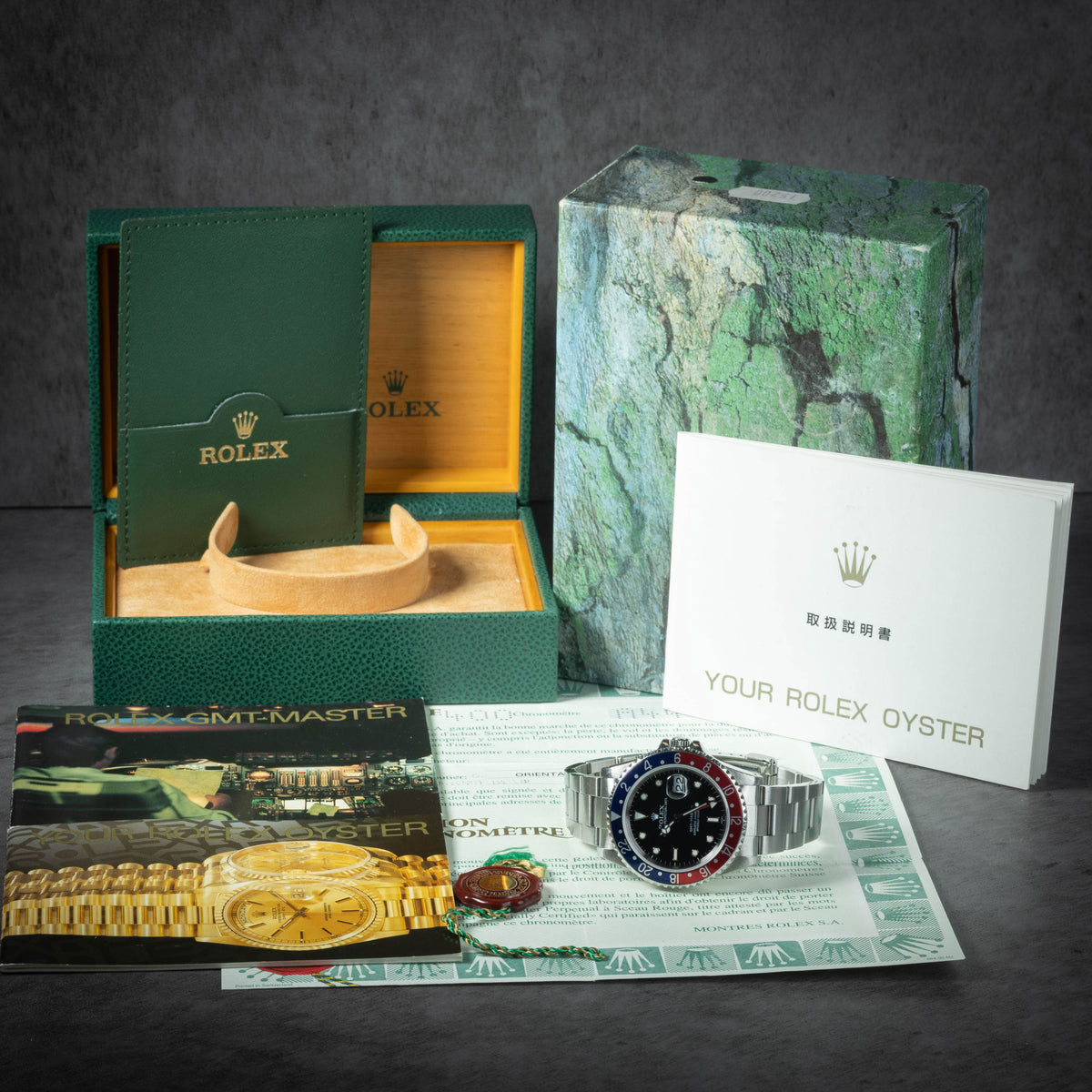
Rolex GMT Master 'Pepsi' 16700 40mm 1999 Box & Papers
Rolex GMT Master 'Pepsi' 16700 40mm 1999 Box & Papers
Couldn't load pickup availability
Rolex GMT Master 'Pepsi' 16700 40mm 1999 Box & Papers
Case and Bracelet
The 40mm Oyster case is in great condition with some wear visible around the case sides. That is the expected place to find it and the expected kind to find. Rolex finished this generation with brushed lug tops and polished flanks, and a polished surface is the one that records every contact with a desk edge or a doorframe over twenty seven years, so light marking along the sides is a record of the watch having been looked after. The more useful question on a 16700 is what the case has not had done to it, and the answer here is favourable. This reference has drilled lugs, which give an unusually honest gauge of polishing, because a case worked hard on a wheel loses definition around the lug holes first and the openings begin to soften and elongate. The lug profile and the crown guards on this example are retained.
The watch is on its Oyster bracelet, in very good condition with very light stretch. Stretch on a bracelet of this era is a matter of mechanics rather than metal. Nothing actually elongates. Very light stretch on a twenty seven year old daily wear Oyster is a normal finding and it sits comfortably with the rest of the watch.
Dial and Hands
The dial and hands are excellent. This is a 1999 watch, which places it in the final two years of the reference and on the Luminova side of Rolex's changeover from tritium, so the dial carries the single word SWISS at six o'clock rather than the SWISS T<25 depth marking of earlier examples. On this reference an excellent grade means exactly what it says.
Chronometry
The watch was demagnetised and tested on a Witschi WAIO, passing the tightness, demagnetisation and chronometry stages. Across four positions it ran +8.3 seconds per day dial up, +7.9 dial down, +9.3 at six up and +4.7 at twelve up, for a mean of +7.6 seconds per day and a positional delta of 4.6. Amplitude averaged 245.7 degrees, from 260.8 dial up to 232.5 at six up, a horizontal to vertical drop of 28.3 degrees, with beat error between 0.2 and 0.4 milliseconds.
The tightness stage passed but keep the crown fully screwed down whenever it is worn.
Share
Why we love this watch
Why we love this watch
The Last Turn of the Bezel: The 1999 Rolex GMT-Master 16700 'Pepsi'
In 1999 Rolex finished building a watch that had been outclassed inside its own catalogue for ten years. The GMT-Master II had arrived in 1989 with an hour hand that could be moved on its own, which is the more useful way to track a second time zone, and yet the simpler GMT-Master stayed in production alongside it until the end of the decade. This is one of the last of them, complete with its box and its punched guarantee paper, and it still answers the question the way Pan Am first asked it in 1954. You do not move a hand. You turn the bezel.
The Airline That Asked for Two Time Zones
The GMT-Master exists because commercial aviation outgrew the wristwatch.
1954, Pan Am and the reference 6542
Pan American World Airways wanted a reliable watch that could show two time zones at once for its transatlantic crews, and Rolex answered in 1954 with the reference 6542. The mechanism was straightforward. An additional hand completed one rotation every twenty four hours rather than twelve, and a rotating bezel carried a matching twenty four hour scale, so a navigator could read home time and local time from the same dial without arithmetic.
The 6542 wore its scale on a Bakelite insert with luminous radium numerals set into the plastic. The inserts cracked, and Rolex moved to anodised aluminium in 1956. That change removed the glowing numerals and set the material that would carry the GMT-Master bezel for the next fifty years.
From 1675 to 16750
The reference 1675 replaced it in 1959 and ran until 1980, the longest life of any GMT-Master. It brought crown guards to the line, moved from the calibre 1565 to the faster calibre 1575 in 1965, and switched from radium to tritium lume in 1963. The reference 16750 followed from 1981 to 1988 with the calibre 3075, a quickset date that let the wearer advance the date independently of the hands, and water resistance lifted to 100 metres.
Three references, thirty years, and the core idea untouched. The twenty four hour hand stayed tied to the hour hand throughout, and the bezel remained the instrument you actually used.
1988: Rolex Builds Two GMT-Masters
By the late 1980s Rolex was selling the GMT-Master in two forms at once, and the reason has more to do with pricing than with engineering.
The Fat Lady came first
The independently adjustable hour hand did not arrive with the 16700. It arrived five years earlier, in 1983, on the GMT-Master II reference 16760. That watch ran the calibre 3085, which let the local hour hand jump forward or back in one hour steps without disturbing the minutes or seconds, and it was the first steel GMT to receive a sapphire crystal. It was also noticeably thicker than what came before, which earned it the nickname Fat Lady. It was withdrawn in 1988.
Why the simpler watch survived
The reference 16700 arrived that same year, 1988, and the GMT-Master II reference 16710 replaced the Fat Lady in 1989. For the following decade the two sat side by side in the catalogue, near enough identical from a metre away, separated by what happened when you pulled the crown. The 16700 was the more affordable of the pair.
So the 16700 is not a watch Rolex forgot to discontinue. It was kept deliberately, offered to anyone who did not need a third time zone and preferred the older logic, and it outlived the reference that first made it look dated.
Calibre 3175
Inside is the Rolex calibre 3175, made from 1988 to 1999 and fitted to this reference alone. It is a self winding chronometer running 31 jewels at 28,800 vibrations per hour with a 48 hour power reserve, chronometer certified by the COSC, with a Breguet overcoil hairspring and Microstella regulating screws on the balance rim rather than a sliding index. It hacks, so the seconds hand stops dead when the crown is pulled and the watch can be set against a time signal, and it carries the quickset date inherited from the calibre 3075.
The 3175 was the last Rolex GMT movement built without an independently adjustable twenty four hour hand. The twenty four hour hand is geared to the hour hand and moves with it, which means the second time zone is read by rotating the bezel until the hand points at the right figure. The calibre 3185 in the 16710 broke that link, and in doing so allowed a third zone to be read from the bezel. Nothing in the 3175 was a compromise of build quality. The difference is one of function, and the function it keeps is the original one from 1954.
The Case That Split the Difference
The case is a 40mm steel Oyster with crown guards, rated to 100 metres, and it does something the 16760 did not manage. It carries a sapphire crystal, which the single timezone GMT-Master had never had before, while returning to slimmer crown guards and the proportions of the 1675 and 16750. The Fat Lady bought modernity at the cost of bulk. The 16700 took the crystal and left the bulk behind.
The lugs are drilled through, with holes visible on the outside of the case at the spring bar, a detail Rolex carried on the 16700 for its entire run and phased out of the 16710 by 2003. The serial number sits between the lugs at the six o'clock side, hidden behind the end link, in the position every Rolex used before the engraving moved to the rehaut in 2005. Our Rolex serial numbers guide sets out the letter prefixes for this era.
Red for Day, Blue for Night
Few objects in watchmaking are recognised as fast as this bezel, and almost nobody can tell you what the colours mean.
The nickname Rolex never used
Red marks the daytime hours on the twenty four hour scale and blue marks the night, so a glance at where the twenty four hour hand sits tells you whether the other city is in daylight before you have read a single number. That is the entire purpose of the split. Rolex has never called it a Pepsi. The company's own designation is BLRO, from the French bleu and rouge. The nickname came from enthusiasts noticing the colours matched a soft drink logo, and it stuck so thoroughly that the official name is now the obscure one.
Anodised aluminium and ultraviolet light
An anodised aluminium insert is a dyed oxide layer, and dyed oxide layers surrender their colour to ultraviolet light. On a two colour bezel that process is uneven in a way a single colour bezel cannot show you, because red pigment absorbs the destructive wavelengths and gives up quickly while blue reflects far more of that energy and holds on for years longer. The red half travels towards pink and coral while the blue is still deep. Given long enough the blue moves too, towards a paler sky tone. Ceramic replaced aluminium on the GMT-Master II in 2005 and does not fade at all, which places every aluminium Pepsi on the far side of a line that will not be crossed again.
Reading a 1999 Dial
The 16700 dial is glossy black lacquer for the whole run, with applied hour markers set in white gold surrounds, a Mercedes hour hand, and a red twenty four hour hand tipped with a luminous triangle. The date sits at three under the Cyclops.
The Luminova changeover
Lume is what dates this dial. From 1988 to 1997 the 16700 used tritium, marked SWISS T<25 at six o'clock, the declaration that tritium radioactivity sat below twenty five millicuries. From 1997 to 1999 Rolex fitted Luminova instead, a photoluminescent compound with no radioactive component, and the depth of that marking collapsed to a single word. SWISS, and nothing else.
A 1999 example therefore belongs to the short final phase of the reference, with a dial that reads SWISS alone. Super-LumiNova followed on the 16710 from around 2000, by which time the 16700 was gone. The whole Luminova window on this reference is roughly two years wide at the very end of an eleven year run.
The date wheel
One further detail separates early examples from late. The 16700 used a vintage style open six on the date wheel until 1992, when Rolex switched to a closed six. A 1999 watch sits comfortably on the later side of that change.
Bracelet and Clasp
The 16700 was supplied on either the Oyster bracelet, reference 78360 with 501B end links, or the Jubilee, reference 62510 with 503B end links, and a folding Oysterlock clasp secured both. Rolex also offered the Oyster reference 78790 with the Oysterlock clasp from 1989 and, as a premium option, the reference 93150 with a diver's extension.
The choice changes the watch more than it sounds like it should. The Oyster keeps the GMT firmly in the tool watch register that Pan Am commissioned. The Jubilee, with its five piece links and polished centre rows, softens the case into something closer to dress wear. Both were catalogue options from the same counter, which is worth remembering when a Jubilee fitted GMT is treated as unusual.
The Punched Guarantee
This example arrives with its box and papers, and the papers are of a specific and now obsolete type. Through the 1970s, 1980s and 1990s Rolex issued large paper guarantee certificates rather than cards, with the watch's details recorded by a pattern of punched holes. The serial and reference were punched into the document at the point of sale, along with the dealer's stamp and date. Rolex replaced the format with small plastic warranty cards in the mid 2000s.
What that paper does is tie a specific case number to a specific date and a specific retailer. The case tells you when the watch was made; the guarantee tells you when and where it was sold, which is the one part of a watch's history the steel cannot record for itself.
The End of Forty Five Years
When production of the 16700 stopped in 1999, a line that had begun with the reference 6542 in 1954 closed after forty five years. Everything that came afterwards carried the GMT-Master II name and the independently adjustable hour hand. The 16710 ran until 2007, ceramic arrived in 2005 on the GMT-Master II, and the configuration that had defined the model for its first three and a half decades simply stopped being made.
That makes this reference the end of a specific idea rather than the end of a model. The idea was that a rotating twenty four hour bezel is the instrument, and the hands are there to be read against it. Rolex built that watch for forty five years, kept building it for ten more after it had a better answer, and then stopped.
Final Thoughts
What we love about a 1999 16700 is the particular kind of lateness it represents. The watch was already the older of two options when it was made. It had a sapphire crystal, a chronometer certified movement with quickset and hacking, a Luminova dial and drilled lugs, which is a genuinely odd combination of the modern and the outgoing. It wears the proportions of a 1970s GMT-Master with none of a 1970s GMT-Master's fragility, and it does the job by the method the airline originally specified.
Rolex could have retired the reference in 1989 and nobody would have argued. Instead it ran for another decade, and the last of them arrived with paper certificates that were themselves about to be replaced. A 1999 Pepsi with its box and guarantee is the final version of the first idea, documented on the day it was sold.
References
1. Bob's Watches, Rolex GMT-Master 16700 Ultimate Guide: https://www.bobswatches.com/rolex-blog/watch-review/vintage-week-gmt-master-ref-16700.html
2. Bob's Watches, Getting Baked: The Highly Collectible GMT-Master 6542: https://www.bobswatches.com/rolex-blog/watch-review/reference-gmt-master-6542.html
3. Bob's Watches, Rolex Pepsi GMT-Master II Guide: Every Reference and History: https://www.bobswatches.com/rolex-blog/buying-guides/rolex-gmt-pepsi.html
4. Bob's Watches, The Evolution of the Rolex GMT-Master's Bezel: https://www.bobswatches.com/rolex-blog/resources/evolution-rolex-gmt-masters-bezel.html
5. Crown Vintage Watches, Evolution of the Rolex GMT-Master: 1675 to Today: https://crownvintage.com.au/blogs/vintage-stories/evolution-of-the-rolex-gmt-master-1675-to-today
6. Lange Dyk Vintage Watches, The Rolex GMT-Master 16700 vs. the GMT-Master II 16710: https://langedykvintagewatches.com/articles/rolex-gmt-master-16700/
7. Millenary Watches, Rolex Caliber 3175 Complete Guide: https://millenarywatches.com/rolex-caliber-3175/
8. Millenary Watches, When Did Rolex Change to 904L Steel: https://millenarywatches.com/when-did-rolex-change-to-904l-steel/
9. WatchProZine, The Rolex Paperwork Through the Ages: https://www.watchprozine.com/rolex/the-rolex-paperwork-through-the-ages/
10. Bob's Watches, Rolex Serial Numbers and Production Dates Lookup Chart: https://www.bobswatches.com/rolex-serial-numbers
Case & Bracelet
Case & Bracelet
- Case in great condition, some wear visible around case sides
- Oyster bracelet in very good condition, very light stretch.
Dial & Hands
Dial & Hands
- Dial & hands excellent
Warranty & Condition
Warranty & Condition
Crown Vintage Watches provides a minimum 6-month mechanical warranty on pre-owned watches, from the date of purchase.
The warranty covers mechanical defects only.
The warranty does not cover damages such as scratches, finish, crystals, glass, straps (leather, fabric or rubber damage due to wear and tear), damage resulting from wear under conditions exceeding the watch manufacturer’s water resistance limitations, and damage due to physical and or accidental abuse.
Please note, water resistance is neither tested nor guaranteed.
Shipping and insurance costs for warranty returns to us must be covered by the customer. Returns must be shipped via traceable courier. Return shipment must be pre-paid and fully insured. Collect shipping will be refused. In case of loss or damages, the customer is liable.
Our Pledge
At Crown Vintage Watches, we stand by the authenticity of every product we sell. For added peace of mind, customers are welcome to have items independently authenticated at their own expense.
Condition
Due to the nature of vintage timepieces, all watches are sold as is. We will accurately describe the current condition and working order of all watches we sell to the best of our ability.
Shipping & Refund
Shipping & Refund