

Crown Vintage
Rolex Seadweller 1665 'Double Red' MK2 1967 Box & Papers
Rolex Seadweller 1665 'Double Red' MK2 1967 Box & Papers
Couldn't load pickup availability
Case and Bracelet
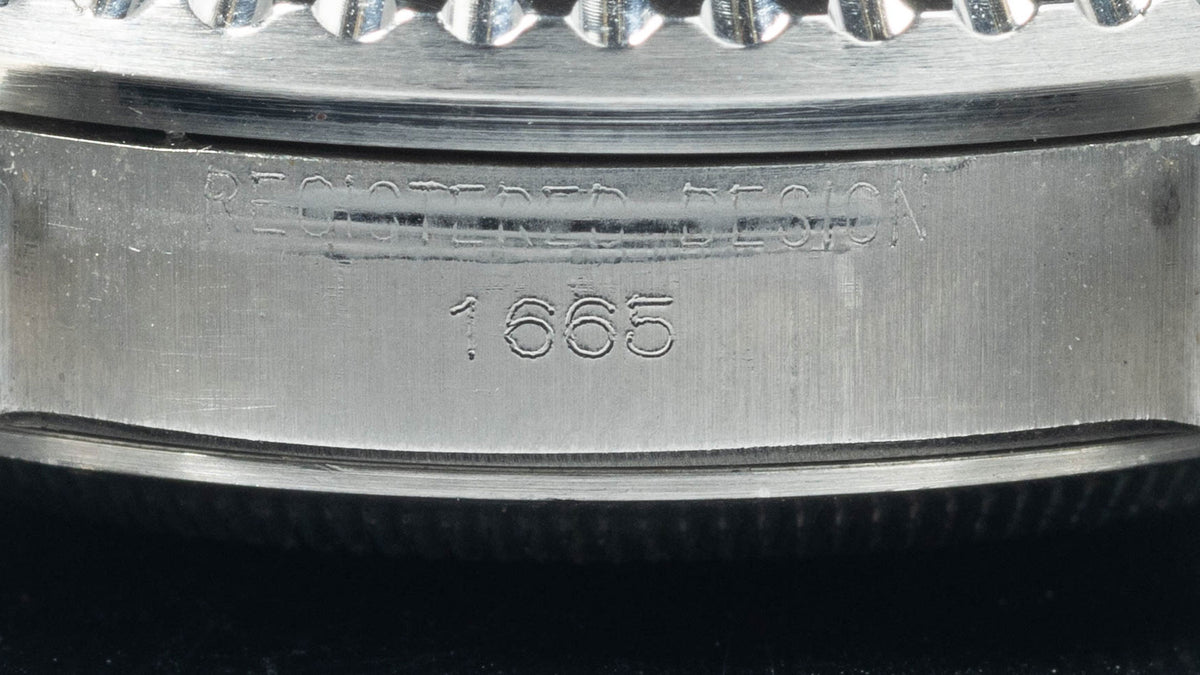
The previously polished 40mm Oyster case is in excellent condition, and the chamfers running along the lugs remain very strong. On a 1665 that is the most telling indicator of all, because the Sea-Dweller was a working tool serviced hard, and the bevelled lug edges are the first thing a heavy polish erases. No pitting or corrosion is visible anywhere on the case, a testament to careful ownership of a watch designed to be soaked. The bracelet is in excellent condition, with light stretch as expected at this age.
Dial and Hands
The dial and hands are in very good condition. The dial has been professionally relumed by Horoluma in Germany, arguably the best in the business. The work was undertaken because a previous owner had the watch lumed with Super-LumiNova, a modern material that sits wrong on a 1967 Double Red both visually and tonally. Horoluma's treatment returns the correct period appearance with an original old stock tritium pigment.
Share
Why we love this watch
Why we love this watch
Sold in 1974, Papers Still Attached: The Rolex Sea-Dweller 1665 Double Red Mark II
The original papers that crossed a dealer's counter with this Sea-Dweller in 1974 are still with it, which is a rarer survival than the watch. Five decades of house moves, insurance claims and drawer clear-outs have separated most 1665s from their documentation, and what usually reaches the market is a very good watch with nothing standing behind it. This one still carries its first sale on paper. Sitting above that paperwork is a Mark II dial that has begun to leave black behind, two lines of red text that record exactly what Rolex thought it was building, and a valve set into the left flank of the case that exists because an American diver complained.
A Watch Named After the Diver, Not the Dive
Every other Rolex professional model of the period is named for an activity. The Submariner submerges, the Explorer explores, the GMT-Master tracks a second time zone. Sea-Dweller is the outlier, because the name does not describe the watch at all. It describes the person wearing it, and in the 1960s that person was a recent invention.
The men who stopped coming up
Saturation diving rests on a single piece of arithmetic. Once a diver's tissues are fully saturated with inert gas at a given pressure, the decompression penalty stops growing, so a diver can live at working depth for weeks and settle the bill once at the end rather than every evening. That turned deep work from a series of short, expensive visits into a job with a roster. The US Navy built the SEALAB programme around the idea, and Perezcope records that after SEALAB 2 worked successfully at around 62 metres in 1966, the Navy was planning SEALAB 3 at roughly 137 metres with divers expected to reach further still.
The men doing it were called aquanauts. They were not visiting the sea, they were living in it, and a Submariner rated to 200 metres had not been designed with them in mind. Rolex named the answer after them.
What Rolex already knew about deep water
None of this was Rolex's first look at pressure. On 23 January 1960 the bathyscaphe Trieste carried Jacques Piccard and US Navy Lieutenant Don Walsh to 10,916 metres in the Mariana Trench with an experimental Rolex Deep Sea Special strapped to the outside of the hull. It came back working. Piccard's telegram afterwards, quoted by La Cote des Montres, reported that the watch worked as well at 11,000 metres as it did on the surface.
That watch had a crystal like a paperweight and no commercial future whatsoever, but it settled one question permanently. Rolex could keep water out of a case at any depth a human would ever encounter. The problem the aquanauts brought back was the exact reverse.
The Complaint That Built the Valve
Watches worn in saturation were not failing at depth. They were failing on the way home. Days spent breathing and living in a helium atmosphere let the gas work its way past seals that stop water without any difficulty, and when the chamber pressure dropped the gas trapped inside had nowhere to go and left through the crystal. Bob Barth, the US Navy aquanaut and SEALAB veteran, identified the problem and proposed the fix himself, a small one-way valve that would let the pressure out in a controlled fashion. Barth passed it to the diver T. Walker Lloyd, who took it to Rolex, and Perezcope records that André Heiniger hired Lloyd as an oceanographic consultant and handed the engineering to André Zibach, formerly of Patek Philippe.
Rolex filed the patent on 6 November 1967 and it was granted in June 1970 as Swiss patent CH492246, which is why the earliest casebacks of this reference read Patent Pending, a chronology traced by Perezcope and Monochrome. Rolex's own description of the mechanism is a cylinder, piston, seal and spring, held shut by water pressure from outside and lifting only when the pressure inside exceeds it. That is the entire idea. The 610 metre rating that came with it is absurd for a human being and exactly right for a case that had to survive being cycled up and down for weeks, because the case was never the thing that broke. The chamber was.
How the 1665 Reached the Shop
Single Reds first
The reference existed before the valve did. Perezcope documents around forty prototypes built between April and June 1967 carrying a single line of red text and a 500 metre rating, produced four months before the valve patent was filed and conceived simply as a harder Submariner. Those Single Reds went to people rather than to shops, among them figures attached to SEALAB 3, Deepstar 4000 and Tektite I, with one going to Philippe Cousteau and another to the hyperbaric researcher Dr Ralph Brauer. Four are known to survive. Everything the Double Red became was worked out on that handful of watches.
Comex, and a market launch in 1971
The commercial shove came from Marseille. Comex, the French saturation diving contractor whose work was setting the depth records of the period, was equipping its divers with Omega. Perezcope records that in late 1971 Rolex changed that by supplying 100 co-branded watches, and that Comex founder Henri Delauze abandoned Omega immediately on receiving them. From that point the Sea-Dweller was the watch of professional deep diving, and Revolution traces the Comex relationship through the rest of the reference's life.
The general public got it at the same moment. Perezcope dates the first American newspaper advertisements to late 1970, one from November of that year quoting USD 300, with regular series production and market introduction following in 1971. A watch sold in 1974 therefore belongs to the first proper commercial stride of the reference rather than to its experimental prologue. Rolex built cases in batches and drew on them as demand required, so a 1665 case can be a little older than the watch it ended up in, but the date that matters here is the one on the papers.
The Two Lines of Red
What the dial actually says
The nickname is literal, and the dial is the whole explanation. Where a Submariner of the period printed its model line in white, this watch printed SEA-DWELLER on one line and SUBMARINER 2000 beneath it on a second, both in red. Bob's Watches, Monochrome and Revolution all record the same two lines and the same origin for the name.
The second line is the one worth reading, because it tells you how Rolex understood what it had built. This was not being introduced as a new family. It was a Submariner that had been taken somewhere the Submariner could not follow, and the dial said so in plain text. The line disappeared in 1977 when the Great White dial arrived and the Sea-Dweller stopped explaining itself by reference to its parent.
Reading a Mark II
Rolex revised the Double Red dial repeatedly across the reference's life and announced none of it, which is why collectors sort the printing into four marks. The Mark II is defined by two visible changes. The SUBMARINER 2000 line shrinks noticeably against SEA-DWELLER above it, so the two lines no longer balance, and the coronet at twelve o'clock loses definition, printing soft and slightly blurred at its edges. That second trait gave the dial its collector name, the smudge crown, recorded by Bob's Watches, Revolution and SwissWatchExpo alike, with Bob's Watches adding a third tell, that the D and the W run together where they meet. The Mark III tightened the fonts again and thinned the coronet, and the Mark IV, the dial of the long production run, printed its red text in a denser stipple that looks almost pixelated under magnification.
The brown that was never specified
Mark II dials carry a habit the later ones largely lost. The lacquer Rolex used on them reacts to ultraviolet light over decades, and a proportion of surviving examples have moved from black toward a deep chocolate. Revolution, Bob's Watches and SwissWatchExpo attach the tendency specifically to this generation of dial, and Bob's Watches describes the same chemistry running across the sports references of the era, prolonged sunlight acting on a period lacquer.
This dial sits early in that process rather than at the end of it. Face on under indoor light it still reads black. Angled toward a window the warmth appears, brown rather than grey, uneven in the way that only comes from a watch having been worn in particular places at particular times. A fully brown Mark II records decades of sun. A dial like this one records a life that included some.
Forty Millimetres Without a Cyclops
The case is 40mm of stainless steel with crown guards, and it wears larger than that figure suggests because of its depth rather than its width. Over the dial sits a thick domed acrylic crystal with no cyclops at all, a decision recorded by Monochrome and Bob's Watches. The reasoning is structural. A cyclops is a second piece of plastic bonded to the crystal at the one point a case under repeated pressure cycling can least spare, so it was a liability rather than a convenience. Its absence is the quickest way to tell a Sea-Dweller from a Submariner across a room, and it leaves the dial a symmetry the Submariner has never had.
The dial is matte, from the period Bob's Watches dates from the late 1960s to the mid 1980s, when Rolex used matte finishes on tool watches to kill reflection underwater. The luminous material is tritium, which has a half-life of a little over twelve years, so no dial of this age glows usefully. What it leaves instead is colour, plots drifting toward cream and amber at their own individual rates, which on a dial already warming toward brown produces a quieter contrast than the watch had when it was new.
Calibre 1575, and a Date You Walk Around
Inside is the Rolex calibre 1575 in its date configuration, a movement that ran from 1965 to 1981, carries 25 jewels and beats at 19,800 vibrations per hour, figures agreed by Quill and Pad and Millenary Watches, with a power reserve those two put at 48 hours where Monochrome quotes 42. It uses a free-sprung balance with an overcoil hairspring regulated by Microstella nuts on the balance rim rather than by an index, which is the reason a properly serviced example of this generation still holds a respectable rate more than fifty years on.
Two details date the watch honestly every time it is used. At 19,800 vibrations per hour the seconds hand advances five and a half times a second rather than the eight of a modern Rolex, and the sweep is visibly softer for it. Then there is the date. Quill and Pad notes that the calibre snaps the date over instantaneously at midnight through a cam, spring and jewel arrangement, which is elegant, but there is no quickset, a point Bob's Watches makes about the 1665 specifically. Setting it after the watch has stopped means walking the hands around the dial until midnight arrives, a small ritual this watch asks of its owner and a modern Sea-Dweller does not.
A Folded Oyster From the Year It Sold
The bracelet is a folded Oyster, reference 9315, and it belongs to the moment of the sale. Folded link construction means each link is a single piece of steel folded over on itself rather than machined from solid, a method Robb Report describes as inherently stronger than the riveted design it replaced. The 9315 arrived around 1969, carried a diver's extension in its clasp, and ran through the middle of the 1970s before the solid link 93150 took over around 1975.
What that construction gives is a bracelet that is light, supple and audible. A folded Oyster has a soft rattle a solid link bracelet does not, it collapses around the wrist rather than sitting on it, and it takes on a polished sheen along the outer links where a solid bracelet holds its edges. On a watch built for saturation divers the effect is slightly incongruous and completely correct for 1974, because this is what Rolex was shipping on its professional references in the years either side of that date.
Final Thoughts
Almost nothing about this watch was chosen for effect. The valve exists because an aquanaut told Rolex that crystals were leaving their cases in decompression chambers. The cyclops is missing because it was a weak point Rolex declined to build in. The 610 metre rating is meaningless for a human being and exactly right for the pressure cycling the case had to survive. The second line of red text is there because in 1967 Rolex still thought of this as a Submariner that had gone further, and by 1977 it no longer needed to say so.
The one thing nobody designed is the dial. Rolex mixed that lacquer to be black and specified nothing about what half a century of sunlight would do to it, and on this example the answer has been arriving slowly, in warmth rather than in obvious brown. Sold in 1974 with papers that are still here to say so, on a folded Oyster from the same moment, this is a watch whose story can be checked rather than assumed, and whose dial exists in exactly one version.
References
1. Perezcope, The Sea-Dweller Chronicles: Genesis of the Decompressing Watch: https://perezcope.com/2020/05/27/the-sea-dweller-chronicles-genesis-of-the-decompressing-watch/
2. Perezcope, The Sea-Dweller Chronicles: Dry Run and Teaming Up With Comex: https://perezcope.com/2020/06/28/the-sea-dweller-chronicles-dry-run-and-teaming-up-with-comex/
3. Monochrome Watches, In-Depth: The History of the Rolex Sea-Dweller: https://monochrome-watches.com/history-rolex-sea-dweller-saturation-dive-watch-helium-escape-valve-deepsea/
4. Revolution, The Depths of Understanding: History of the Rolex Sea-Dweller: https://revolutionwatch.com/the-depths-of-understanding-history-of-the-rolex-sea-dweller/
5. Rolex, Helium Escape Valve: https://www.rolex.com/en-gb/watchmaking/features/cases/helium-escape-valve
6. La Cote des Montres, January 23, 1960: the bathyscaphe Trieste and Rolex reach a depth of 10,916 metres: https://lacotedesmontres.com/en/January-23-1960-the-bathyscaphe-Trieste-and-Rolex-reach-a-depth-of-10-916-meters-below-the-surface-of-the-sea-No_7640.htm
7. Bob's Watches, Minute Details: Rolex Double Red Sea-Dweller 1665 Part I: https://www.bobswatches.com/rolex-blog/resources/rolex-double-red-sea-dweller-part-1.html
8. Bob's Watches, The First Rolex Sea-Dweller: DRSD 1665: https://www.bobswatches.com/rolex-blog/watch-review/15328-drsd-rolex-first-sea-dweller.html
9. Bob's Watches, Vintage Rolex 1665 Sea-Dweller Ultimate Reference Guide: https://www.bobswatches.com/rolex-blog/watch-review/vintage-week-sea-dweller-reference-1665.html
10. Bob's Watches, Vintage Rolex Dials: The Ultimate Collector's Guide and History: https://www.bobswatches.com/rolex-blog/editorial/vintage-rolex-dials.html
11. SwissWatchExpo, Rolex Sea-Dweller ref 1665 Ultimate Guide: https://www.swisswatchexpo.com/thewatchclub/2024/02/13/rolex-seadweller-ref-1665-ultimate-guide/
12. Quill and Pad, Exceptional Movements in History: Rolex Caliber 1575: https://quillandpad.com/2018/06/15/exceptional-movements-in-history-rolex-caliber-1575-the-watchmakers-watch/
13. Millenary Watches, Rolex Caliber 1575 Complete Guide: https://millenarywatches.com/rolex-caliber-1575-complete-guide/
14. Robb Report, The Complete Guide to the Rolex Oyster Bracelet, From 1948 to Present: https://robbreport.com/style/watch-collector/rolex-submariner-oyster-bracelet-complete-guide-1235855011/
Case & Bracelet
Case & Bracelet
- Case in excellent condition, very strong chamfered lugs.
- The bracelet is in excellent condition, light stretch as to be expected with age.
- Case has no pitting or corrosion visible, a testament to its careful ownership
Dial & Hands
Dial & Hands
- Dial & hands are in very good condition.
- Dial professionally relumed by Horoluma Germany (Arguably the best in the business) Reasoning is due to the previous owner having it lumed with superluminova.
Warranty & Condition
Warranty & Condition
Crown Vintage Watches provides a minimum 6-month mechanical warranty on pre-owned watches, from the date of purchase.
The warranty covers mechanical defects only.
The warranty does not cover damages such as scratches, finish, crystals, glass, straps (leather, fabric or rubber damage due to wear and tear), damage resulting from wear under conditions exceeding the watch manufacturer’s water resistance limitations, and damage due to physical and or accidental abuse.
Please note, water resistance is neither tested nor guaranteed.
Shipping and insurance costs for warranty returns to us must be covered by the customer. Returns must be shipped via traceable courier. Return shipment must be pre-paid and fully insured. Collect shipping will be refused. In case of loss or damages, the customer is liable.
Our Pledge
At Crown Vintage Watches, we stand by the authenticity of every product we sell. For added peace of mind, customers are welcome to have items independently authenticated at their own expense.
Condition
Due to the nature of vintage timepieces, all watches are sold as is. We will accurately describe the current condition and working order of all watches we sell to the best of our ability.
Shipping & Refund
Shipping & Refund