

Crown Vintage
Rolex Submariner 16610 'Swiss only' 40mm 1999
Rolex Submariner 16610 'Swiss only' 40mm 1999
Couldn't load pickup availability
Preloved Rolex Submariner 16610 'Swiss only' 40mm 1999
Case and Bracelet
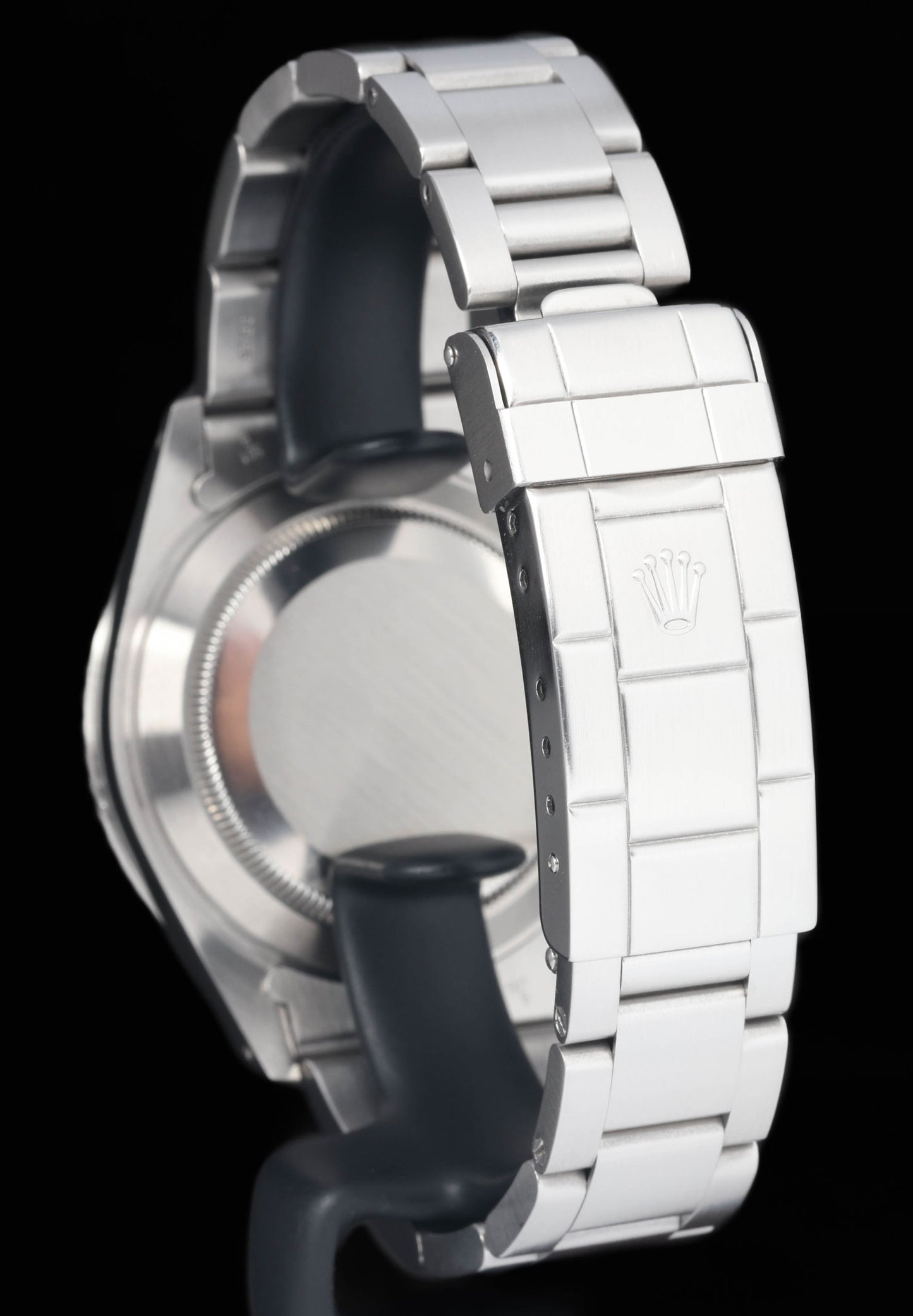
The 40mm 904L Oyster case of this Submariner 16610 presents in very good condition. Most notably, the chamfers along the lug edges remain strong and well defined, with the factory brushing still visible across the lug tops. On a reference produced in 1999, these are the details most readily lost to routine refinishing, as the bevels of the Oyster case soften quickly under the polishing wheel, so their strength on this example speaks to a case that has retained the crisp transitions between brushed and polished surfaces as they left Geneva.
The 93150 Oyster bracelet is likewise in very good condition, showing only light stretch through the links. A degree of play is characteristic of this bracelet after more than two decades of wear, and the light stretch present here sits at the modest end of what the construction typically develops, with the bracelet retaining a firm, cohesive feel on the wrist rather than the pronounced droop that heavily worn examples exhibit.
Dial and Hands
The dial and hands are in very good condition. The glossy black dial of the 16610 is an unforgiving surface, showing any disturbance to its lacquer readily, and this example presents cleanly, with the white gold surrounds of the applied markers and the Mercedes handset consistent across the dial. As a 1999 Swiss only example, the luminous plots and hand fill belong to the reference's first non-radioactive generation, and their even presentation preserves the dial signature that defines this production year.
Share
Why we love this watch
Why we love this watch
Rolex Submariner Date 16610 from 1999: The Swiss Only Dial at the End of an Era
Beneath the six o'clock marker of this Rolex Submariner Date 16610 sits a single printed word, SWISS, a dial signature Rolex used for scarcely more than a year and one that fixes the watch to 1999 as surely as its serial number. That short word marks the exact moment the Submariner gave up tritium, the faintly radioactive compound that had lit its dial since the 1950s, and adopted the non-radioactive photoluminescent material that still illuminates dive watches today. A 1999 reference 16610 is therefore not simply another year of a twenty-two year production run. It is the Submariner Date caught mid-transition, still wearing its drilled lugs, hollow end link Oyster bracelet and clean unengraved rehaut, details Rolex would quietly delete one by one over the following decade. Offered here with its original box and papers, it is a precisely documented snapshot of the last Submariner generation before the modern era.
Rolex: A Brand Built Around a Single Argument
Rolex was founded in London in 1905 by Hans Wilsdorf and his brother in law Alfred Davis, and from the beginning it pursued one proposition with unusual single-mindedness: that a wristwatch could be a genuine precision instrument, certified to chronometric standards and durable enough to survive conditions that would destroy conventional timepieces. The company relocated to Geneva in 1919, placing itself at the centre of Swiss watchmaking, and then proved its argument in stages. The Oyster case, patented in 1926, established that a hermetically sealed wristwatch was achievable, a claim demonstrated the following year on the wrist of Mercedes Gleitze as she swam the English Channel. The Perpetual self-winding rotor, patented in 1931, made automatic winding practical and kept the crown, the Oyster's one vulnerable point, screwed down and undisturbed. By mid-century the pieces were in place for the professional tool watches that would come to define the brand.
Proving It Two Miles Down
Before the Submariner ever reached a shop window, Rolex demonstrated its ambitions in characteristically direct fashion. On 30 September 1953, an experimental Oyster prototype known as the Deep Sea Special was fixed to the exterior of Auguste and Jacques Piccard's bathyscaphe Trieste, which descended to a record 3,150 metres in the Tyrrhenian Sea off the island of Ponza. Piccard's telegram to Geneva confirmed the watch had resisted the depth perfectly. The production dive watch followed at the Basel Fair in 1954, though Rolex marks 1953, the year the first examples were completed, as the Submariner's birth year. The reference 6204 offered water resistance to 100 metres, a rotating bezel for tracking elapsed dive time and luminous markers sized for poor underwater visibility. It was an instrument designed around a specific physical environment, and for the next seven decades Rolex refined it with steady discipline, upgrading movements, materials and tolerances without ever disturbing the fundamental architecture.
The Submariner Date: From Reference 1680 to 16610
The Submariner acquired a date complication in the late 1960s with the reference 1680, and the model's identity expanded with it. Where the no-date Submariner was a pure dive instrument, the 1680, with its date at three o'clock beneath a Cyclops magnifying lens, was a watch that could be worn to the office all week and taken into the water at the weekend. It became, in time, the version most people mean when they say Submariner. The reference 16800 followed in 1979, introducing sapphire crystal, a unidirectional ratcheting bezel, 300 metre water resistance, the Triplock screw-down crown and the calibre 3035 with its quickset date. The transitional reference 168000 then brought 904L stainless steel to the line, and in 1988 the reference 16610 arrived, pairing that harder, more corrosion-resistant alloy with a brand new movement. The 16610 would remain in production until 2010, and along the way it spawned the green bezel 16610LV Kermit of 2003, released as the Submariner's unofficial fiftieth anniversary piece. Within that long run, the 1999 example sits at one of the reference's most distinctive moments.
That discipline of incremental change is worth pausing on, because it is the quality that separates the Submariner from nearly every other watch design of its era. Rolex never redesigned the Submariner Date, it revised it, and each revision addressed a specific functional shortcoming while leaving everything else alone. Acrylic gave way to sapphire because sapphire scratched less. The bidirectional bezel became unidirectional because a knocked bezel should only ever shorten a dive, never lengthen it. Tritium gave way to safer compounds as the science moved on. By the time the 16610 appeared, the model was less a design than an accumulation of correct answers, and the 1999 example inherits every one of them.
Calibre 3135: The Workhorse of Modern Rolex
The 16610 introduced the calibre 3135 to the Submariner, and the movement went on to become one of the longest serving and most widely used calibres in Rolex history, remaining in the Submariner Date until 2020. It operates at 28,800 beats per hour, carries 31 jewels, delivers a power reserve of around 48 hours and is chronometer certified by the COSC to within minus four and plus six seconds per day. Mechanically it is defined by the full balance bridge that replaced the cantilevered balance cock of earlier calibres, anchoring the balance at both ends and markedly improving shock stability. A Glucydur balance wheel, chosen for its dimensional stability under temperature change, is regulated by Microstella screws, and a Breguet overcoil hairspring helps the rate stay consistent across positions. Hacking seconds and a quickset date complete the specification. None of this was exotic, and that was precisely the point. The 3135 was engineered to be serviced anywhere, to shrug off daily wear and to keep chronometer time for decades.
904L Steel and the 40mm Oyster Case
The case housing the movement is machined from 904L stainless steel, an alloy substantially more resistant to corrosion than the 316L used across most of the industry, and one that takes a brighter polish and holds its brushed finishing longer. Rolex invested in dedicated tooling to work the harder material, and the Submariner was among the first beneficiaries. The 40mm Oyster case of the 16610, with its brushed lug tops, polished flanks and slimmer profile, had reached its resolved form by the reference's introduction and was never revised during the production run, which means a 16610 from 1988 and one from 1999 wear identically. What separates them is the details, and the 1999 watch carries a remarkable concentration of the ones that matter.
1999 and the Swiss Only Dial
From 1988 until the late 1990s, the 16610's markers and hands were filled with tritium, a mildly radioactive isotope that glowed continuously without needing to be charged by light. Dials of that era are signed SWISS T under 25 at six o'clock, confirming the tritium content sat within regulatory limits. As standards around radioactive materials tightened, Rolex retired tritium in favour of a non-radioactive photoluminescent compound of the LumiNova family, which stores ambient light and releases it in darkness. The dials produced during the changeover, in 1999 and into early 2000, were signed simply SWISS, without the T designations of the tritium years and without the SWISS MADE signature that arrived from 2000 onwards. This Swiss only dial occupied a production window of roughly a year, and it is the defining feature of a 1999 example. The distinction is more than typographical. It records the precise moment a material that had defined the Submariner's night-time identity for over four decades was retired, on a watch that was otherwise unchanged.
The Details That Date a 1999 Example
The 93150 Bracelet with Hollow End Links
A 1999 reference 16610 wears the 93150 Oyster bracelet with hollow end links and the fold-over flip lock clasp, a construction that gives the watch a lighter, more articulated feel on the wrist than the solid end link 93250 bracelet that replaced it from around 2000. The solid end links added sturdiness and a more monolithic connection between bracelet and case, but they also changed the watch's character. The 93150 belongs to a specific chapter of the reference's life, and its presence is one of the quickest ways to place a 16610 in the first half of production.
Drilled Lugs and a Clean Rehaut
Two case details complete the picture. The lugs of this example carry drilled holes at their outer ends, a practical engineering feature inherited from the Submariner's tool watch generations that made bracelet removal straightforward. Rolex deleted the lug holes around 2003, giving later cases a smoother, more sculpted flank. The rehaut, the inner ring between dial and crystal, is plain brushed steel with no text at all. From the final years of production, around 2007 to 2008, Rolex began engraving the rehaut with its name repeated around the circumference and the serial number at six o'clock as an anti-counterfeiting measure. The 1999 watch predates all of it, and the result is a dial opening of uncluttered clarity that no late example can replicate.
A Dial Resolved Over Four Decades
The glossy black dial of the reference 16610 represents the Submariner's visual language in its most fully developed pre-ceramic form. Applied hour markers outlined in white gold are paired with Mercedes-pattern hands in the same metal, both filled with luminous compound, and the running seconds hand carries a lume dot so a diver can confirm at a glance that the watch is running. The date sits at three o'clock beneath the Cyclops lens, and the unidirectional bezel carries an anodised aluminium insert graduated across sixty minutes, its knurled edge sized for operation with gloved hands. Nothing in the composition is decorative for its own sake. Every element answers a requirement written into the model in 1954, and the aluminium bezel and slimmer case of the 16610 preserve a set of proportions that ended when the ceramic bezel 116610 and its heavier Super Case arrived in 2010.
On the wrist, the combination of these period details produces a watch that feels distinctly different from its ceramic successors. The hollow end links and lighter clasp keep the weight modest, the slimmer lugs sit close to the wrist, and the aluminium bezel insert carries a soft sheen that ceramic never reproduces. It is the last Submariner Date configuration that reads unmistakably as a tool watch first, made in the years before the model's proportions thickened to match its changing audience, and it remains comfortable through a full day in a way that surprises those who know only the modern references.
Box and Papers at a Pivotal Year
With a reference that changed as much as the 16610 did across twenty-two years, original documentation carries particular weight. The papers accompanying this example establish its 1999 issue precisely, resolving any question of whether the watch is a late tritium piece or an early Swiss only example, and anchoring the drilled lugs, hollow end link bracelet and unengraved rehaut to their correct production moment. The box completes the record of the watch's documented life and preserves its original presentation.
Final Thoughts
The Rolex Submariner Date 16610 from 1999 arrived at a precise and unrepeatable intersection. The tritium that had illuminated Submariner dials since the 1950s had just been retired, and the Swiss only signature recording that change would itself vanish within a year. The solid end links, the filled lugs and the engraved rehaut of later production were still years away. What this watch offers is the 16610 in its original engineering form at the exact moment Rolex updated its luminous material for a new regulatory era, changing the chemistry of the dial while leaving everything else untouched. Calibre 3135 kept chronometer time beneath the screw-down caseback as it had since 1988, and the 904L case kept resisting what the ocean asks of it. That continuity of purpose across a change of material is the Submariner's whole argument in miniature, and the original box and papers fix this example's place in the story with a precision the watch itself would approve of.
References
1. Monochrome Watches, History of the Rolex Submariner, Part 3: The 5-Digit References. monochrome-watches.com
2. Luxury Bazaar, Rolex 16610 Submariner Collector's Guide: Timeline of All Variants. luxurybazaar.com
3. SwissWatchExpo, Rolex Submariner 16610 Buying Guide. swisswatchexpo.com
4. Watches Guild, Submariner Ref. 16610: Aluminum Era Ends. watchesguild.com
5. Swiss Watch Trader, Rolex Submariner 16610 Date: Everything You Need to Know. swisswatchtrader.co.uk
6. Perezcope, The Realities of the Rolex Deep Sea Special No. 1 at Christie's Geneva. perezcope.com
7. Christie's and Monochrome Watches, 1953 Rolex Deep Sea Special No. 1 Auction Announcement. monochrome-watches.com
8. Rolex, Deepsea History and the Bathyscaphe Trieste. deepseachallenge.com
9. Analog:Shift, Rolex Submariner Date Swiss Only 16610. analogshift.com
10. Majestix Collection, Rolex 16610 Submariner Date: Why It Still Stands Out. majestixcollection.com
Case & Bracelet
Case & Bracelet
- Case in very good condition, strong chamfered lugs with factory brushing still visible.
- Bracelet in very good condition, light stretch.
Dial & Hands
Dial & Hands
- Dial and hands are very good
Warranty & Condition
Warranty & Condition
Crown Vintage Watches provides a minimum 6-month mechanical warranty on pre-owned watches, from the date of purchase.
The warranty covers mechanical defects only.
The warranty does not cover damages such as scratches, finish, crystals, glass, straps (leather, fabric or rubber damage due to wear and tear), damage resulting from wear under conditions exceeding the watch manufacturer’s water resistance limitations, and damage due to physical and or accidental abuse.
Please note, water resistance is neither tested nor guaranteed.
Shipping and insurance costs for warranty returns to us must be covered by the customer. Returns must be shipped via traceable courier. Return shipment must be pre-paid and fully insured. Collect shipping will be refused. In case of loss or damages, the customer is liable.
Our Pledge
At Crown Vintage Watches, we stand by the authenticity of every product we sell. For added peace of mind, customers are welcome to have items independently authenticated at their own expense.
Condition
Due to the nature of vintage timepieces, all watches are sold as is. We will accurately describe the current condition and working order of all watches we sell to the best of our ability.
Shipping & Refund
Shipping & Refund