

Crown Vintage
Rolex Submariner 5513 'Meters First Dial' 40mm 1963
Rolex Submariner 5513 'Meters First Dial' 40mm 1963
Couldn't load pickup availability
Rolex Submariner 5513 'Meters First Dial' 40mm 1963
Case and External Components
The stainless steel case is in good vintage condition with scratches visible around the case surfaces, consistent with age and prolonged use. As expected for a vintage Submariner of this age, signs of wear are present and should be viewed as commensurate with decades of service rather than defects.
The watch is fitted with a 7206 rivet bracelet, which remains in good vintage condition. Stretch is within expectations for a riveted construction of this era.
Dial and Hands
The dial currently fitted to this watch is a later genuine Rolex meters first dial, identifiable by the matte texture & meters-first depth rating. Meters first dials were introduced by Rolex in the late 1960s as part of a broader shift toward matte dials. The dial remains in excellent condition, free from blemishes and oils.
The hands exhibit visible oxidation, typical of tritium-era components that have aged naturally over time. Luminous material remains present, with ageing consistent with the service-era dial configuration.
Chronometry
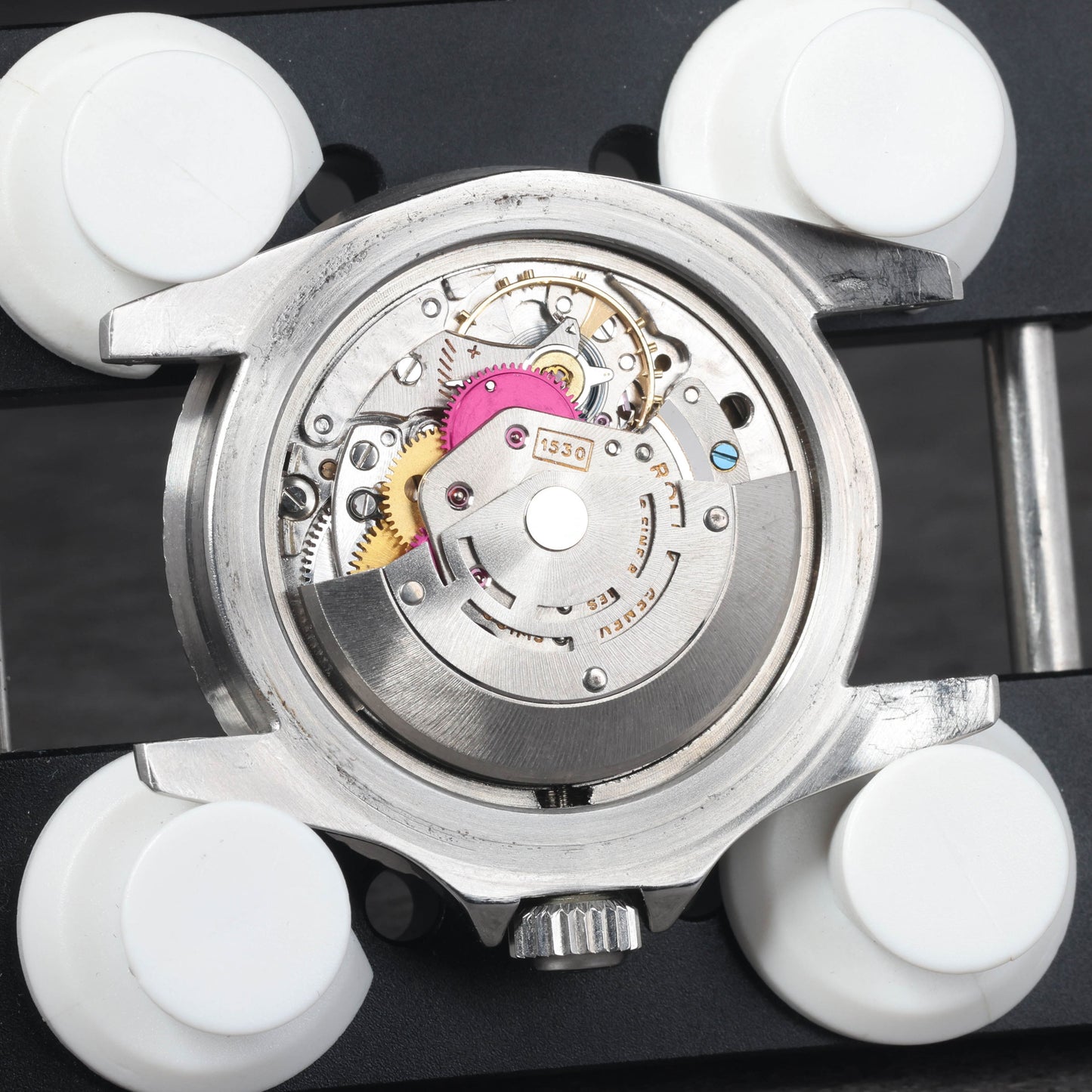
Chronometry was carried out on the Witschi WAIO across four positions. The 5513 is not a chronometer-certified reference, so its calibre 1530 was never held to COSC tolerances, and the readings are assessed instead against what a sound, well-adjusted movement of this type should deliver. The movement returned a mean daily rate of minus 4.8 seconds per day, and comfortably within sensible expectations for a non-chronometer calibre now more than sixty years old.
The two flat positions were tight and close to zero at minus 0.5 and minus 4.4 seconds per day, with the vertical positions showing a little more deviation and the twelve-up position the outlier at minus 11.9, giving a positional spread of 11.4 seconds per day that is normal for a vintage movement of this age.
Beat error was low throughout, between 0.3 and 0.8 milliseconds, which points to a healthy and well-adjusted escapement. Amplitude averaged 231.6 degrees, holding around 240 to 248 degrees in the flat positions and easing to roughly 216 to 222 degrees in the vertical positions, a consistent pattern with no steep drop that reflects a sound mainspring and gear train.
The movement was demagnetised, and the case passed its tightness test at 5BAR.
Vintage Use Advisory
Given the age of this watch, it should be treated as a vintage timepiece. While it has passed pressure testing, it is not recommended to wear the watch while swimming or expose it to water. Vintage seals, components, and tolerances differ from modern standards, and cautious use is advised to preserve the watch.
Share
Why we love this watch
Why we love this watch
Twenty-Seven Years of the Same Watch: The Rolex Submariner 5513
The Reference That Ran Longest
No Rolex Submariner reference stayed in production longer than the 5513. Introduced in 1962 and manufactured until 1989, it spans nearly three decades of continuous production without a date window, without a chronometer certification, and without a single major structural overhaul. That constancy is not an accident of neglect. It reflects a design that required almost nothing from Rolex to improve it.
How the 5513 Arrived
The 5513 came to market in 1962, around three years after the 5512. The relationship between the two references is straightforward on paper: both use the same 40mm Oyster case, the same rotating bezel, the same acrylic crystal, and the same rated depth of 200 metres. The distinction that separated them was movement certification. The 5512 carried a COSC-stamped chronometer movement, and its dial declared it. The 5513 did not, and its two-line dial text reflected that difference. The use of non-certified movements kept the cost down, and it became the diver's choice for working conditions.
The Movement Inside
The early 5513s were equipped with the Calibre 1530 movement, but the majority ran on the Calibre 1520. Both are self-winding movements without a quickset date complication. The 1530 features a Breguet overcoil and KIF shock absorbers. The Calibre 1530 features a balance wheel with a microstella regulating system, a Breguet overcoil, and KIF shock absorbers, all of which contribute to its precision and durability. To keep production costs to a minimum, the Breguet overcoil was replaced with a flat hairspring later on.
Neither movement was built to impress on a specification sheet. Both were built to function reliably under physical stress, and the 27-year production record of the reference suggests they did exactly that.
A Dial That Changed Its Mind Several Times
From Gilt to Matte
The earliest 5513 dials were gilt finished, with gold printing on a gloss black surface. These are the most visually immediate markers of early production, with radium lume giving way to tritium as the 1960s progressed. The first matte dials appeared in 1966, and Rolex utilised the matte finish dials for 18 years. The transition to matte also brought a change to the depth rating text, shifting from metres-first to feet-first notation at some point around 1969, most likely to reflect the growing American market.
The Maxi Dial Years
The Mk1 Maxi dial was introduced in 1977, and it represents the last and largest expression of the matte 5513. The Maxi dials evolved through five recognised types (Type I through Type V), with each showing different typography and text placement. The Maxis were an attempt by Rolex to make the watch more legible in low-light conditions. With enlarged hour markers and bolder dial text, they look immediately different from the more restrained early matte examples, though they share the same architecture.
As production drew to a close on the 5513 in the late 1980s, the dial was now the glossy black familiar today, with the tritium hour markers encircled by white gold. These late-production examples sit closest to the five-digit Submariners that would follow and represent the end of a long typological journey that began with gilt printing in the early 1960s.
The Military Commission
The 5513 was also the basis of one of the most documented military watch programmes in horology. Made upon special request for the British Ministry of Defence, the Military Submariner was issued from 1972 to 1976. The requirements included fixed bars, an oversized 60-minute fully graduated bezel, large luminous sword hands, and a luminous dial with an encircled "T" indicating the use of low-radiation tritium.
Today, it is estimated that approximately 200 of the original 1,200 models are still in circulation, making the Military Submariner one of the rarest collectibles from the Rolex brand. The 5513 was not the only reference issued to the Royal Navy, but alongside the 5517, it remains the primary documentation of Rolex's relationship with British military diving.
Final Thoughts
The Rolex Submariner 5513 is, in the most literal sense, the longest version of the same idea. From 1962 to 1989, relatively few changes were made, staying true to the watch's original design. What changed instead were the details: the dial text, the lume compound, the crown guard profile, the bezel font, the bracelet clasp. Each of those changes is legible on the watch itself, and taken together they make the 5513 one of the most internally varied single references in Rolex's production history. The architecture stayed constant. Everything else recorded the time.
Case & Bracelet
Case & Bracelet
- Case in good vintage condition, scratches visible around the case.
- rivet bracelet in good condition.
Dial & Hands
Dial & Hands
- Dial in excellent condition
- Hands oxidised
Warranty & Condition
Warranty & Condition
Crown Vintage Watches provides a minimum 6-month mechanical warranty on pre-owned watches, from the date of purchase.
The warranty covers mechanical defects only.
The warranty does not cover damages such as scratches, finish, crystals, glass, straps (leather, fabric or rubber damage due to wear and tear), damage resulting from wear under conditions exceeding the watch manufacturer’s water resistance limitations, and damage due to physical and or accidental abuse.
Please note, water resistance is neither tested nor guaranteed.
Shipping and insurance costs for warranty returns to us must be covered by the customer. Returns must be shipped via traceable courier. Return shipment must be pre-paid and fully insured. Collect shipping will be refused. In case of loss or damages, the customer is liable.
Our Pledge
At Crown Vintage Watches, we stand by the authenticity of every product we sell. For added peace of mind, customers are welcome to have items independently authenticated at their own expense.
Condition
Due to the nature of vintage timepieces, all watches are sold as is. We will accurately describe the current condition and working order of all watches we sell to the best of our ability.
Shipping & Refund
Shipping & Refund