

Crown Vintage
Rolex Submariner Date 1680 MK4 'Red' 40mm 1970 Box & Papers
Rolex Submariner Date 1680 MK4 'Red' 40mm 1970 Box & Papers
Couldn't load pickup availability
Rolex Submariner Date 1680 MK4 'Red' 40mm 1970 Box & Papers
This particular example Submariner carries provenance as specific as its dial. Purchased new in the United States in 1970, the year the Mk4 first appeared, it passed from father to son and has remained within a single family ever since. That continuity is reflected in the watch itself: over half a century of careful ownership, in the hands of two people rather than the open market.
The stainless steel case remains in good vintage condition, showing strong proportions with wear visible. Lugs retain good definition, and factory finishing is still evident. The bezel is fairly clean and well-preserved, with some surface marks from use.
Fitted to the watch is a 73860 Oyster bracelet, also in good condition. Links display light wear with only minor stretch, entirely consistent with age, and the clasp remains tight and functional.
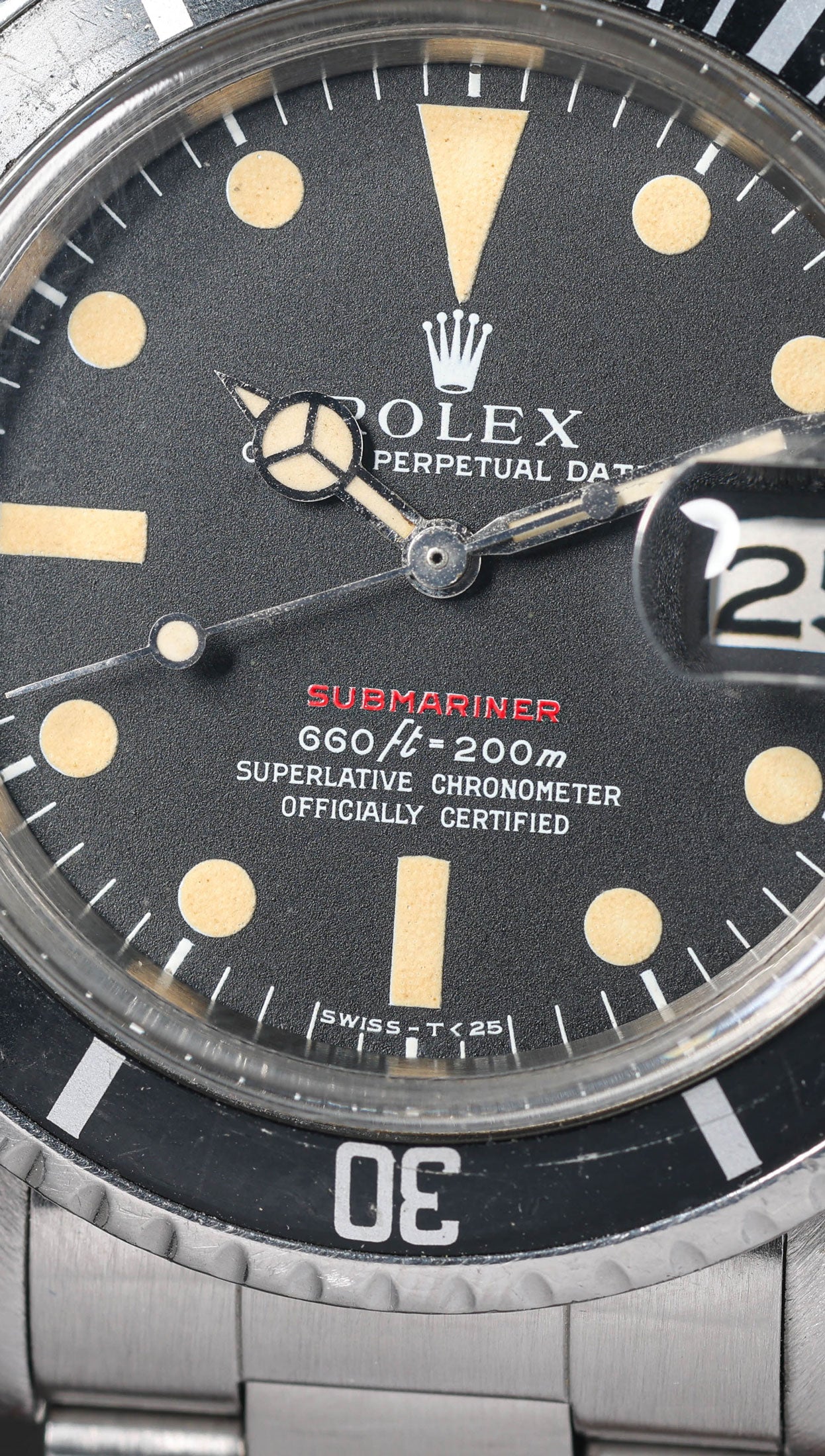
The MK4 matte dial presents in very good condition, with clear text and evenly aged tritium plots. Hands are in equally good condition, matching the dial well with intact
luminous fill. The overall dial and handset retain a crisp, attractive vintage appearance.
This is a well-preserved example of the Submariner Date reference 1680 from 1970 clean case lines, a strong bracelet, and a well-preserved dial and handset make it an excellent representation of this historically significant model.
Share
Why we love this watch
Why we love this watch
Feet First: The Rolex Submariner Date Reference 1680 and the Mk4 Dial
When Rolex quietly inverted the depth rating on the Submariner 1680 dial at the turn of the 1970s, placing 660 feet ahead of 200 metres, it produced a configuration unique to a single dial variant: the Mk4, the earliest feet-first Red Submariner, and the point at which one of the most studied dials in vintage horology shifted register.
From Oceanography to Oyster: The Making of the Submariner
A Watch Built for the Deep
The Rolex Submariner reference 6204, produced in 1953 and formally released in 1954, marks the beginning of one of the most recognisable dive watches ever made. It arrived at a precise cultural moment. The advent of scuba diving in the early 1950s ushered in a new era for reliable tool watches capable of functioning underwater, and the Rolex Submariner quickly became a cult favourite amongst professional divers. The watch Rolex brought to market was deliberate in its restraint. The 6204 was a restrained watch: black dial, radium-lumed indices, 37mm case, 100 metres of water resistance. The crown was small and unprotected, the crystal a domed plexiglass, and the hands of the pencil type.
In 1953, Rolex also pulled off one of its most memorable marketing gestures: when Swiss physicist and explorer Auguste Piccard took his Bathyscaphe deep-diving submarine to a depth of 3,131.8 metres, a specially designed Rolex went with it. The watch emerged unscathed and keeping perfect time. The Submariner's credibility, from the very beginning, was earned rather than claimed.
The Road to Reference 1680
The fifteen years between the 6204 and the 1680 were years of systematic refinement. Reference 6205, which succeeded the 6204 in early 1954, is remembered by collectors as the clean dial Submariner. It was only on the second series, still within 1954, that the Mercedes hands destined to become the Submariner's signature appeared for the first time. The 5512 and 5513 followed in 1959 with crown guards, defining the visual silhouette that the 1680 would later inherit.
By the mid-1960s the Submariner was an established presence in the tool-watch market, but it remained resolutely time-only. The Submariner sported a time-only movement when it hit the market in 1954. It was initially developed as a diver's tool watch, so there wasn't a need for a date display at the time. However, as the Submariner evolved into more of a status symbol worn by more than just professional divers, adding a date window to the dial became a more practical notion.
The Red Dial Era Calibre 1575 and the Date Complication
When Rolex unveiled the reference 1680, it was the first Submariner to be equipped with a date window at 3 o'clock and the magnifying Cyclops lens affixed to the surface of its acrylic crystal. The change was not cosmetic. A new movement was required to carry the complication. The Submariner Date reference 1680 ran on the Calibre 1575, which was based on the existing Calibre 1570 but with an added date function. It is important to note that the calibres inside the reference 1680 are stamped "1570."
The Calibre 1575 is the third generation in the 15xx range, with its balance frequency increased to 19,800 vph. Although it is still missing the quickset date function, it does have the cam and jewel system which causes the instantaneous date change at midnight, a development first made for the Datejust several years earlier. It is sometimes described as a "quick switch, slow set" movement. The movement offers a 48-hour power reserve and includes precise adjustment via a free-sprung balance and Microstella regulation. It is a capable and durable calibre, one Rolex used across the Datejust and GMT-Master of the same era, and it carries the 1680 with a reliability that remains practically demonstrable on the bench today.
The reference 1680 is truly unique as the only date-equipped Submariner to have been fitted with an acrylic crystal. After the reference 1680, all subsequent date-displaying Submariner references left the factory with flat crystals made from synthetic sapphire. The domed acrylic and its attendant Cyclops give the 1680 a particular visual character, a slight optical exaggeration in the date display that later generations of the watch would never replicate.
Mapping the Dial Marks
In 1969, Rolex introduced the very first Submariner with a date complication. The earlier examples, produced until approximately 1975, included the "SUBMARINER" name in red letters on the matte black dial, hence the "Red Submariner" nickname. During those early years, Rolex experimented with dial design, which led collectors to categorise the different dials from Mark 1 to Mark 7.
The first three marks share a common characteristic: the water resistance text on Mk1 through Mk3 dials reads in metres first, with feet as the secondary unit. For the Mk3, the word "Submariner" in red was printed directly onto the dial surface without an additional white base layer. The earliest marks therefore represent the pure Geneva-centric view of the metric system, printed in the sequence that would have read most naturally in Europe.
Six dial variations existed for the reference 1680 with red SUBMARINER inscription. The transition between them was not announced. It is visible only in the accumulated evidence of surviving watches, charted painstakingly by researchers and collectors over the course of decades. Each mark carries minor shifts in typography, printing method, or numeric formatting that, taken together, allow a 1680 to be dated to within a few years of production.
The Mk4 Dial in Detail
Mk4 Red Submariner dials are the earliest versions of the feet-first variety. They first appeared near the end of 1970 and remained in use for a few years. Mk4 dials feature the red "SUBMARINER" text printed on top of white, along with very distinct open sixes for the depth rating.
The inversion of the depth rating, which defines the Mk4 relative to its predecessors, has an uncertain explanation. The best working hypothesis is that the change was made for the US market, although the reason for this shift remains somewhat mysterious. What is clear is that Rolex also reverted in the same transition to printing the red text over a white base, stepping back from the direct-print method introduced in the Mk3. The result is a dial in which the red text sits with a particular legibility and contrast, slightly raised from the surface, the white undercoat giving the lettering a faint visual depth.
The straightforward way to differentiate a Mk4 from a Mk5 is by observing the horizontal members of the "ft" in the depth rating, On the Mk5, these are co-linear. Moreover, the Mk5 has the "Submariner" name stamped directly in red on the dial surface, without the white base layer of the Mk4. The Mk4 and Mk5 appeared at roughly the same time, but the Mk4 was phased out earlier, making it a shorter-lived configuration within the feet-first family.
The Mk4 is recognisable in particular by the shape of the open 6s in the depth inscription, the red overprint on the initially white "Submariner" line, and the depth inscription in the feet-first format, reflecting the growing importance of the American market at the turn of the 1970s.
The tritium luminous material on Mk4 dials, applied to both the dial plots and the handset, tends to develop a warm, honey-toned patina over the following decades. Below the 6 o'clock position, the dial carries the "Swiss-T<25" designation, indicating tritium content within regulatory limits, a marking present across all six red-dial marks and one of the cleaner ways to distinguish original red-era dials from the later luminova service replacements that began to circulate in subsequent decades.
The 1680 in Context
The 1680 arrived while the 5512 and 5513 were still in production. Rather than replacing those references, it existed alongside them as a third, more feature-rich option. The reference 1680 became the third Submariner reference available, sharing the era with the no-date models. The effect was a three-tier Submariner line: the chronometer-rated 5512 at the top, the more affordable 5513 below it, and the date-equipped 1680 occupying a distinct position defined by its additional complication rather than its movement grade.
For many purists, the introduction of the date Submariner marks the point at which the reference crossed over from functional tool watch to something more cosmopolitan. Desk divers loved knowing the date at a glance. Whether that reading is fair or reductive depends on your view of what a diver's watch is obligated to be. The 1680 was rated to the same 200-metre depth resistance as the 5513, carried the same case diameter, the same bidirectional bezel insert, and the same fundamental legibility. The Cyclops and the date added utility. They did not diminish the rest.
The case carrying all of this is the 40mm Oyster, with screw-down crown and caseback, crown guards inherited from the 5512 generation, and the same clean lug geometry that defines the Submariner across its tool-watch era. On a 1970 example, the case will typically show its age in the lugs and between the case flanks, the original finishing largely softened by decades of wear and, in many instances, by servicing. A strong, unpolished example from this period is increasingly rare.
The acrylic crystal, domed and proud of the bezel lip, gives the watch a presence that sapphire-era Submariners simply do not replicate. The slight distortion at the edges of the dial, the way the crystal catches light differently depending on angle, the soft convexity when viewed from the side: all of it is characteristic of the material and the era, and none of it is available in any later production Submariner.
Final Thoughts
The Rolex Submariner Date reference 1680 with a Mk4 dial represents a specific and now unrepeatable configuration. The red line of text was only available for the first half of 1680 production. It was definitively Rolex's first Submariner to introduce a date complication to the Sub line, which was distinct amongst its competitors. The Mk4 sits at the earliest end of the feet-first sequence, with the shortest production window of the feet-first red marks, printed in a method that would not outlast it: red over white, open sixes, 660ft first.
A 1970 example places this dial in its very first year of production. The movement underneath it, the Calibre 1575, is a well-understood calibre with a strong service tradition, robust enough to have remained reliably in use across the half-century since it left the factory. The case form, the crystal, the bezel insert material: these are fixed by the year of production and cannot be sourced new. What was made in 1970 can only be preserved from that point forward, not recreated.
The 1680 Mk4 is, in that sense, entirely time-specific. Its appeal is inseparable from the particularity of its moment: a single line of red text, printed over white, on a matte black dial that Rolex would quietly revise, then quietly discontinue, within a few years of this watch leaving the factory.
Case & Bracelet
Case & Bracelet
- Case is in very good vintage condition.
- Bracelet 93150 oyster is in good condition.
Dial & Hands
Dial & Hands
- Dial and hands are in very good condition.
- Original MK4 tritium dial
Warranty & Condition
Warranty & Condition
Crown Vintage Watches provides a minimum 6-month mechanical warranty on pre-owned watches, from the date of purchase.
The warranty covers mechanical defects only.
The warranty does not cover damages such as scratches, finish, crystals, glass, straps (leather, fabric or rubber damage due to wear and tear), damage resulting from wear under conditions exceeding the watch manufacturer’s water resistance limitations, and damage due to physical and or accidental abuse.
Please note, water resistance is neither tested nor guaranteed.
Shipping and insurance costs for warranty returns to us must be covered by the customer. Returns must be shipped via traceable courier. Return shipment must be pre-paid and fully insured. Collect shipping will be refused. In case of loss or damages, the customer is liable.
Our Pledge
At Crown Vintage Watches, we stand by the authenticity of every product we sell. For added peace of mind, customers are welcome to have items independently authenticated at their own expense.
Condition
Due to the nature of vintage timepieces, all watches are sold as is. We will accurately describe the current condition and working order of all watches we sell to the best of our ability.
Shipping & Refund
Shipping & Refund