

Crown Vintage
Rolex Submariner Date 1680 'Red' MK2 Tropical Meters First 40mm 1970
Rolex Submariner Date 1680 'Red' MK2 Tropical Meters First 40mm 1970
Couldn't load pickup availability
Vintage Rolex Submariner Date 1680 'Red' MK2 Tropical Meters First 40mm 1970
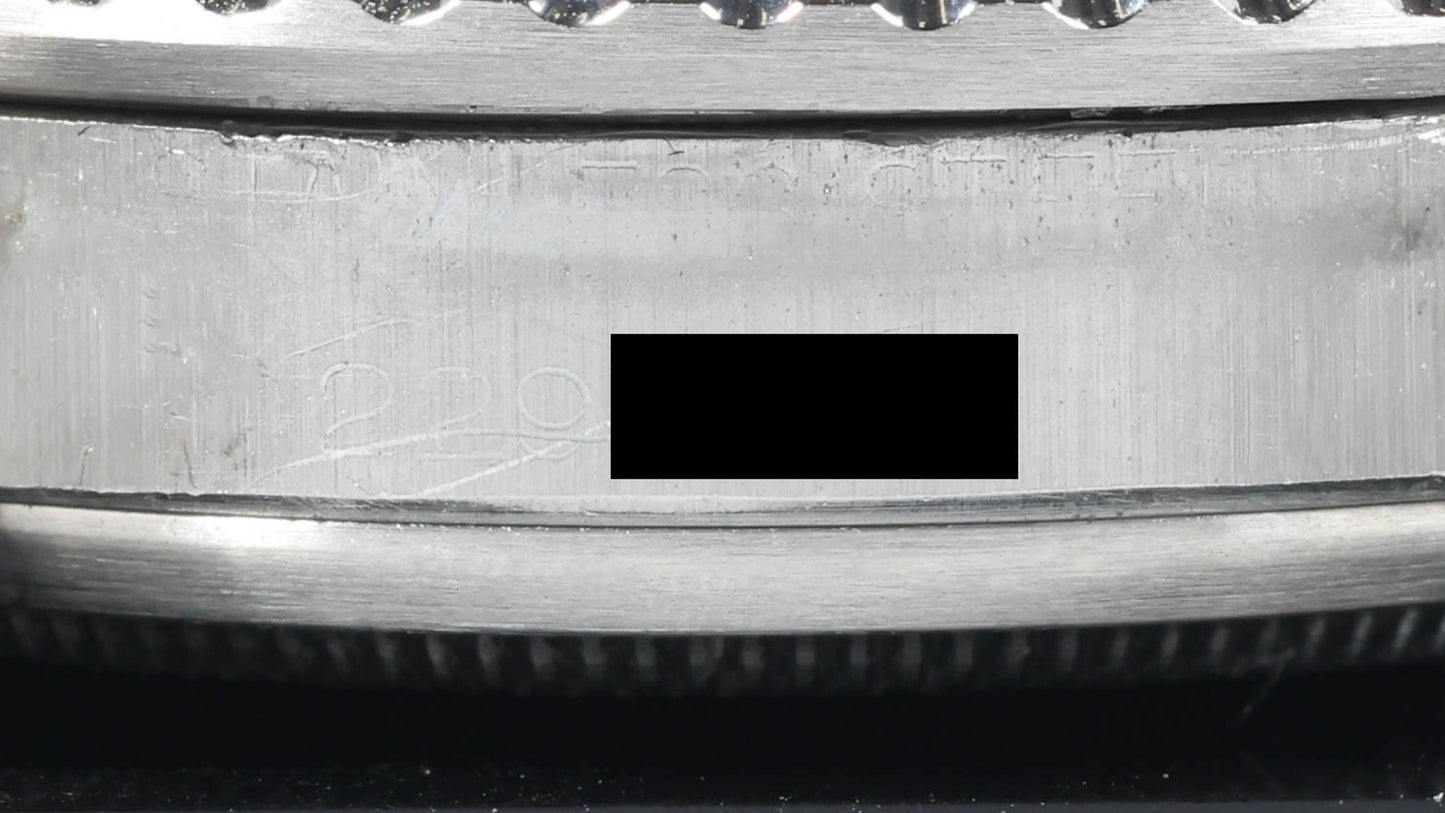
The previously polished stainless steel case remains in very good vintage condition, showing strong proportions with little wear visible. Lugs retain good definition, and factory finishing is still evident. The bezel is fairly clean and well-preserved, with some surface marks from use.
Fitted to the watch is a 9315 Oyster bracelet, also in very good condition. Links display light wear with only minor stretch, entirely consistent with age, and the clasp remains tight and functional.
The MK2 ‘Tropical’ meters first dial presents in great condition, with clear text and evenly aged tritium plots. Hands are in equally good condition, matching the dial well with intact
luminous fill. The overall dial and handset retain a crisp, attractive vintage appearance.
This is a very well-preserved example of the Submariner Date reference 1680 from 1970 — clean case lines, a strong bracelet, and a well-preserved dial and handset make it an excellent representation of this historically significant model.
Share
Why we love this watch
Why we love this watch
The Red That Changed Everything: Rolex Submariner Date Reference 1680 'Red' MK2 Tropical Meters First, 1970
There are Submariners, and then there is this one: a 1970 reference 1680 whose matte dial has spent five decades slowly turning from black to a deep, even chocolate brown, while a single line of red text above the six o'clock reads "SUBMARINER" in a typeface that Rolex would quietly retire within a few years. The combination of that red print and a fully tropical dial on an early MK2 meters-first example represents one of the most layered expressions of what the Submariner lineage can produce.
From Oyster to Ocean: The Rolex Foundation
To understand what the reference 1680 represented, it helps to trace the thread back to where Rolex's waterproofing ambitions began. Hans Wilsdorf founded Rolex in London in 1905, relocating to Geneva after the First World War. By 1926, his company had patented the Oyster case: the first hermetically sealed wristwatch, protected by a screw-down caseback and a screw-down crown. That innovation gave Rolex a structural advantage in water resistance that would prove durable for decades.
The self-winding Perpetual rotor followed in 1931, and together these two technologies created the mechanical foundation on which the professional tool watch family would be built. The 1950s were Rolex's most prolific decade for new references: the Explorer, the GMT-Master, the Milgauss and, in 1953, the Submariner.
The first Submariner, reference 6204, was introduced at the Basel watch fair in 1953 alongside the Blancpain Fifty Fathoms. René-Paul Jeanneret, a Rolex board member and keen diver, had championed the project to Hans Wilsdorf with backing from his friend Jacques Cousteau, whose Aqua-Lung developments were simultaneously transforming recreational and professional diving. The 6204 was rated to 100 metres. Rolex demonstrated its seriousness by attaching a Submariner to the hull of Auguste Piccard's bathyscaphe Trieste during a record-setting dive to 3,131 metres in the Tyrrhenian Sea the same year, surfacing the watch in working order.
Water resistance progressed quickly. By 1954 Rolex had achieved a 200-metre rating, and the Submariner settled into its purpose: a legible, reliable instrument for men working underwater. Over the following fifteen years the reference evolved through the 6538, 5512 and 5513 families, refining the case proportions, bezel geometry and lume application while keeping the fundamental toolwatch brief intact.
Reference 1680: The Submariner Date Arrives
In 1969, Rolex introduced the reference 1680, and it changed the Submariner's character in a single stroke. It was the first Submariner to incorporate a date complication, displayed through a date aperture at three o'clock. For the traditional Submariner audience, this was contentious. A date window added mechanical complexity and disrupted the dial's clean symmetry. For a growing population of professionals who wore their Submariners at desks and on aircraft as much as underwater, it made immediate practical sense.
The case remained 40mm in stainless steel, retaining the broad angular lugs and brushed surfaces of the late-1960s Submariner. The bezel was bidirectional on early examples, with an aluminium insert. The acrylic crystal sat proud of the bezel lip in the characteristic stepped profile designated component code 127, and a sapphire-coated version would not arrive until the reference 16800 of 1979. The crown and caseback were screw-down, and the watch was rated to 200 metres.
The movement inside was the Calibre 1575, part of Rolex's 15xx family: the first series of mechanisms the brand had developed entirely in-house. The 1575 was the third-generation variant, sharing its architecture with the Cal. 1570 but incorporating an additional calendar module for the instantaneous date change. It runs at 19,800 vibrations per hour, carries 26 jewels, and features a Breguet overcoil hairspring with a Kif Ultraflex shock system. An idiosyncrasy of this calibre is that the rotor bridge is stamped "1570" internally despite the correct designation being 1575; many service records and period documents reflect both numbers interchangeably. The 1680 was fitted exclusively with the 1575 throughout its entire production run, a consistency unusual in a reference that remained in the catalogue for roughly a decade.
The Red Print: A Small Detail with a Long History
Early reference 1680 dials carried one line of red text reading "SUBMARINER" printed above the depth rating "200m=660ft", with the remaining text in white. This chromatic detail gave the watch its enduring shorthand: the Red Sub. Rolex produced the red-text variant from approximately 1969 until around 1975, after which subsequent examples carried all-white printing. The reason for the change has never been formally documented by Rolex; the red lettering disappeared without announcement.
Within the red-text production, Rolex and its dial suppliers introduced several dial variants, designated by the hobbyist community as MK1 through MK6. The MK1 dial is identified by its closed sixes in the depth rating, a "SUBMARINER" text width matching that of the depth rating, and a distinctive "ft" ligature where the top of the "f" curls above the "t". The MK2 followed around 1969 to 1970, introducing open sixes in the depth rating, a thinner "ft" without the upward curl, and a hooked "2" in the 200m notation. Like MK1, the MK2 is a meters-first dial: the depth rating reads "200m=660ft", placing metric before imperial. MK3 dials are nearly identical to MK2 and are distinguished by only the most minute typographic differences.
The MK2 production window falls within the 2.2 to 2.45 million serial number range, placing the watch in 1969 to 1970. An important associated detail is the bezel insert: up until approximately 1969 to 1970, meters-first production examples were fitted with the "Long 5" bezel insert, a component distinguished by its elongated "5" numeral marker at the 55-minute position. This insert has become independently sought after by restorers and is now considered a significant period-correct detail on early 1680 examples.
What Tropical Means, and Why It Matters Here
The term tropical is used throughout vintage watch communities to describe a specific and unrepeatable transformation. On certain matte Rolex dials produced through the late 1960s and into the 1970s, the original black paint has shifted over time to warm brown tones ranging from dark chocolate to caramel. The cause is a photochemical reaction in the dial's pigment and varnish layers triggered by sustained ultraviolet exposure and heat. The humidity inside an imperfect seal accelerated the process in some cases. The effect is entirely unpredictable and non-reproducible: no two tropical dials are identical, and no manufacturer could deliberately produce one.
The "tropical" descriptor itself originated from observation: the first examples to be noticed had spent years in warm, UV-saturated climates across South America, Southeast Asia, the Caribbean and parts of Africa, where the conditions that accelerate the reaction are ambient. The terminology has since broadened to describe the phenomenon wherever it occurs, but the name carries the heat and light of those origins.
On a matte dial such as that found on the reference 1680, tropical browning is relatively uncommon compared to the earlier glossy gilt dials of the 1950s and early 1960s, where the effect was first catalogued. A genuine tropical on a matte Submariner requires that the paint transformation be even and consistent across the full surface, that the lume plots remain intact (water damage, which can produce a superficially similar browning, typically destroys or displaces the lume), and that the lacquer show no cracking or lifting. The print itself should read clearly through the changed base colour. On this particular example, the dial has achieved a rich, deep brown that is consistent from centre to edges, with the white and red print retaining its clarity above it. The lume plots have dried but remain in situ, characteristic of an organic transformation rather than moisture ingress.
The convergence of a tropical dial with a red-print MK2 meters-first configuration is uncommon. Each element is a product of the specific manufacturing period in which they overlapped, and the tropical transformation adds an unrepeatable visual dimension to an already historically specific configuration.
The Submariner's Parallel Life
The reference 1680 arrived at a moment when the Submariner was simultaneously completing its evolution as a professional instrument and beginning its life as something else: a cultural object. Sean Connery had worn a Submariner as James Bond since Dr. No in 1962. By 1969, the watch was embedded in the imagery of competent, physical masculinity in ways that no marketing campaign could have engineered, and Rolex had not needed to. The 1680 introduced the date complication precisely as this broader audience was consolidating. The desk diver was already a known consumer type by the time the red print version appeared.
Yet the 1680 never abandoned its technical credentials. The Cal. 1575 was COSC-certified, and the 200-metre water resistance rating matched the contemporary standard for professional diving. The Twinlock crown system, introduced in 1953, was standard on early 1680 production, with the improved Triplock system appearing later in the reference's life from around 1970 onward. The watch remained a functional diving instrument capable of meeting the demands for which the Submariner lineage had been developed.
This dual identity is part of why the 1680 reads differently from its predecessors. The 5513, which ran concurrently without a date function, retained the pure tool aesthetic. The 1680 carried the same case, the same bezel, the same depth rating, but the Cyclops lens and date window gave it a slightly more legible, slightly more considered character. On a tropical example, that character is complicated further by the patina: the brown dial reads as unmistakably aged, yet the red print and open sixes place it in a very specific and brief production window.
Case, Dial, and Bracelet: The Physical Object
The case of a 1970 reference 1680 presents the broad, muscular proportions of late-1960s Rolex sports references. The lugs are thick and straight, with brushed upper surfaces and polished chamfers on the sides. At 40mm, the watch wears with a solidity that later Submariner references, with their slightly softer machining, do not fully replicate. The bezel insert on this example retains its original black aluminium with the tritium pearl at 12 o'clock, the lume having aged to match the overall patina of the dial.
The dial itself, in its tropical state, is the object's defining feature. At close range the brown is rich rather than washed out: a deep, even tone across the matte surface with no evidence of moisture damage or lacquer disruption. The "SUBMARINER" text in red sits cleanly above the depth rating "200m=660ft", the open sixes of the MK2 variant visible without magnification once you know to look for them. The Mercedes hands have aged to an ivory tone consistent with the dial's overall patina.
The bracelet is an Oyster configuration period-correct to the reference, fitted with folded links appropriate to the production era. The Submariner 1680 bracelet of this period used end links numbered 380, attaching the folded-link body to the case lugs. The clasp is the period flip-lock type. Some stretch is expected in a bracelet of this age and is characteristic rather than a defect.
Final Thoughts
The reference 1680 occupies a particular position in the Submariner lineage: it introduced the date function that would define every subsequent Submariner Date reference through to the present day, and it did so in a production window brief enough that the red-print dials it carried have become among the most recognisable and discussed variants in the entire Rolex canon. An MK2 meters-first example brings the additional specificity of a precisely datable production window from 1969 to 1970, the open sixes and hooked "2" placing it clearly within the early red-text chronology.
When that dial has also undergone a genuine tropical transformation, the result is a watch that carries its history in the most literal way possible. The brown is not damage. It is the accumulated record of time, light and chemistry acting on a specific paint formulation that Rolex's suppliers used for a narrow period and then moved away from. No contemporary dial can replicate it. No future example will develop it from new. The watch you are looking at is the only version of itself that will ever exist.
References
- Bob's Watches. "The Red Rolex Submariner 1680 Ultimate Guide." bobswatches.com. March 2023.
- Bob's Watches. "The Rolex Submariner 1680: The Ultimate Reference Guide." bobswatches.com. March 2023.
- Craft & Tailored. "Tropical 1970 Rolex Red Submariner Ref. 1680 Mk. II Meters First." craftandtailored.com.
- Italian Watch Spotter. "Everything You Need To Know About The Rolex Submariner 1680 Red." italianwatchspotter.com. April 2024.
- Gray and Sons. "The History and Evolution of the Rolex Submariner Date." grayandsons.com. February 2024.
- 41Watch. "Rolex Submariner 1680 MK6, the Last Red Sub." 41watch.com. June 2025.
- TrueFacet. "History of the Rolex Submariner." truefacet.com. July 2018.
- Time and Tide Watches. "Dive Watch Fundamentals: Why Rolex Still Wears the Crown of the Deep." timeandtidewatches.com. June 2021.
- Bob's Watches. "Vintage Rolex Dials: The Ultimate Collector's Guide and History." bobswatches.com. April 2026.
- Oracle of Time. "What Is a Tropical Dial and Why Does It Make Vintage Rolexes Worth More?" oracleoftime.com. July 2025.
- LeWatchBuyers. "Rolex Tropical Dials: The Manufacturing Defect Worth $50,000." lewatchbuyers.com. March 2026.
- Rolex Passion Report. "The Importance of the Vintage Rolex Dial." rolexpassionreport.com. September 2021.
- Millenary Watches. "Rolex Caliber 1570: A Complete Guide." millenarywatches.com. November 2022.
- Crown Vintage. "The Evolution of the Rolex Submariner Date: 1680 to 16610." crownvintage.com.au. June 2025.
- Fédération de l'industrie horlogère suisse. "Hans Wilsdorf's Challenge Still Relevant Today." fhs.swiss. 2021.
Case & Bracelet
Case & Bracelet
- Case is in Great vintage condition.
- Bracelet 9315 oyster is in very good condition.
Dial & Hands
Dial & Hands
- Dial and hands are in very good condition.
- Original mk2 tropical meters first dial
Warranty & Condition
Warranty & Condition
Crown Vintage Watches provides a minimum 6-month mechanical warranty on pre-owned watches, from the date of purchase.
The warranty covers mechanical defects only.
The warranty does not cover damages such as scratches, finish, crystals, glass, straps (leather, fabric or rubber damage due to wear and tear), damage resulting from wear under conditions exceeding the watch manufacturer’s water resistance limitations, and damage due to physical and or accidental abuse.
Please note, water resistance is neither tested nor guaranteed.
Shipping and insurance costs for warranty returns to us must be covered by the customer. Returns must be shipped via traceable courier. Return shipment must be pre-paid and fully insured. Collect shipping will be refused. In case of loss or damages, the customer is liable.
Our Pledge
At Crown Vintage Watches, we stand by the authenticity of every product we sell. For added peace of mind, customers are welcome to have items independently authenticated at their own expense.
Condition
Due to the nature of vintage timepieces, all watches are sold as is. We will accurately describe the current condition and working order of all watches we sell to the best of our ability.
Shipping & Refund
Shipping & Refund