

Crown Vintage
Seiko 6105-8000 'Slim Willard' 41mm 1968
Seiko 6105-8000 'Slim Willard' 41mm 1968
Couldn't load pickup availability
Seiko 6105-8000 'Slim Willard' 41mm 1968
Case and Bracelet
The 41mm cushion case is in very good condition and, more to the point, unpolished. The original geometry is intact, the transition between the top surface and the flanks is still clearly defined, and the marks present are the ordinary record of use rather than the ghost of a buffing wheel.
The bezel carries a handsome ghost fade, the insert having lightened from black towards grey over more than five decades of light exposure. It is not a finish that can be manufactured or hurried, and it is the single most difficult element to find intact on this reference, since a tired insert is the first thing an owner replaces and reproduction inserts are plentiful. The bezel itself turns in both directions on friction alone, with no click spring, so the action is a continuous sweep rather than a series of detents. That is correct for the 8000 and is one of the clearest points of separation from the clicking 60 position bezel of the later 8110.
Dial and Hands
The matte black dial and the hands are both in very good condition. The printing remains crisp and the luminous plots sit evenly in their positions with no losses or lifting. The hands match the dial in condition. As with any luminous material of this age, it no longer performs as a light source and should be regarded as a visual element rather than a functional one.
Use Advisory
This is a watch approaching sixty years of age and it should be treated as a vintage timepiece regardless of the 150 metre rating, so it should be kept away from water entirely. Wear it as the survivor it is rather than as the dive instrument it once was.
Share
Why we love this watch
Why we love this watch
Borrowed Name, Original Watch: The 1968 Seiko 6105-8000 Slim Willard
The nickname on this watch was borrowed from a film character who never wore one. Captain Willard took a Seiko up the Nung River in 1979, but the watch on Martin Sheen's wrist was the 6105-8110, a wider and more aggressive case that did not exist until 1970. This is the one that came first, in 1968, at 41mm, with a crown that does not screw down and a case that is symmetrical on both flanks. Collectors eventually gave it the name Slim Willard for want of anything better, which means the original spent fifty years being described as a thinner version of its own successor. The history runs the other way.
The Diver Japan Built Against a Deadline
The Olympics that made a dive watch possible
Seiko did not arrive at dive watches through diving. It arrived through the 1964 Tokyo Olympics. Omega and Longines had held the official timing role at the Games since 1932, and the Seiko Museum Ginza records that Seiko took it on for Tokyo with very little sports timing expertise and very little time. Three companies within the group split the work between 1961 and 1964 and delivered 1,278 timing instruments across 36 models, supported by 172 staff. Among them were the world's first portable quartz timepiece, the Crystal Chronometer QC-951, accurate to within two tenths of a second a day, and the digital stop clock that recorded Abebe Bikila's marathon.
That effort did two things. It gave Seiko an international reputation it had never had before, and it left the company with a deep bench of engineers who had just spent three years building instruments that had to work in public, in front of the world, without excuses. Nine months after the closing ceremony, Seiko released its first dive watch.
Antarctica, and a watch that missed its own expedition
Seiko's first proper dive watch, the 62MAS, reached the market in July 1965 as reference 6217-8000, guaranteed to 150 metres and described by The Seiko Guy as Japan's first professional dive watch. It was developed under real pressure, because the Japanese Antarctic Research Expedition needed equipment and Seiko wanted its watches on those wrists.
It did not quite make it. The Seiko Guy records that the original small-crown version was not included in the kit of JARE-7, which sailed on 20 November 1965, and that the revised big-crown 6217-8001 went south with JARE-8 the following year. DIVE Magazine records the same outcome from the other end, describing the Diver's 150M as the official watch of the eighth Japanese Antarctic survey expedition in 1966. Seiko's dive watch programme began, in other words, with a watch that was revised before it was even deployed, and that habit of iterating in public is the thread that runs straight into the 6105.
The Grammar of Design goes underwater
The man behind both was Taro Tanaka. Worn and Wound records that Tanaka joined Seiko in 1959 as the first formally trained designer the company had ever hired, and that by 1962 he had written the set of rules now known as the Grammar of Design. Every surface flat and geometrically true so it catches light cleanly, bezels reduced to simple faceted curves, no distortion from any viewing angle, and no generic round cases. The first flagship expression of it was the Grand Seiko 4420-9000 in 1967.
The point worth holding onto is that the 6105-8000 is a Tanaka design too. The Seiko Guy credits him with the 62MAS, with the 300 metre 6215-7000, with the 6105-8000 and with the 8110 that followed it. The diver that arrived in 1968 came off the same drawing board, in the same year the Grammar was reshaping Grand Seiko, and it shows in the way the cushion case holds a flat plane across its top surface and then breaks sharply to the side. This is not a round case with lugs attached. It is one shape, cut.
1968, the Loudest Year Seiko Ever Had Underwater
By the time the 6105-8000 appeared, Seiko was running two dive programmes at once. The Seiko Guy dates the monobloc 300 metre 6215-7000 to 1967 and its successor, the 6159-7000 and 7001, to 1968, calling the latter the world's first diver with a hi-beat movement. Those were the professional instruments. The 6105-8000, launched the same year at 150 metres, was the watch for everybody else, and it is the one that ended up defining how a Seiko diver looks.
Something else happened in 1968, and it matters more than any specification. Monochrome and DIVE Magazine both record a letter sent to Seiko that year by a saturation diver working out of Kure, in Hiroshima prefecture. His complaint was blunt. Seiko divers were filling with helium in saturation and losing their crystals on the way back up. Seiko took it seriously enough to start a seven year development programme under the engineer Ikuo Tokunaga, which surfaced in 1975 as the 600 metre titanium professional diver with its L-shaped gasket and around twenty patents, the watch the world calls the Tuna.
So the 6105-8000 occupies a very particular place in the story. It was on shop shelves when that letter arrived. It is the last Seiko diver conceived before the company learned, from a working diver rather than from a laboratory, exactly where the limit of its own product sat. Everything Seiko built underwater after 1975 is a response to that letter. This watch predates the question.
Forty-One Millimetres, and a Crown That Does Not Screw Down
The case
The case is 41mm across and around 12.5mm deep, described by Belmont Watches as a symmetrical cushion, and symmetry is the whole difference. The 8110 that replaced it in 1970 went asymmetric, throwing a heavy shroud around the right flank to protect the crown and giving the watch the lopsided silhouette that became famous. The 8000 does not do that. Both sides match, the case narrows cleanly to short lugs, and the watch sits considerably smaller on the wrist than the 44mm successor recorded by Worn and Wound.
The crown
The crown sits at four o'clock, signed, shaped to avoid snagging, and it does not screw down. Belmont Watches, Craft and Tailored and The Wabi Lobby all confirm it as a non-screw-down, non-locking crown with no guard around it. To a modern eye that reads as a compromise. In 1968 it was a gasket decision rather than an omission, and the locking crown, the one you push in and turn, did not arrive until the 8110.
The four o'clock position is the more interesting choice, and it survived every Seiko diver that followed. It moves the crown off the wrist bone, keeps it clear of the back of the hand when the wrist is flexed, and leaves the case flank at three o'clock unbroken. Seiko has been building divers that way for nearly sixty years because Tanaka got it right the first time.
Bezel, crystal and dial
The bezel turns in both directions and has no click spring, running on friction alone, a detail noted by both Craft and Tailored and The Wabi Lobby, and it is one of the clearest differences from the clicking 60 position bezel of the 8110. The dial is matte black with applied luminous plots, printed simply, and the date sits at three behind a small window. Sources disagree on the original crystal, with Belmont Watches describing Hardlex mineral glass and The Wabi Lobby describing a thin plastic crystal on the example it restored, so that is flagged here rather than settled.
Calibre 6105A
Inside is the 6105A, an automatic of 17 jewels beating at 21,600 vibrations per hour, as recorded by The Seiko Guy and Worn and Wound. It does not hack. The seconds hand keeps running when the crown is pulled, which was normal for a 1968 tool watch and which the later 6105B corrected from around 1970.
There is no quickset date either. The Wabi Lobby describes the period method, rocking the hands back and forth through the late evening to walk the date forward one day at a time, though Belmont Watches describes the movement as quickset, so the two accounts differ. Either way, setting this watch after it has stopped is a deliberate act rather than a click, which is the same small ritual every mechanical watch of the decade asks for.
The reference number carries one more piece of information. The Watch Bloke and The Wabi Lobby both explain that a final digit of 9 marked a watch built for the United States market and a 0 marked everything else, so 6105-8000 and 6105-8009 are the same watch sold through different doors.
Proof, Not Resist
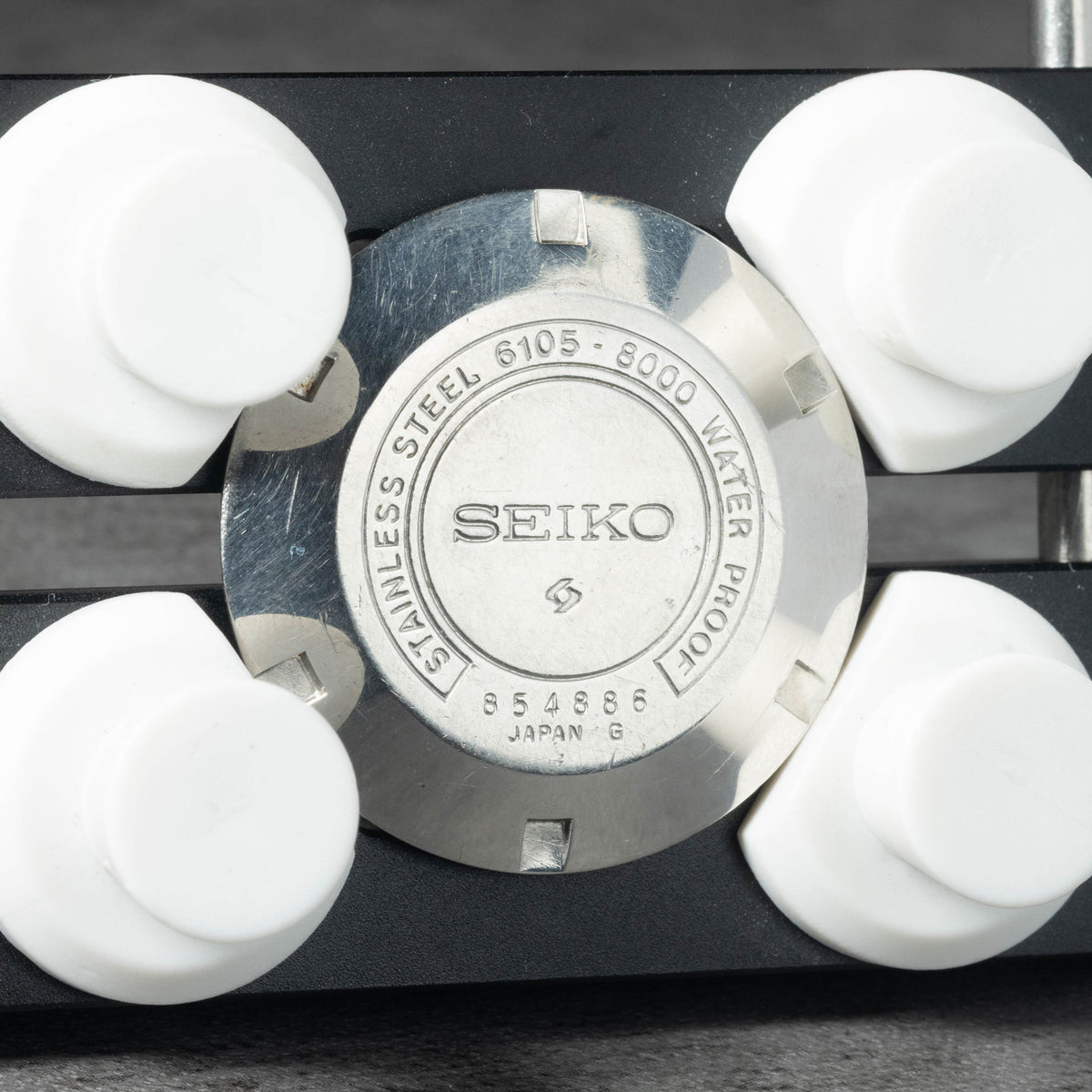
The dial and caseback of a 1968 example read Water 150m Proof rather than Resist. That wording is a small piece of history in itself. Plus9Time records that Seiko moved from Proof to Resist around 1970, with the change essentially complete by 1971, in response to labelling legislation in the United States. The watches did not change. The law did, and a vocabulary that had been perfectly acceptable for a decade quietly disappeared from every Seiko dial. A 1968 6105 still speaks in the older language.
The Watch That Went to War Without Being Issued
The 6105 was never a military contract watch. It reached Vietnam commercially, through the PX system, and DIVE Magazine and Worn and Wound both record American servicemen buying Seikos there in preference to the watches they had been issued. That is an unusual kind of endorsement. Nobody ordered these onto anybody's wrist. Men who needed a watch to survive a tour chose this one and paid for it themselves.
It is worth being precise about why. A watch bought at a PX in 1968 had to work in heat, humidity, salt, mud and river water, be legible at night, and survive being knocked against everything, and it had to do all of that without a service department within several thousand miles. The 6105 offered 150 metres of water resistance, a case with no exposed crown at three o'clock, a bezel that could be turned with wet hands, and an automatic movement that needed nothing from its owner beyond being worn. It was also cheap enough to replace and robust enough not to need replacing. Those are the terms on which it earned its reputation, and none of them appear in a catalogue.
The physical evidence turns up in surviving examples. The Watch Bloke describes tobacco-coloured lume on a 1968 US market watch and suggests prolonged exposure to hot, dry climates as the cause, which is about as close as a dial gets to a service record.
The film came a decade later. Apocalypse Now reached cinemas in 1979 with a 6105-8110 on Martin Sheen's wrist, and the entire 6105 family took its popular name from a fictional captain. In Japan the 8110 is more often called the Uemura, after the explorer Naomi Uemura, a name The Seiko Guy records alongside the Willard. The 1968 original, having no film of its own, was handed the leftovers.
Final Thoughts
What makes the 6105-8000 worth knowing is that it is the hinge. Behind it sit the 62MAS and an Antarctic expedition that sailed without it. Ahead of it sit the asymmetric 8110, the Turtle of 1976, and every Seiko diver since, all of them built around a crown at four o'clock and a cushion case that this watch established. Alongside it, in the same year, sits a letter from a diver in Kure that would eventually force Seiko to reinvent the entire category.
It is also the quietest of them. Symmetrical where the 8110 is aggressive, 41mm where its successor is 44, running a movement that neither hacks nor quicksets, wearing a crown you simply pull out. Taro Tanaka drew it under the same rules he was using on Grand Seiko, and the result is a tool watch with genuine geometry to it. The name it ended up with belongs to somebody else. Everything else about it came first.
References
1. The Seiko Guy, Seiko Divers Timeline: Every Model Since 1965: https://www.theseikoguy.com/seiko-diver-timeline
2. The Seiko Guy, Seiko 62MAS: The First Seiko Diver (1965) Guide: https://www.theseikoguy.com/seiko-62mas
3. Worn and Wound, The Art of Time: Taro Tanaka and Seiko's Grammar of Design: https://wornandwound.com/art-time-taro-tanaka-seikos-grammar-design/
4. Worn and Wound, Affordable Vintage: Seiko 6105: https://wornandwound.com/review/affordable-vintage-seiko-6105/
5. Monochrome Watches, The History of the Seiko Tuna, the Deep Sea Fish: https://monochrome-watches.com/history-seiko-tuna-dive-watch/
6. DIVE Magazine, The History of Seiko's Iconic Diver's Watch Collection: https://divemagazine.com/scuba-diving-equipment/seiko-dive-watch-history
7. Craft and Tailored, Seiko's Slim Willard and the Value of the Old Breed: https://journal.craftandtailored.com/seikos-slim-willard-and-the-value-of-the-old-breed/
8. Belmont Watches, The OG Seiko 6105-8000: https://www.belmontwatches.com/blogs/news/the-og-seiko-6105-8000
9. The Wabi Lobby, Seiko 6105-8000: https://watchwabi.com/seiko-6105-8000/
10. The Watch Bloke, Seiko 6105-8009: https://thewatchbloke.co.uk/2015/10/19/seiko-6105-8009/
11. Plus9Time, Deciphering Seiko Case Back Information: https://www.plus9time.com/seiko-case-back-information
12. The Seiko Museum Ginza, Our Challenge to Become the Official Timer of the Olympics: https://museum.seiko.co.jp/en/seiko_history/milestone/milestone_01/
Case & Bracelet
Case & Bracelet
- Case in very good unpolished condition
- Strap is aftermarket nato
- Bezel nice ghost fade
Dial & Hands
Dial & Hands
- Dial & hands very good condition
Warranty & Condition
Warranty & Condition
Crown Vintage Watches provides a minimum 6-month mechanical warranty on pre-owned watches, from the date of purchase.
The warranty covers mechanical defects only.
The warranty does not cover damages such as scratches, finish, crystals, glass, straps (leather, fabric or rubber damage due to wear and tear), damage resulting from wear under conditions exceeding the watch manufacturer’s water resistance limitations, and damage due to physical and or accidental abuse.
Please note, water resistance is neither tested nor guaranteed.
Shipping and insurance costs for warranty returns to us must be covered by the customer. Returns must be shipped via traceable courier. Return shipment must be pre-paid and fully insured. Collect shipping will be refused. In case of loss or damages, the customer is liable.
Our Pledge
At Crown Vintage Watches, we stand by the authenticity of every product we sell. For added peace of mind, customers are welcome to have items independently authenticated at their own expense.
Condition
Due to the nature of vintage timepieces, all watches are sold as is. We will accurately describe the current condition and working order of all watches we sell to the best of our ability.
Shipping & Refund
Shipping & Refund