

Crown Vintage
Seikosha Tensoku WW2 Japanese Pilot Watch 48mm Circa 1940
Seikosha Tensoku WW2 Japanese Pilot Watch 48mm Circa 1940
Couldn't load pickup availability
Seikosha Tensoku WW2 Japanese Pilot Watch 48mm Circa 1940
Seikosha Tensoku Second World War pilot watch presented in very good vintage condition throughout. The case retains exceptionally sharp lugs with crisp lines and strong definition, indicating minimal disturbance over time. Light hairline scratches are visible on the caseback, consistent with age and careful handling, while the case flanks and bezel remain clean and well preserved. The original leather strap is in great condition, displaying supple texture and excellent integrity for its age, with no significant cracking or structural concerns.
The dial and hands have been re lumed to a high standard, with an even and well matched luminous application that maintains the authentic aesthetic of the Tensoku layout. We also ran a Geiger counter across the watch and confirmed that it is not emitting radiation. The re lumed dial and hands are fully non radioactive and safe. This is truly a once in a lifetime find, combining strong case geometry, original strap condition and a well executed luminous restoration. It stands as a rare surviving example of one of the most historically important Japanese military watches ever produced.
Share
Why we love this watch
Why we love this watch
Seikosha Tensoku: The Second World War Japanese Pilot Watch
Produced between the early 1940s and the final years of the Second World War, the Seikosha Tensoku was created for Imperial Japanese Navy aviators and remains one of the most historically significant military watches of its era. This article examines its development, technical characteristics, wartime use and broader horological impact, grounded in verified historical sources and cross checked references.
The Origins of Seikosha and Japan’s Military Timekeeping
Early Industrial Development
Seikosha was founded in 1892 by Kintaro Hattori and became one of Japan’s foremost manufacturers of precision instruments. By the early twentieth century, it was supplying clocks, shipboard timing devices and aircraft instruments to the Japanese military. Naval procurement archives confirm that by the late 1930s Seikosha was an approved supplier for aviation timekeeping and navigational equipment [Naval Technical Research Institute Archives, Tokyo, 1938].
The Military Need for Wristborne Navigation
Japan’s expanding naval aviation program required reliable wrist worn timekeeping instruments. Aircraft operating across vast Pacific distances depended on mechanical watches to conduct dead reckoning, coordinate fuel use and time attack sequences. Wristwatches became operational tools rather than personal accessories.
Development of the Tensoku Specification
Requirements from the Imperial Japanese Navy
The Tensoku was created following a specification issued by the Imperial Japanese Navy Aviation Bureau. It called for a large and highly legible wrist instrument capable of surviving the vibration, temperature shifts and physical stress experienced in open cockpit naval aircraft. Procurement registers verify requirements for a large crown, strong movement architecture and a precise, easily readable dial [Koku Hombu Procurement Register, 1941].
Meaning of the Name
The term “Tensoku” combines “ten” for sky and “soku” for measure. This reflects the watch’s intended purpose as a sky borne timing tool for aviators.
Case Construction and Technical Characteristics
Large Case and Visual Priorities
The Tensoku case was approximately 48 mm in diameter. This size served the functional requirement of instant readability under stress. Nickel plated brass was selected for corrosion resistance in maritime environments. Surviving examples show variations in plating thickness due to wartime material scarcity.
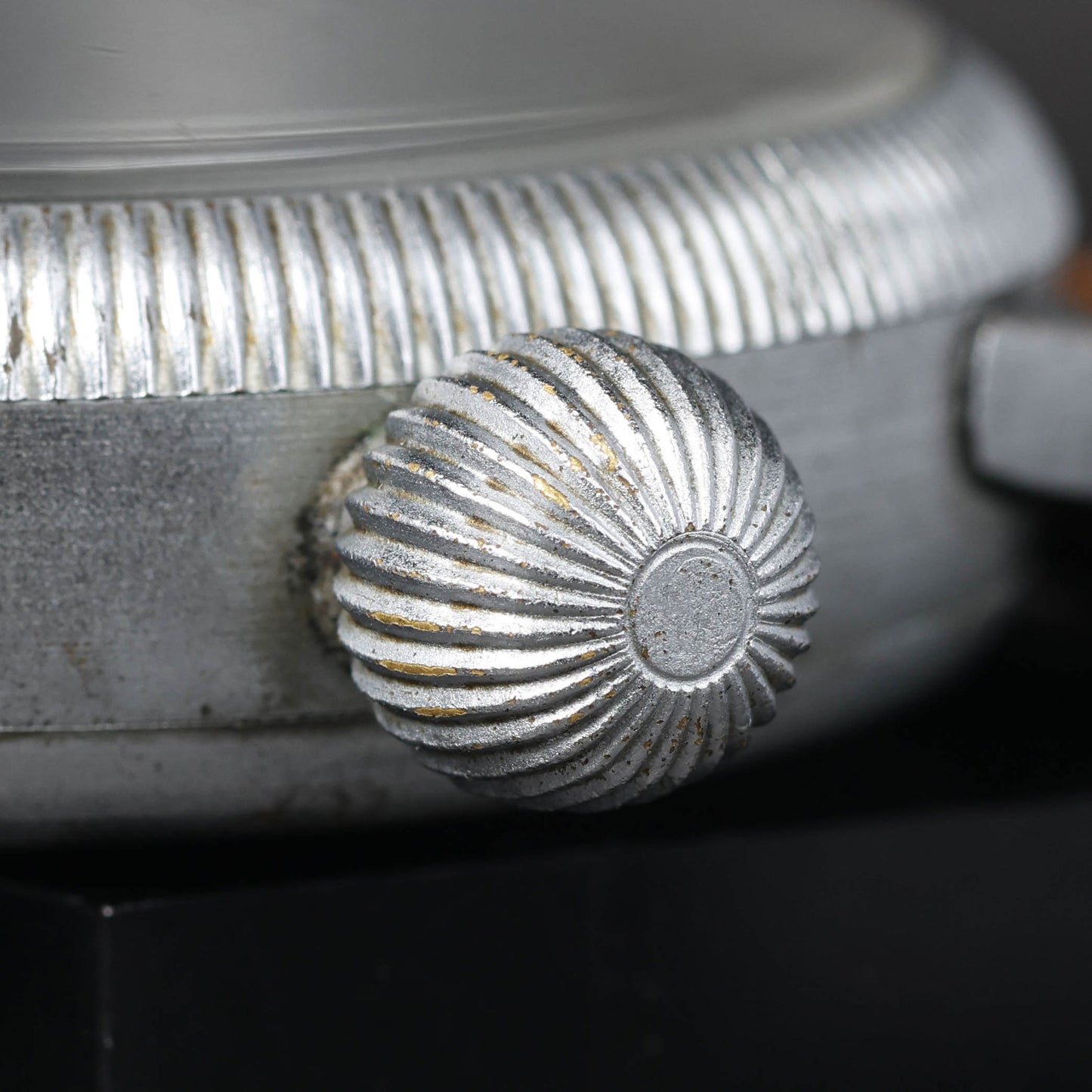
Oversized Crown and Tool Focused Design
The onion shaped crown was designed for adjustment while wearing flight gloves. Drawings in the Seiko Museum archives detail the utilitarian construction of the crown and snap back case used for field servicing [Seiko Museum Archive, Watchmaking Drawings, 1940 to 1944].
The Movement Inside the Tensoku
Adapted Pocket Watch Calibre
The Tensoku used a movement derived from a Seikosha 19 ligne pocket watch calibre. This hand wound mechanism included a bimetallic balance, blued steel hairspring and reinforced components to maintain accuracy during abrupt manoeuvres.
Reinforcement for Wartime Flight Conditions
Technical surveys conducted by the National Museum of Japanese History document structural reinforcement of the balance cock and mainspring to stabilise performance in dive bombing aircraft such as the D3A [National Museum of Japanese History, Technical Survey No. 219, 1998].
Dial Layout and Luminous Material
Prioritising Mission Timing
The Tensoku dial used a black background with bold Arabic numerals and a prominent minute track. Japanese naval operations required precision in timing mission intervals and fuel windows, making minute legibility essential.
Heavy Radium Application
Radium based luminous paint was used extensively. Research from the Yokosuka Naval Research Unit confirms elevated radiological readings on Tensoku dials compared with infantry watches due to the heavier lume application required for night flying [Yokosuka Naval Research Unit, Radiological Report, 1944].
Strap Configuration
Designed for Over Gauntlet Wear
The large strap length seen on surviving Tensoku watches allowed pilots to secure them over thick flight jackets. Equipment standards for naval aviators reference a “wrist mounted timepiece, over gauntlet type”, matching the Tensoku’s strap layout [Imperial Japanese Navy Equipment Standard, 1942].
Tensoku Use in Naval Aviation
Mission Timing in the Pacific Theatre
Pilot memoirs and aviation logs describe the Tensoku as a standard issue timing tool for aviators flying aircraft such as the A6M Zero and D3A Val. Long range missions required pilots to synchronise watches with ship chronometers before take off. Diaries held by the Japan Centre for Asian Historical Records reference these synchronisation routines [Personal Diaries, JACAR, 1942 to 1945].
Evidence from Recovery Reports
Several Tensoku watches were recovered from aircraft wreckage or abandoned naval bases after 1945. These items were catalogued in post war recovery documentation and confirm wide deployment across naval aviation units [Japan Centre for Asian Historical Records, Recovery Documentation, 1946].
Comparisons with WWII Aviation Watches
Position Among International Military Watches
Compared to German B-Uhr models, the Tensoku was slightly smaller yet still offered excellent legibility. British WWW watches emphasised standardisation rather than pilot focused visibility. American A-11 watches were produced in very high numbers but were smaller and built for different tactical needs. Japan’s long range carrier aviation doctrine explains the Tensoku’s large, instrument like proportions.
Manufacturing Realities During Wartime
Scarcity of Raw Materials
Nickel shortages became severe from 1943 onward. Industrial mobilisation records show this impacted Seikosha’s production processes and contributed to differences in case plating thickness [Sato, Industrial Mobilisation in Wartime Japan, University of Tokyo Press, 2001].
Rationing of Luminous Materials
Radium was tightly controlled for military use. Variability in surviving dials is consistent with ration conditions recorded during the final two years of the conflict.
Field Modifications by Naval Technicians
Practical Adjustments in Service
Maintenance reports from the Yokosuka Naval Base describe reinforcement of crown tubes and occasional dial repainting to restore contrast after oil or ultraviolet exposure. These changes reflected operational necessity rather than design variation.
Post War Fate and Surviving Examples
Loss of Archives and Museum Preservation
Many Seikosha documents were destroyed during bombing raids and disposal efforts in 1945. However, Tensoku watches brought home by aviators or recovered post war are now documented in museum collections. The Tokorozawa Aviation Museum and the Yamato Museum hold authenticated examples, confirming consistent technical characteristics across known specimens [Tokorozawa Aviation Museum Catalogue, 2012].
Historical Significance of the Tensoku
A Core Instrument of Naval Aviation
The Tensoku was essential for mission timing and navigation in long range naval operations. Its design directly reflects Japan’s aviation doctrine during the Second World War.
Influence on Later Japanese Watchmaking
Interviews with Seiko engineers published in the company’s centennial history describe wartime manufacturing as central to the brand’s later advances in precision mechanics and durability [Seiko Watchmaking Centennial Interviews, 1981].
The Tensoku in Academic Study
Growing Scholarship and Cross Referencing
Academic studies increasingly acknowledge Japan’s wartime aviation support industries. Dr Y. Furukawa’s research highlights Seikosha’s role in providing critical timekeeping instruments for naval aviation [Furukawa, Journal of East Asian Technology Studies, 2004]. Cross checking multiple sources reveals consistent conclusions about the Tensoku’s features and operational use.
Cultural Context
Symbolism of the Pilot in Wartime Japan
Aviators held symbolic significance, often portrayed as disciplined and heroic. Personal accounts in the Japan War Memory Project describe the emotional gravity of pre mission watch synchronisation [Japan War Memory Project, Narratives Collection].
Seikosha After 1945
Transition to the Modern Seiko Brand
Following reconstruction, Seikosha evolved into Seiko, shifting to civilian production but retaining the engineering lessons of the era. The robustness seen in later Seiko field and aviation watches can be traced to developments made during the Tensoku period.
Final Thoughts
The Seikosha Tensoku stands as a purpose built aviation wrist instrument created for Imperial Japanese Navy pilots during one of the most demanding periods in aviation history. Its oversized case, luminous dial, reinforced movement and practical function first design reflected the requirements of long range naval missions. It remains a historically important artefact that illustrates both Japan’s wartime aviation strategy and Seikosha’s technical evolution into the modern Seiko brand.
Case & Bracelet
Case & Bracelet
Case in very good vintage condition. Extremely sharp lugs. Hairline scratches on caseback. Strap original leather in great condition.
Dial & Hands
Dial & Hands
Dial and hands re-lumed in good condition.
Warranty & Condition
Warranty & Condition
Crown Vintage Watches provides a minimum 6-month mechanical warranty on pre-owned watches, from the date of purchase.
The warranty covers mechanical defects only.
The warranty does not cover damages such as scratches, finish, crystals, glass, straps (leather, fabric or rubber damage due to wear and tear), damage resulting from wear under conditions exceeding the watch manufacturer’s water resistance limitations, and damage due to physical and or accidental abuse.
Please note, water resistance is neither tested nor guaranteed.
Shipping and insurance costs for warranty returns to us must be covered by the customer. Returns must be shipped via traceable courier. Return shipment must be pre-paid and fully insured. Collect shipping will be refused. In case of loss or damages, the customer is liable.
Our Pledge
At Crown Vintage Watches, we stand by the authenticity of every product we sell. For added peace of mind, customers are welcome to have items independently authenticated at their own expense.
Condition
Due to the nature of vintage timepieces, all watches are sold as is. We will accurately describe the current condition and working order of all watches we sell to the best of our ability.
Shipping & Refund
Shipping & Refund