

Crown Vintage
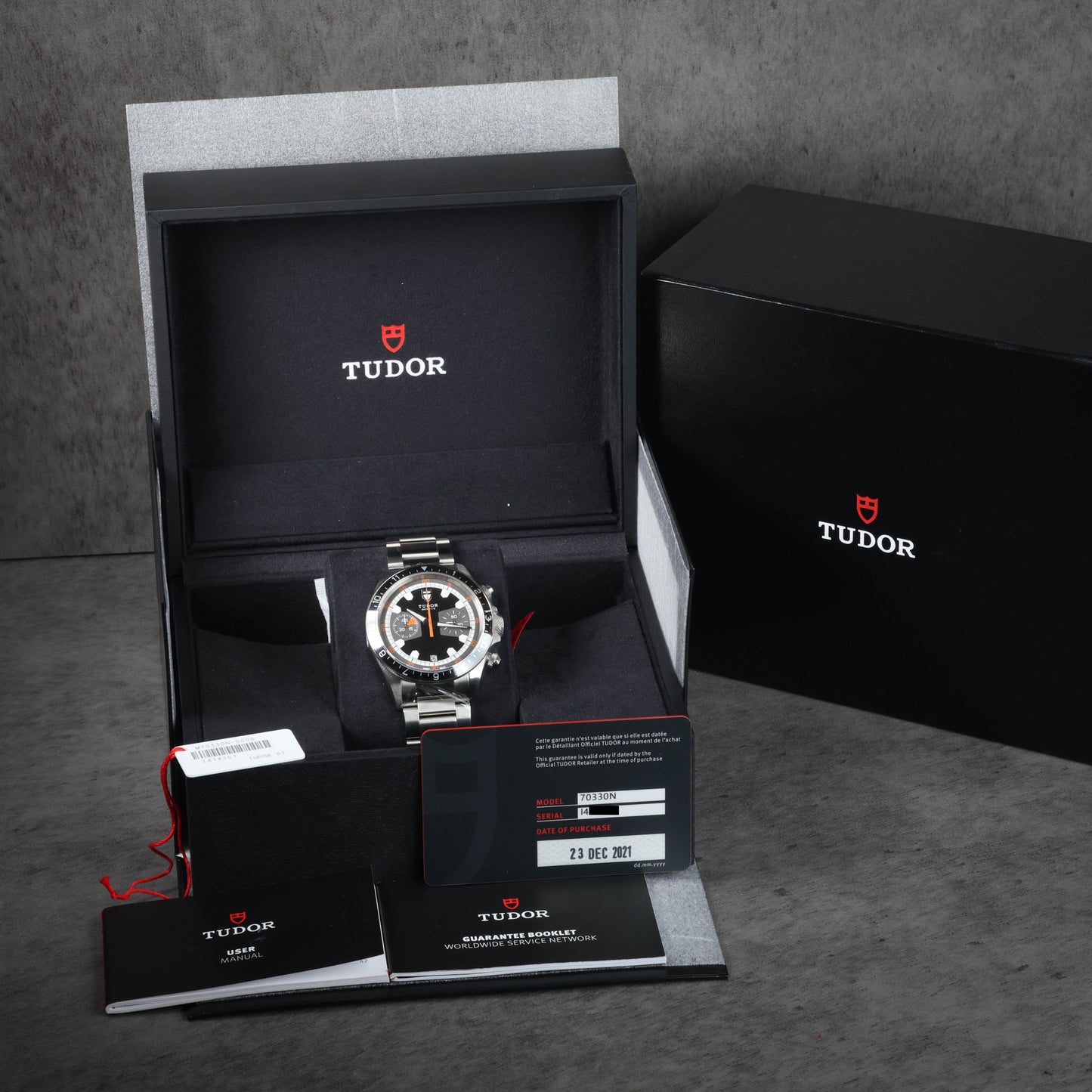
Tudor Heritage Chrono Monte Carlo 70330N 42MM NOS 2021
Tudor Heritage Chrono Monte Carlo 70330N 42MM NOS 2021
Couldn't load pickup availability
Tudor Heritage Chrono Monte Carlo 70330N 42MM NOS 2021
This Tudor Heritage Chrono Monte Carlo 70330N presents in genuinely unworn condition, retaining its original factory stickers across the case, crystal, and bracelet. The 42mm stainless steel Oyster case shows no evidence of use: the satin-brushed lug surfaces are unmarked, the polished flanks and chamfered edges are crisp, and the crown guards carry no contact wear. This one will suit the fussiest of collectors.
Share
Why we love this watch
Why we love this watch
The Roulette That Never Left the Table: Tudor Heritage Chrono Monte Carlo 70330N
There is something quietly audacious about a watch that takes its name not from a racing circuit or a naval mission, but from the felt surface of a casino gaming table. The Tudor Heritage Chrono Monte Carlo 70330N draws its nickname from a lineage of 1970s chronographs whose coloured, multi-register dials so closely resembled the concentric zones of a roulette wheel that enthusiasts stopped using the official reference numbers altogether. That association has held for more than five decades, carrying enough cultural weight to shape the character of a modern reissue produced decades after the originals left the catalogue. At Crown Vintage, this is a watch we keep returning to, and the reasons run far deeper than its distinctive grey and orange palette.
Hans Wilsdorf and the Birth of a Second Empire
To understand the Heritage Chrono is to understand what Tudor was built to accomplish. In February 1926, the Swiss watchmaking house Veuve de Philippe Hüther registered the trademark "The Tudor" on behalf of Hans Wilsdorf, the founder of Rolex. Wilsdorf had spent years refining Rolex into a name synonymous with precision and prestige, but he recognised that this positioning left a large portion of the market unaddressed. In his own words, he wanted to create "a watch that our agents could sell at a more modest price than our Rolex watches, and yet one that would attain the standard of dependability for which Rolex is famous."
The ambition was commercial, but it was not cynical. Wilsdorf did not simply badge a cheaper product under a separate name. He formally incorporated Montres Tudor S.A. on 6 March 1946, a company structured to benefit from Rolex's manufacturing infrastructure, distribution network, and after-sales service. Both companies have remained under the ownership of the Hans Wilsdorf Foundation ever since, a non-profit structure that has preserved the founding intent of each brand independently.
Through the 1950s and 1960s, Tudor established a reputation through tool watches. Its Oyster Prince Submariner, first introduced in 1954, was issued to naval forces including the French Marine Nationale. The watches were sold without bracelets so that military-issued straps could be fitted. This background in professional, functional timekeeping is important context for what followed in 1970, when Tudor entered the chronograph category for the first time.
Tudor's First Chronograph
The Home Plate Series: 1970
The first Tudor chronograph arrived in 1970 under the name Oysterdate, powered by the manually wound Valjoux calibre 7734 with a cam-controlled chronograph mechanism. The case measured 39mm, a substantial diameter by the standards of the era, and the dial design was unlike anything Tudor had produced previously. Hour markers were painted in a pentagonal shape that recalled the home plate on a baseball field, a detail so unusual that enthusiasts immediately christened these references "Home Plate." The counters were trapezoidal, the chronograph seconds hand was orange, and the minute track at the dial's periphery was rendered in a contrasting colour that gave the layout an energy rarely seen in Swiss chronograph design at the time.
There were three reference variations in the 7000 series, each differentiated by bezel type. Reference 7031 featured a Plexiglas insert with a 500-unit tachymetric scale; reference 7032 used a satin-brushed steel bezel with the same engraved scale. The third, reference 7033, was different in kind. It was fitted with a bidirectional rotating bezel carrying a 12-hour graduated black anodised aluminium insert, a format designed to track a second time zone rather than calculate speed. This watch was a prototype. It was never commercially produced.
That unreleased reference would become one of the most consequential pieces in Tudor's history.
The Monte Carlo Arrives: 1971 to 1977
In 1971, Tudor introduced the second generation of its Oysterdate chronograph family. The 7100 series retained the case architecture and graphic spirit of the 7000 series, but arrived with a substantially upgraded movement. In place of the Valjoux 7734, these references were now driven by the manually wound Valjoux 234, a calibre operating at 21,600 vibrations per hour with a more refined chronograph mechanism employing a column wheel and clutch rather than the previous cam arrangement.
The dials evolved too. A new colour combination was introduced alongside the established grey and black scheme: a blue and grey configuration with matching blue bezels, giving these references a vibrancy that felt entirely of their decade. The peripheral minute track, the coloured subdials, and the contrasting zones of the dial face collectively produced an appearance that enthusiasts found immediately evocative. The comparison was unanimous: the dials looked like roulette wheels. The nickname "Monte Carlo" entered the lexicon and never left it.
Three references defined this generation. Reference 7149 used a Plexiglas tachymetric bezel; reference 7159 used an engraved steel equivalent; and reference 7169 carried the bidirectional 12-hour rotating bezel that the 7033 prototype had introduced but never reached production with. These watches remained in the Tudor catalogue until 1977, when the brand transitioned to automatic movements with the 9400 Big Block series.
The 7100 series Monte Carlos represent the creative high point of Tudor's vintage chronograph output. Their combination of functional intelligence, graphic boldness, and mechanical refinement is precisely the territory that the Heritage Chrono 70330N was built to revisit, half a century later.
From Prototype to Production: The Heritage Chrono 70330N
A Direct Line to Reference 7033
In 2010, to mark the 40th anniversary of the first Tudor chronograph, the brand launched the Heritage Chrono. The 70330N was not only the first release within this model family; it was the first watch in the entire Heritage collection, predating the Heritage Black Bay, the Heritage Ranger, and every other archive-inspired Tudor that followed.
The direct design ancestor of the 70330N is the unproduced 7033 prototype. Tudor drew on that reference's bidirectional rotating bezel with 12-hour graduation and black anodised aluminium insert, the feature that defined the 7033 and distinguished the 7169/0 within the Monte Carlo generation. This connection is precise, not approximate: the 70330N preserves the functional logic of a bezel calibrated for second time zone tracking rather than tachymetric measurement, exactly as the 7033 intended.
Dial Design and Aesthetics
The 70330N dial is bi-compax in layout, with registers positioned at three and nine o'clock. The counter at three carries the running seconds; the counter at nine measures up to 45 minutes, a deliberate echo of the original 1970s configuration rather than the 30-minute standard more commonly found on contemporary chronographs. A date aperture sits at six o'clock, present on the original Oysterdate references, though on the Heritage Chrono it is unaccompanied by a cyclops magnifier over the crystal.
The hour markers are applied home-plate indices, three-dimensional steel renderings of the painted pentagonal markers from the 7031/0 originals. They are filled with SuperLuminova and sit with visible depth against the dial surface. Two colour configurations exist within the 70330N designation: a primarily grey dial with black-background subdials, and an inverted scheme with a primarily black dial and grey registers. In both versions, the orange chronograph seconds hand is a constant presence, and the area between the five and ten minute marks on the left subdial carries an orange accent that mirrors the minute track colouration. These are not decorative decisions applied retroactively. They are faithful transcriptions of how the 1970s dials were actually designed.
Case, Bracelet, and Finishing
The stainless steel Oyster case measures 42mm in diameter and is water resistant to 150 metres, with screw-down pushers and crown. The lug finishing combines satin-brushed surfaces on the upper faces with polished flanks and bevelled edges, the chamfered treatment that links the modern reference visually to Rolex and Tudor case design from earlier decades. The bezel, winding crown, and chronograph pushers all carry a clou-de-Paris knurled texture, a detail that introduces a handsome historical reference while improving grip in operation. The case back is solid, and the crown is protected by guards that are more rounded in profile than those on the original 7000 series.
The bracelet is an Oyster-type unit in stainless steel with a folding clasp. In 2018, Tudor revised the sub-references within the 70330N designation: the original -0001 (grey dial, bracelet with additional strap) was succeeded by the -0006 (bracelet) and -0004 (fabric NATO strap), both carrying the same case and dial configuration without alteration to any visual detail. The 2021 example offered here is a later-production piece from this revised reference structure, representing the Heritage Chrono at its most mature point in production.
Calibre T401: The Movement
Inside the Heritage Chrono beats the Tudor-designated Calibre T401, a module-equipped derivative of the ETA 2892 base movement, with a Dubois-Dépraz chronograph mechanism added above it. The complete assembly beats at 28,800 vibrations per hour and provides a power reserve of approximately 42 hours from full wind. The ETA 2892 is among the most thoroughly proven automatic movements produced in Switzerland, and its use here was a considered choice: reliability, repairability, and a thin enough profile to accommodate the module without excessive case thickness.
The use of a modular construction means that the chronograph pushers are positioned in a slightly staggered arrangement on the case flank, a characteristic visible on the finished watch and the natural consequence of mounting the chronograph mechanism above rather than integrated within the base calibre. This is a detail worth knowing. It does not affect function, but it is part of the honest account of how this movement is constructed.
The 45-minute counter is a consequence of the base movement's architecture combined with Tudor's deliberate decision to replicate the original register format from the 7000 series. A more conventional solution would have been a 30-minute counter; Tudor chose fidelity to the vintage reference instead.
Final Thoughts
The Tudor Heritage Chrono Monte Carlo 70330N occupies an unusual position in watchmaking history. It began as the opening statement of a Heritage collection that would go on to include the Black Bay and become one of the most commercially successful revivalist programmes in the modern industry. Yet the 70330N itself remained largely unchanged across more than a decade of production, quiet testimony to the coherence of its original design.
What makes it worth sustained attention is the precision of its historical argument. The rotating bezel traces directly to an unproduced prototype from 1970. The 45-minute counter is a deliberate departure from convention to honour a 1970s configuration. The home-plate indices, the trapezoidal subdials, the orange seconds hand: none of these are surface decoration borrowed loosely from a general period aesthetic. They are specific answers to specific questions about what the 7000 and 7100 series looked like and why. That level of reference is rarer than it appears in the landscape of vintage-inspired watches, and it is a significant part of what distinguishes the 70330N from its contemporaries.
Tudor built its early identity on the promise of Rolex-level dependability at a more accessible price. The Heritage Chrono, produced in the brand's modern era, carries a different kind of value: it makes the graphic intelligence and mechanical character of one of horology's most distinctive chronograph lineages available in a form that wears reliably on the wrist every day. That it does so while retaining the orange seconds hand, the roulette-wheel registers, and the 12-hour bezel of a watch that was never even commercially released makes it, in the most literal sense, a piece of Tudor history finally made.
References
- Tudor Watch Company, "Tudor History: Origins, 1926 to 1949," tudorwatch.com, accessed 2025.
- Hans Wilsdorf, quoted in Tudor Watch Company, "Tudor History: Origins, 1926 to 1949," tudorwatch.com, accessed 2025.
- Tudor Watch Company, "Tudor History: Origins, 1926 to 1949," tudorwatch.com, accessed 2025.
- Wikipedia, "Tudor Watches," en.wikipedia.org, accessed 2025.
- Wikipedia, "Tudor Watches," en.wikipedia.org, accessed 2025.
- Tudor Watch Company, "Tudor History: Chronographs, 1971 to 1976," tudorwatch.com, accessed 2025.
- Watches of Switzerland, "Race Day: Celebrating 50 Years of Tudor Chronographs," watchswiss.com, accessed 2025.
- Watches of Switzerland, "Race Day: Celebrating 50 Years of Tudor Chronographs," watchswiss.com, accessed 2025.
- Tudor Watch Company / Masterhorologer.com, "Tudor Historical Chronograph Watches from 1970 to 1996," masterhorologer.com, accessed 2025.
- Tudor Watch Company, "Tudor History: Chronographs, 1971 to 1976," tudorwatch.com, accessed 2025.
- Monochrome Watches, "Tudor and its Heritage: The 1970s Chronographs and the Tudor Heritage Chrono," monochrome-watches.com, accessed 2025.
- Masterhorologer.com, "Tudor Historical Chronograph Watches from 1970 to 1996," masterhorologer.com, accessed 2025.
- Tudor Watch Company, "Tudor History: Chronographs, 1971 to 1976," tudorwatch.com, accessed 2025.
- Petite Genève, "1970–2020: 50 Years of Tudor Chronographs," petitegeneve.com, accessed 2025.
- Monochrome Watches, "Tudor and its Heritage: The 1970s Chronographs and the Tudor Heritage Chrono," monochrome-watches.com, accessed 2025.
- Petite Genève, "1970–2020: 50 Years of Tudor Chronographs," petitegeneve.com, accessed 2025.
- Watch Collecting Lifestyle, "Insider: Tudor Heritage Chrono ref. 70330N," watchcollectinglifestyle.com, accessed 2025.
- Watch Collecting Lifestyle, "Insider: Tudor Heritage Chrono ref. 70330N," watchcollectinglifestyle.com, accessed 2025.
- Watch Collecting Lifestyle, "Insider: Tudor Heritage Chrono ref. 70330N," watchcollectinglifestyle.com, accessed 2025.
- WatchBase, "Tudor 70330N-0001: Heritage Chrono Grey," watchbase.com, accessed 2025.
- The Calibrated Wrist, "A Second Look at the Tudor Heritage Chronograph M70330N," thecalibratedwrist.com, accessed 2025.
Case & Bracelet
Case & Bracelet
NOS (New old stock) Stickered
Dial & Hands
Dial & Hands
- Brand new
Warranty & Condition
Warranty & Condition
Crown Vintage Watches provides a minimum 6-month mechanical warranty on pre-owned watches, from the date of purchase.
The warranty covers mechanical defects only.
The warranty does not cover damages such as scratches, finish, crystals, glass, straps (leather, fabric or rubber damage due to wear and tear), damage resulting from wear under conditions exceeding the watch manufacturer’s water resistance limitations, and damage due to physical and or accidental abuse.
Please note, water resistance is neither tested nor guaranteed.
Shipping and insurance costs for warranty returns to us must be covered by the customer. Returns must be shipped via traceable courier. Return shipment must be pre-paid and fully insured. Collect shipping will be refused. In case of loss or damages, the customer is liable.
Our Pledge
At Crown Vintage Watches, we stand by the authenticity of every product we sell. For added peace of mind, customers are welcome to have items independently authenticated at their own expense.
Condition
Due to the nature of vintage timepieces, all watches are sold as is. We will accurately describe the current condition and working order of all watches we sell to the best of our ability.
Shipping & Refund
Shipping & Refund