

Crown Vintage
Tudor Submariner Oyster-Prince 7928 'Tropical' Eagle Beak 40MM 1960
Tudor Submariner Oyster-Prince 7928 'Tropical' Eagle Beak 40MM 1960
Couldn't load pickup availability
Tudor Submariner Oyster-Prince 7928 'Tropical' Eagle Beak 40MM 1960
Case and Bracelet
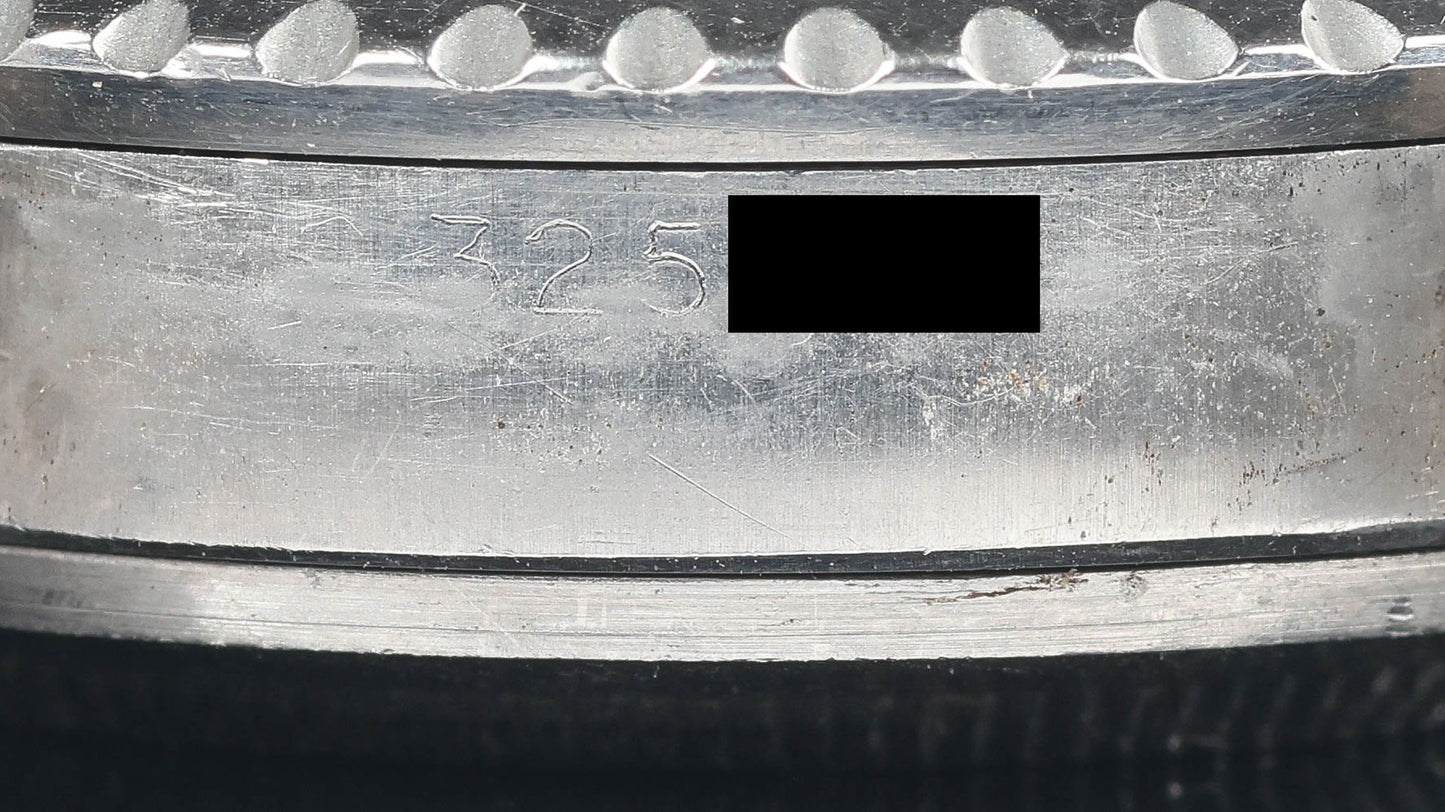
This reference 7928 presents in excellent condition, with only very light wear visible across the case and entirely consistent with a watch of this age. Most significant for an Eagle Beak example, the case is unpolished and the original factory brushing remains visible, which means the faceted crown guards and the lug bevels retain the geometry they carried out of the workshop. That matters more here than on almost any other Tudor Submariner, because the Eagle Beak guards taper to a sharp point that is so often softened or lost once a case has been polished. Finding those original surfaces intact is the clearest possible evidence of how lightly this case has been handled across six decades. Adding to the rarity, there are only known to be 100 or so examples of the 7928 reference with eagle beak crown guards, known as the MK2 case.
Dial and Hands
The dial is the original tropical example and remains stable. Its gilt black surface has transformed dramatically over the decades into a deep caramel and amber tone, with pronounced mottling and spotting across the face that is most concentrated toward the outer chapter ring and the lower half of the dial. This is the signature of an early gilt dial that has aged hard and honestly, and the result is wholly individual to this watch, the kind of surface that can never be reproduced and that gives a full tropical 7928 its character. The original printing has been substantially absorbed into the browning and no longer reads crisply, which is entirely consistent with patina of this depth. The luminous hour plots remain in place and have warmed to a matching brown. The hands are original and stable, in the correct Mercedes form for the reference, with their luminous fill now heavily degraded in keeping with the dial. The appeal of this dial lies in the depth and individuality of its tropical patina rather than in pristine preservation, and it presents as a strong, characterful survivor.
Use Advisory
This is a vintage timepiece now well over sixty years old, and it should be enjoyed and cared for as one rather than treated as a modern tool watch. Despite the reference's original two hundred metre design rating, the acrylic crystal and age-hardened gaskets mean it should be kept away from water, moisture and humidity entirely, and it is best removed before swimming, bathing or any other wet activity. Periodic servicing by a watchmaker familiar with vintage Tudor calibres will keep it running dependably and remains the surest way to preserve both its mechanics and its character for years to come.
Share
Why we love this watch
Why we love this watch
The Beak That Bit First: A Tudor Submariner 7928 Eagle Beak
The crown guards on this Tudor Submariner reference 7928 do not curve, they taper to a faceted point sharp enough to have earned the nickname Eagle Beak. Most divers' watches from the early 1960s soften at the shoulders, but this one bares its teeth, and the gilt dial behind that point has spent six decades warming from glossy black into the deep tropical brown that vintage collectors chase. Produced around 1960, this is the Oyster-Prince Submariner caught at the precise moment Tudor was still deciding what a guarded crown should look like, before the answer was settled and the edges were rounded away for good. Few references capture the experimental energy of an entire diving line in a single detail the way this one does.
To understand why a small wedge of steel beside the winding crown matters so much, it helps to start with the brand that made it, and with the man who built two watch houses at once.
A Quieter Name Born in the Wilsdorf Workshop
Tudor is not a junior imitation of Rolex so much as a deliberate second voice from the same author. In February 1926, the Geneva watch dealer Veuve de Philippe Huther registered the trademark The Tudor on behalf of Hans Wilsdorf, the founder of Rolex, who had been searching for a way to bring his standard of dependability to buyers who could not stretch to a Rolex. Wilsdorf took full control of the name in 1936, and on the sixth of March 1946 he founded Montres Tudor S.A. as a company in its own right. His stated ambition was plain, a watch his agents could sell at a more modest price than a Rolex while still reaching the level of reliability for which Rolex was famous.
The name itself was chosen for its associations with strength and continuity, borrowed from the English Tudor dynasty, and the rose that became the brand emblem comes straight from that heraldry. Both Tudor and Rolex sit today under the ownership of the Hans Wilsdorf Foundation, a structure that has kept the two houses bound together for the best part of a century while allowing each to develop its own character. In the early decades that shared parentage was visible on the watches themselves.
From a Borrowed Case to a Brand of Its Own
Wilsdorf's method was elegant in its thrift. Tudor watches of this era were built around proven Swiss movements bought in and then modified, and those movements were housed in Rolex cases and fitted with Rolex bracelets and crowns. The result was a watch that carried Rolex engineering on the outside and a sturdy, serviceable calibre within, sold for meaningfully less. The Oyster case, Rolex's hermetically sealed answer to water and dust, became the backbone of the Tudor Oyster-Prince line, and a famous run of endurance advertisements in the 1950s put those watches on coal miners, stonecutters and riveters to prove the point. By the time the diving watches arrived, Tudor had already established that its tool watches could take a beating and keep running.
The Submariner Tudor Sent Into the Water
Tudor's diving story opens in 1954, the year after the Rolex Submariner appeared, with the reference 7922. It was a self-winding Oyster-Prince Submariner rated to one hundred metres and powered by the Calibre 390, the movement that would run through the entire family that followed. A short series of siblings explored the idea further. The 7923 was an oddity with a hand-wound movement, the 7924 pushed water resistance to two hundred metres, and the 7925 carried much of the 7924's specification at a shallower rating. Each variation tested a different idea about what the ideal diver should be.
The reference 7928 arrived in 1959 as the last and most complete expression of that 7900 series. It gathered the lessons of its predecessors into one design, two hundred metres of water resistance, a self-winding movement, a thirty-nine millimetre Oyster case, and one feature none of the earlier Submariners had carried. For the first time on a Tudor Submariner, the winding crown was protected by guards. That single addition fixed the general shape of the Tudor Submariner for the next forty years, which is why the 7928 is so often described as the reference where the model finally found itself.
Why the Crown Needed Guarding
The reasoning was entirely practical, and it came from the people actually using the watches underwater. The previous reference exposed a large crown that sat proud of the case, and divers found that a hard knock could damage the winding stem or, worse, compromise the seal and let water in. The French Navy, the Marine Nationale, was closely involved in shaping the design, and the answer was to flank the crown with raised shoulders of steel and to grow the case to thirty-nine millimetres to accommodate them. The caseback continued to carry the proud inscription that it was an original Oyster case made by Rolex in Geneva. What looks today like a styling cue began life as a piece of damage limitation.
The Eagle Beak, Filed by Hand
Crown guards may have solved a problem, but Tudor clearly had not decided what they should look like, and the reference 7928 records that indecision in metal. The earliest cases wore Square Crown Guards, a blunt and rectilinear form that collectors estimate survives in only around one hundred examples. What came next is the case on this watch. The Eagle Beak guards taper downward and inward to a hard, faceted edge that ends in a genuine point, and the prevailing theory among those who study these watches is that the shape was achieved by cutting down and reworking leftover Square Crown Guard cases, which explains why so few were ever made. Estimates vary, but most accounts put the total Eagle Beak production, across both Tudor and its Rolex-supplied cases, somewhere in the low hundreds at most.
That sharp point is also the variant's vulnerability. On the great majority of surviving Eagle Beak cases the tip has been knocked, polished or worn into a softer nub, so an example that still carries a crisp, faceted point is showing its case very much as it left the workshop. After the Eagle Beak came the more familiar pointed crown guards that collectors sometimes call cornino, and then, from around 1964, the rounded guards that proved the most ergonomic and comfortable. Those rounded shoulders stayed on Tudor Submariners essentially unchanged until the line was retired at the end of the 1990s. The Eagle Beak therefore occupies a narrow and fleeting chapter, a transitional form that existed for barely a year before the design moved on.
A Dial That Kept the Time and Told Its Age
The face of an early 7928 is a study in gilt printing. The dial began life as a glossy black surface with a printed chapter ring around its outer edge and all of its text rendered in fine gold, a treatment that gives these early Submariners a warmth quite different from the matte dials that followed later in the run. At noon sits the small Tudor rose above the words Oyster-Prince. The lower half carries four lines of text, the depth rating of two hundred metres and six hundred and sixty feet, then Submariner, then Rotor, and finally Self-Winding, with that last line printed in a gentle upward arc. Collectors affectionately call it the smiley, and it is a flourish entirely unique to Tudor that never appeared on any Rolex Submariner. Tudor liked it enough to revive the detail on its modern Black Bay dials decades later.
The handset is the classic Mercedes form, with the circular cutout in the hour hand that filled with luminous material for legibility in dark water. On a dial of this age that luminous compound is the early radium type, which is why these dials are signed Swiss only at the foot, and why the lume plots have generally faded to a soft cream or vanilla. Capping it all is a domed acrylic crystal, the Tropic 19, an unhurried piece of plexiglass that gives vintage Subs their warm, slightly distorted reflection.
The word tropical describes what time and sunlight have done to that gilt black surface. Exposure to ultraviolet light and humidity over many years can break down the dial's lacquer and pigment so that the black gradually turns brown, ranging from a light tobacco to a rich, even chocolate. Far from being a flaw, this slow chemical drift is one of the most prized characteristics a vintage dial can develop, because every tropical dial ages in its own way and the result can never be reproduced on demand. A tropical Eagle Beak 7928 is, in effect, a watch wearing a record of its own life.
Built on the Same Bones as a Rolex
The kinship with Rolex was not merely a matter of branding, it was structural. The 7928 launched alongside the Rolex Submariner reference 5512 in 1959 and was built on the same engineering platform. It shared the Tropic 19 crystal with the Rolex 5512 and the later 5513, its Oyster case was made to Rolex specification, its crown carried the Rolex signature, and the clasp on its Oyster bracelet did too. In terms of how the two watches kept the sea out, they were genuinely equivalent, both rated to two hundred metres and built around the same sealed architecture. A diver choosing the Tudor was not accepting a weaker case or a shallower rating.
Inside the Calibre 390
Where the two watches parted company was the heart. The 7928 was driven by the Calibre 390, a self-winding movement based on a robust Fleurier ebauche that Tudor modified for its own use, and it ran through the whole 7900 series, giving the family a single consistent mechanical identity across its entire life. It beat at a steady eighteen thousand vibrations per hour and carried seventeen jewels, and it drove the central seconds by way of an automatic winding system that collectors sometimes call the butterfly rotor. By the conventions of its era it did not hack, meaning the seconds hand kept running when the crown was pulled, and it could not be wound by hand, the assumption being that a watch worn daily would keep itself wound. The contrast with the in-house Rolex movement of the 5512 is the real difference between the two watches, and in this period it was that movement provenance, rather than any gap in case quality or water resistance, that set them apart.
Issued, Not Just Sold
The 7928 did not spend its working life on dry land. From its earliest production the reference was adopted by the French Marine Nationale, and that relationship between Tudor and the French Navy stretched across roughly three decades. It crossed the Atlantic as well, with examples surfacing that carry United States Navy markings, including casebacks engraved with USN and NTS for Naval Training Station, and the reference is firmly associated with use by United States Navy divers. These were not display pieces, they were equipment, issued and worn and serviced and worn again, and that history of genuine military use is woven into the identity of the reference in a way no advertising campaign could manufacture. The honest wear found on so many surviving examples is the visible residue of that service.
It is worth noting that the snowflake handset most people associate with military Tudor Submariners belongs to the references that came after the 7928, so this watch wears the earlier Mercedes hands rather than the angular snowflake. The military bona fides of the 7928 rest not on a famous hand shape but on the simple fact that the world's navies trusted it, very early, to do a serious job.
Final Thoughts
The Tudor Submariner 7928 Eagle Beak is a watch about a single decision being made in real time. The crown guards were a practical fix dreamed up with the help of working divers, and the brief, faceted, hand-cut Eagle Beak shape captures the moment before Tudor knew exactly how that fix should look. Around that sharp point sits everything that makes the early Oyster-Prince Submariner so quietly compelling, the gilt dial with its smiling Self-Winding script, the Mercedes hands, the Tropic 19 crystal, the Rolex-made Oyster case, and the unfussy Calibre 390 beating away inside. Add a dial that has spent sixty years turning a warm tropical brown, and you have a timepiece that documents not only the evolution of a great diving watch but the passage of its own years.
Tudor built the 7928 to be a dependable instrument for a fair price, and in doing so the brand laid down design language that runs straight through to the Black Bay on dealers' shelves today. An Eagle Beak example with a tropical gilt dial is a rare survivor of the very beginning of that story, a watch that earned its character honestly and now wears it on its face. That, more than anything, is why this particular Tudor Submariner holds such a firm grip on the imagination.
References
1. Tudor, “The Submariners, 1954 to 1968,” Inside Tudor. tudorwatch.com/en/inside-tudor/history/tudor-history-submariners-1954-to-1968
2. Tudor, “Origins, 1926 to 1949,” Inside Tudor. tudorwatch.com/en/inside-tudor/history/tudor-history-origins-1926-to-1949
3. La Cote des Montres, “Tudor History: The Submariners and military divers’ watches.” lacotedesmontres.com
4. Tudor Sub, “Reference 7928 Guide.” tudorsub.com/tudorsubmariner7928
5. Tudor Collector, “7928 Submariner.” tudorcollector.com
6. Hairspring, “Tropical Gilt PCG 7928 Tudor Submariner” and “7928 Eagle Beak Gilt Dial Submariner.” hairspring.com
7. Oliver & Clarke, “Tudor Submariner Ref. 7928 Eagle Beak, Gilt Dial Unpolished.” oliverandclarke.com
8. Analog:Shift, “The Story of Tudor Watches” and “Tudor Submariner Ref. 7928 USN-Issued.” analogshift.com
9. Wikipedia, “Tudor Watches.” en.wikipedia.org/wiki/Tudor_Watches
Case & Bracelet
Case & Bracelet
- Case in excellent condition, very light wear visible
- Case unpolised
- Factory brushing is still visible.
Dial & Hands
Dial & Hands
- Original Tropical Dial stable & in good condition
- Original Hands stable & in good condition
Warranty & Condition
Warranty & Condition
Crown Vintage Watches provides a minimum 6-month mechanical warranty on pre-owned watches, from the date of purchase.
The warranty covers mechanical defects only.
The warranty does not cover damages such as scratches, finish, crystals, glass, straps (leather, fabric or rubber damage due to wear and tear), damage resulting from wear under conditions exceeding the watch manufacturer’s water resistance limitations, and damage due to physical and or accidental abuse.
Please note, water resistance is neither tested nor guaranteed.
Shipping and insurance costs for warranty returns to us must be covered by the customer. Returns must be shipped via traceable courier. Return shipment must be pre-paid and fully insured. Collect shipping will be refused. In case of loss or damages, the customer is liable.
Our Pledge
At Crown Vintage Watches, we stand by the authenticity of every product we sell. For added peace of mind, customers are welcome to have items independently authenticated at their own expense.
Condition
Due to the nature of vintage timepieces, all watches are sold as is. We will accurately describe the current condition and working order of all watches we sell to the best of our ability.
Shipping & Refund
Shipping & Refund